
Non-FictionInformativeEducational
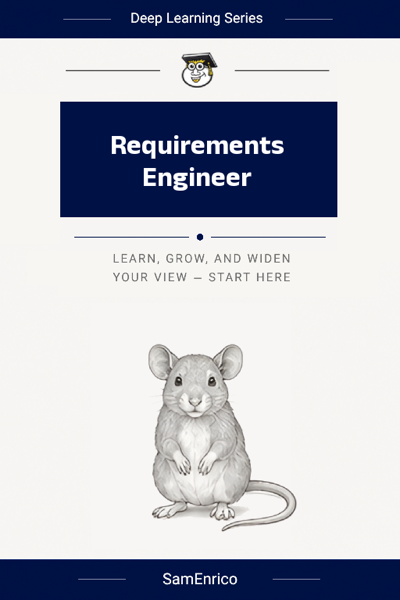
Requirements Engineer eBook
A Coursebook on Requirements Engineer
A Coursebook on Requirements Engineer
Formats
Free sample
Chapter 1: The $1.7 Trillion Blind Spot--–- On October 4, 2004, a software update was pushed to a baggage handling system at Denver International Airport. The update contained a single ambiguous requirement: “The system shall prioritize outbound bags efficiently.” No one thought much of it. Within 48 hours, over 20,000 bags were missorted. Planes departed without luggage. Passengers arrived at destinations to find empty carousels.
The airport spent an additional $15 million on manual sorting, courier deliveries, and passenger compensation. The root cause was not a hardware failure, a network outage, or a coding error. It was a requirement that used the word “efficiently” without defining what efficient meant.This is not an isolated story. It is a pattern.Between 2018 and 2023, the Project Management Institute tracked over 14,000 software projects across 47 countries. Their findings were staggering: projects that failed due to poor requirements cost between three and five times more than projects with solid requirements engineering.
Over 70 percent of project failures traced back to requirements errors—not coding bugs, not hardware failures, not team incompetence. Requirements errors. The Standish Group’s CHAOS Reports, now spanning three decades of data, estimate that the global cost of failed and challenged software projects exceeds $1.7 trillion annually. To put that number in perspective, that is larger than the GDP of Canada, Australia, and Spain combined.And yet, the profession dedicated to preventing these failures—Requirements Engineering—remains one of the most misunderstood, underappreciated, and poorly taught disciplines in technology.This book exists to change that.The Invisible Crisis Let us be brutally honest with each other. If you are reading this book, you have likely been part of a project that went wrong.
Perhaps you were the developer who received a requirements document that was 200 pages of contradictions. Perhaps you were the project manager whose stakeholders changed their minds every week. Perhaps you were the business sponsor who could not understand why a “simple feature” took three months to deliver. Perhaps you were the Requirements Engineer who did everything by the book and still watched the project fail.You are not alone. And more importantly, you are not the problem.The problem is that most organizations treat requirements engineering as an afterthought.
They assign it to junior team members. They compress elicitation into a single meeting. They confuse documentation with understanding. They believe that “Agile” means “no requirements” and that “Waterfall” means “rigid specifications.” They invest millions in development tools and nothing in requirement discovery. They celebrate the launch while ignoring the 40 percent of features that no one uses.This book is the antidote.Across these twelve chapters, drawn from the combined wisdom of the ten best-selling requirements engineering textbooks of the past two decades, you will learn not just what to do, but how to do it.
You will learn a systematic, repeatable, adaptable process for discovering, documenting, validating, and managing requirements. You will learn the difference between being a scribe and being an architect of shared understanding. And you will learn why this role—the Requirements Engineer—is the single highest-leverage position in any software project.What This Chapter Covers Before we dive into the mechanics of elicitation, modeling, and validation, we must first establish a foundation. This chapter answers four essential questions:First, what exactly is a Requirements Engineer, and how does this role differ from Business Analysts, Product Owners, and Project Managers?Second, why do requirements fail? What are the specific, predictable patterns of failure that destroy projects?Third, what competencies must a Requirements Engineer develop to succeed—not just technically, but emotionally and socially?And fourth, where do you stand right now?
A self-assessment checklist will help you identify your current strengths and the gaps you need to fill as you progress through this book.By the end of this chapter, you will understand why requirements engineering is not a task, not a phase, not a document, but a profession. And you will be ready to begin the journey of mastering it.Defining the Modern Requirements Engineer Let us start with a simple definition, then build complexity from there.A Requirements Engineer is the professional responsible for discovering, analyzing, documenting, validating, and managing the needs of stakeholders and constraints of a system, such that the delivered solution delivers measurable value.This definition contains five verbs. Each one matters.Discovery is not asking. It is active investigation—interviewing, observing, prototyping, analyzing existing systems, and extracting hidden needs that stakeholders cannot articulate.Analysis is not repeating. It is structuring, decomposing, and modeling—taking raw statements and transforming them into coherent, non‑contradictory specifications.Documentation is not transcription.
It is precise, unambiguous, testable writing—a craft with rules, patterns, and quality criteria.Validation is not review. It is systematic confirmation that the documented requirements actually reflect what stakeholders need, not just what they said.Management is not archiving. It is tracking changes, maintaining traceability, negotiating priorities, and ensuring that the requirements remain accurate throughout the project lifecycle.Notice what is missing from this definition. Nowhere does it say “write down what someone tells you.” Nowhere does it say “create a document and hand it off.” The Requirements Engineer is not a scribe. The Requirements Engineer is an architect of shared understanding—a person who bridges the chasm between what people want and what engineers can build.The Requirements Engineer vs.
Other Roles A common source of confusion, especially for those new to the field, is how the Requirements Engineer relates to other roles. Let us clarify each distinction clearly, because ambiguity here leads to political problems on real projects.The Business Analyst (BA) focuses primarily on the organizational and strategic level. A BA typically works across multiple projects or a portfolio, analyzing business processes, identifying opportunities for improvement, and developing business cases. The BA asks: “Is this project worth doing?” The Requirements Engineer focuses on a specific project or system, working directly with stakeholders and developers. The RE asks: “Given that we are doing this project, what exactly must the system do?” In smaller organizations, one person may wear both hats.
In larger organizations, they are distinct roles that collaborate closely.The Product Owner (PO) exists within Agile frameworks like Scrum. The PO owns the product backlog and is responsible for prioritizing work to maximize business value. The PO asks: “Which feature is most important to deliver next?” The Requirements Engineer, in an Agile context, owns requirement quality, clarity, and testability. The RE asks: “Is this user story written clearly enough to be estimable and testable?” On small teams, the RE and PO may be the same person. On larger teams, they are separate but tightly coupled.
The RE ensures that what enters the backlog is healthy; the PO ensures that what is at the top of the backlog is most valuable.The Project Manager (PM) is responsible for schedule, budget, resources, and risk at the project level. The PM asks: “Will we finish on time and on budget?” The Requirements Engineer is responsible for the content of what is being built. The RE asks: “Are we building the right thing?” These roles are complementary. A project can be delivered on time and under budget and still fail if the requirements were wrong. Conversely, a project can have perfect requirements…
This is the end of the free sample. Get the eBook to keep going. Buy now
About this book
Details
- Author
- Liles Shaunda
- Publisher
- SamEnrico
- Language
- English
- Genre
- Non-Fiction, Informative, Educational
- Released
- 2026-06-02
- Pages (approx.)
- 146
- Available as
- eBook, Audiobook

Read better in the ZLOADR app
Your eBooks on your phone or tablet. Sign in with your SamEnrico account and start reading.
More by Liles Shaunda
 Call of Duty Mobile BalanceLiles Shaunda$11.99
 Low Carb Pastas GuideLiles Shaunda$11.99
 Sibling DNA Discovery GuideLiles Shaunda$11.99
 Ankle Sprain RehabLiles Shaunda$11.99
 The 1972 Munich Olympics: Africa’s Shadow in the SpotlightLiles Shaunda$11.99
 How to Produce CherimoyasLiles Shaunda$11.99
 How to Start a Pipeline and Ancillary Equipment Testing Business (Beginners Guide)Liles Shaunda$11.99
 AI Vendor Payment OptimizationLiles Shaunda$12.99
You may also like
 Hong Kong Handover 1997Dunn Johnnie$11.99
 Zumba For Postnatal Recovery CourseNeal Christian$11.99
 Zumba for BeginnersLadner Nikia$11.99
 YouTube Comment Mining GuideHumes Pandora$12.99
 Worry Box MeditationCarlin Rudy$11.99
 Workplace Stress MeditationNguyen Lynn$11.99
 Workplace Stress and Sleep RepairHawley Ivory$11.99
 Workplace Perfectionism CureDelaney Jeffry$11.99
 Workplace Injustice Anger GuideWallen Isabelle$11.99
 Work Addiction and Burnout LinkGreenwood Ester$11.99
 Women in Yoga and WellnessBeattie Galina$11.99
 Women in Stand Up ComedyChun Evangeline$11.99