
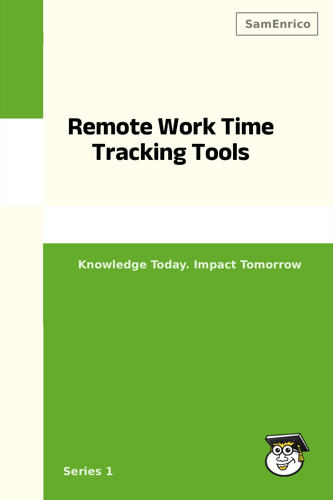
Remote Work Time Tracking Tools eBook
Compare RescueTime, Toggl, and Focusmate to find t
Compare RescueTime, Toggl, and Focusmate to find the best fit for your needs.
Formats
Free sample
Chapter 1: The Unbusy Lie...--–- The Slack notification buzzes at 7:14 PM. You’ve been “online” for eleven hours. Your mouse has jiggled through three pointless meetings. You’ve replied to forty-seven emails, most of which asked questions you’d already answered. You have not, however, done the one thing that would actually move your career forward.
You are exhausted, and you have nothing to show for it. Tonight, you will lie to your partner about how your day went. “Busy,” you’ll say. “Just one of those days.” Tomorrow, you will do it again. And the day after that.
This is not a productivity problem. This is a crisis of meaning dressed up in the clothes of time management.The title of this book is Remote Work Time Tracking Tools, but do not let that fool you. This is not a book about software. This is a book about the gap between how you spend your hours and how you want to spend your life. The tools we will explore—Rescue Time, Toggl, and Focusmate—are merely scalpels for an autopsy you have been avoiding.
Most remote workers have been sold a lie: that if they could just find the right app, the right calendar system, the right Pomodoro technique, they would finally feel productive. That lie is profitable for app developers but fatal for your sanity.This chapter is called “The Unbusy Lie” because busyness has become the modern badge of honor. In an office, busyness looks like walking fast between meetings, carrying a full coffee cup, and frowning at a laptop. In a remote environment, busyness looks like a green Slack light at 10 PM, a rapid typing response to a non-urgent question, and a calendar so full of back-to-back calls that there is no time to actually think. We have confused activity with achievement.
We have confused presence with progress. And we have confused the feeling of being overwhelmed with the reality of being effective.This chapter will do three things. First, it will dismantle the mythology of busyness that keeps remote workers trapped in performative work. Second, it will introduce you to three archetypes of struggling remote workers—The Distracted, The Under-earner, and The Loner—so you can diagnose your own pattern before you ever install a single tool. Third, it will set a radical premise that the rest of the book will prove: the goal of time tracking is not to work more hours.
The goal is to work fewer hours with more intention, to capture the value of those hours, and to log off without guilt.If you are already skeptical, good. You should be. You have probably tried time tracking before. You downloaded an app, used it for three days, forgot to start the timer, felt guilty, and abandoned it. That failure was not your fault.
You were using the wrong kind of tool for your psychological problem. By the end of this chapter, you will know which of the three archetypes you are. By the end of the book, you will have a customized system using one, two, or all three of our core tools that fits your brain, your work, and your life.Let us begin with the lie.The Invention of Busyness as Status Busyness is not natural. It is a social construct invented in the industrial era and perfected in the knowledge economy. In the 19th century, leisure was a status symbol—only the wealthy could afford to not work.
Thorstein Veblen, the economist who coined the term “conspicuous consumption,” observed that the upper classes demonstrated their status through refrained from labor. To be idle was to be powerful. Sometime in the late 20th century, that script flipped. Suddenly, busyness became the new nobility. The venture capitalist who takes fifteen meetings a day, the executive who replies to email at midnight, the freelancer who boasts about seventy-hour weeks—these are the modern aristocrats of exhaustion.Remote work supercharged this phenomenon because it removed the visual cues of busyness.
In an office, your manager can see you typing. They can see you in your chair. They can see you frowning at a spreadsheet. Those visual cues provide a crude but functional signal: this person is working. In a remote environment, those cues disappear.
The manager panics. How do they know you are working? They invent proxies. Slack response time becomes a metric. Calendar density becomes a metric.
Mouse movement becomes a metric. Before long, you are not working to produce value; you are working to produce evidence of working.This is what we call performative productivity. It is the act of appearing productive without actually being productive. It looks like:Writing a long, detailed email when a two-word reply would suffice (because long emails look effortful)Attending a meeting you could have skipped (because declining looks disengaged)Starting a task at 8:59 AM and stopping at 5:01 PM, regardless of whether anything was accomplished (because presence is the metric)Jiggling your mouse every four minutes during a tedious all-hands meeting (because a yellow Slack light invites scrutiny)You have done some version of all of these things. Do not feel shame.
The system rewards you for them. Your manager, if they are trapped in the same mindset, will praise your “dedication” and “responsiveness.” But here is the question this book will force you to answer: What did you actually make today? Not what did you process, forward, reply to, or attend. What did you create, solve, decide, or ship?If you struggle to answer that question, you are not lazy. You are trapped in the Unbusy Lie.
And the first step out of that trap is to stop measuring your day by hours spent and start measuring it by value produced.Productivity vs. Busyness: A Critical Distinction Let us borrow a framework that appears in nearly every bestselling productivity book from Deep Work to *The 4-Hour Workweek* to Atomic Habits. The distinction is simple but radical:Productivity (Output)Busyness (Activity)Completing meaningful work that moves the needle toward a goal Performing low-value tasks that feel like work but produce no progress Measured by results (a finished proposal, a solved bug, a signed contract)Measured by effort (hours logged, emails sent, meetings attended)Requires focus, deep work, and intentionality Requires only motion, responsiveness, and presence Leaves you tired but satisfied Leaves you exhausted and empty Takes less time than you think Takes more time than you have Here is the painful truth that most productivity gurus dance around: You can be busy for twelve hours and productive for zero of them. In fact, busyness is often the enemy of productivity because it consumes the time and mental energy required for deep work. When you spend your morning replying to emails and attending a “quick sync” that runs forty-five minutes long, you have not done anything wrong.
You have simply spent your best hours on your worst tasks.The remote worker who masters their time does not work more hours. They work different hours. They protect their mornings for creative, high-value work. They batch their email into two thirty-minute blocks. They say no to meetings without agendas.
They track their time not to catch themselves slacking, but to catch themselves busy-working—performing activity that feels productive but produces…
This is the end of the free sample. Get the eBook to keep going. Buy now
About this book
Details
- Author
- Cantrell Ariel
- Publisher
- SamEnrico
- Language
- English
- Genre
- Non-Fiction, Self-Help, Apps, Tools
- Released
- 2026-06-08
- Pages (approx.)
- 157
- Available as
- eBook, Audiobook

Read better in the ZLOADR app
Your eBooks on your phone or tablet. Sign in with your SamEnrico account and start reading.
More by Cantrell Ariel
 The Home Comparison TrapCantrell Ariel$11.99
 Gambling Addiction for RetireesCantrell Ariel$11.99
 Financial Stress Budget BurnoutCantrell Ariel$11.99
 The Siege of Chittorgarh: Blood and Betrayal in the Rajput StrongholdCantrell Ariel$11.99
 Learn to Play the TanpuraCantrell Ariel$11.99
 Operations EngineerCantrell Ariel$11.99
 Technical Documentation TemplateCantrell Ariel$12.99
 How to Start a Boxes Made of Non-corrugated Paper Business (Beginners Guide)Cantrell Ariel$11.99