
Non-FictionSelf-HelpProductivity
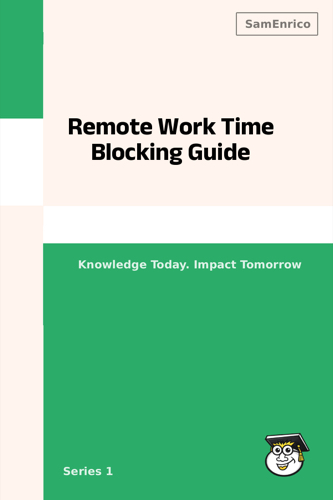
Remote Work Time Blocking Guide eBook
Teaches scheduling deep work around meetings and h
Teaches scheduling deep work around meetings and home life.
Formats
Free sample
Chapter 1: The Calendar Audit...--The day I realized my remote schedule was failing was not a dramatic one. There was no screaming boss, no missed deadline, no tearful breakdown. It was a Tuesday, 4:47 PM, and I had just finished my seventh Zoom call of the day. I looked at my to-do list. Three items.
I had written them at 8:15 AM. None of them were crossed off. I had spent eight hours reacting to other people's priorities, and I had accomplished exactly nothing of my own.I closed my laptop. I walked to the kitchen. I poured a glass of water.
I stood there, staring at the wall, and I thought: what did I actually do today?The answer was nothing. I had answered emails. I had attended meetings. I had responded to Slack messages. I had context-switched forty-seven times.
I had been busy. I had not been productive. There is a difference, and that Tuesday at 4:47 PM, I finally understood it.This chapter is about that difference. It is about why your remote schedule is failing, why generic to-do lists are not working, and why the traditional productivity advice you have been following was designed for an office—not for a home office with a dishwasher running, a partner asking about dinner, and a Slack channel pinging every thirty seconds. Before we can fix your schedule, we need to diagnose the problem.
Before we can build a system, we need to understand why the old one collapsed.The Three Productivity Traps of Remote Work When we worked in offices, our schedules were shaped by external structures. The commute protected our mornings. The closed office door protected our focus. The fixed hours protected our evenings. Remote work removed those structures and replaced them with nothing.
In their place, three traps emerged.Trap One: Meeting Sprawl. In the office, meetings required booking a conference room, walking to the room, and sitting around a table. There was friction. Friction limited quantity. Remote work removed the friction.
Now a meeting is a link in a calendar invite. No travel time. No room booking. No natural limit. The result is meeting sprawl: back-to-back Zoom calls that leave no time for thinking, only for reacting.
I have analyzed hundreds of remote calendars, and the average knowledge worker now spends 26 hours per week in meetings. That is 65% of the standard workweek. The remaining 35% is fragmented into pieces too small for deep thinking.Trap Two: The Always-On Expectation. In the office, when you left at 5:00 PM, you were gone. Your chair was empty.
Your screen was dark. The expectation of availability ended at the door. Remote work erased that boundary. Now your laptop is always in the next room. Your phone is always in your pocket.
The expectation is not explicit—no one says "I expect you to reply at 9:00 PM"—but it is real. It is the expectation that because you can reply, you should reply. The always-on expectation turns your home into a waiting room. You are never fully off. You are never fully present.Trap Three: The Illusion of Flexibility.
Remote work promised flexibility. Work when you want. Work where you want. The promise is not a lie, exactly. You can work when you want.
The problem is that "when you want" becomes "all the time." Without a schedule, flexibility becomes chaos. The flexible schedule, without boundaries, devolves into no schedule at all. You work in the morning, then at lunch, then in the evening, then after dinner. The hours add up. The boundaries dissolve.
The burnout arrives.These three traps—meeting sprawl, always-on expectation, and the illusion of flexibility—are the reason your remote schedule is failing. You are not lazy. You are not disorganized. You are not bad at your job. You are trapped in a system that was designed for a different reality.The To-Do List Lie Most productivity advice starts with the to-do list.
Write down everything you need to do. Prioritize it. Work through it. The to-do list is the default tool of the knowledge worker. It is also failing us.The to-do list fails because it lacks two critical dimensions: time and energy.
A to-do list tells you what to do. It does not tell you when to do it. It does not tell you whether you will have the energy to do it. Without time and energy, a to-do list is just a wish list.Here is what actually happens when you work from a to-do list on a remote schedule. You start the day with a list of tasks.
You open your email. A urgent request arrives. You switch to that. You close email. A Slack message pops up.
You switch to that. An hour passes. You look at your list. Nothing crossed off. You feel anxious.
Anxiety drives you to do something easy, something shallow, something that feels like progress. You answer another email. You attend a meeting. You update a spreadsheet. The day ends.
The list is untouched.This pattern has a name. I call it List-Reactive Mode. You are reacting to notifications and pulling tasks off a list haphazardly, without a plan for when or how you will complete them. The problem is not your willpower. The problem is the system.The neuroscience behind List-Reactive Mode is brutal.
Every time you switch tasks, you pay a switching cost. The cost is measured in time and cognitive energy. Research shows that it takes an average of 23 minutes to fully return to a task after an interruption. In a remote work environment, the average worker is interrupted every 11 minutes. You never return.
You never focus. You never finish.The cost is not just time. It is energy. Decision fatigue is real. Every decision you make—"Should I answer this email now?
Should I attend this meeting? Should I work on this task or that task?"—drains a limited resource. By midday, most knowledge workers have lost 40% of their decision-making capacity. They are not lazy. They are depleted.
The to-do list did not protect them. The to-do list made it worse.The Deep Work vs. Shallow Work Distinction To understand why your schedule is failing, you need to understand the difference between two kinds of work. I borrow this distinction from Cal Newport, but I have adapted it for the remote reality.Deep Work is cognitively demanding work that creates genuine value. Writing a report.
Analyzing data. Solving a complex problem. Strategizing. Creating. Deep work requires focus.
It requires uninterrupted time. It requires that you are not also watching Slack.Shallow Work is low-value logistical work that keeps the operation running but does not move the needle. Answering email. Updating spreadsheets. Attending status meetings.
Responding to Slack messages. Shallow work is necessary. It is not valuable.Here is the problem. Remote work has increased the volume of shallow work while shrinking the windows available for deep work. The reasons are structural.
In the office, shallow work was contained by the physical environment. You answered emails at your desk. You attended meetings in conference rooms. You had boundaries. Remote work removed the boundaries.
Shallow work now bleeds into every moment. You answer emails while on a Zoom call. You respond to Slack while…
This is the end of the free sample. Get the eBook to keep going. Buy now
About this book
Details
- Author
- Hanes Kristal
- Publisher
- SamEnrico
- Language
- English
- Genre
- Non-Fiction, Self-Help, Productivity
- Released
- 2026-06-06
- Pages (approx.)
- 102
- Available as
- eBook, Audiobook

Read better in the ZLOADR app
Your eBooks on your phone or tablet. Sign in with your SamEnrico account and start reading.
More by Hanes Kristal
 Gluten Free Vegan GuideHanes Kristal$11.99
 The Social Auto PurchaseHanes Kristal$11.99
 Two to One BreathHanes Kristal$11.99
 Anger De escalation in CourtHanes Kristal$11.99
 Mastering Active Listening Core SkillsHanes Kristal$11.99
 Morning Nature TimeHanes Kristal$11.99
 Networking for ChefsHanes Kristal$11.99
 The Siege of Hōjōjō: A Samurai's Last StandHanes Kristal$11.99
 The Iron Tide: How One Man Built a Shipping Empire from ScratchHanes Kristal$11.99
 Service Providers Guide to GiveawaysHanes Kristal$11.99
 A Collector's Handbook to the Mercedes-benz 230.6Hanes Kristal$11.99
 Collarbone Tap TechniqueHanes Kristal$12.99
You may also like
 Hong Kong Handover 1997Dunn Johnnie$11.99
 Zumba For Postnatal Recovery CourseNeal Christian$11.99
 Zumba for BeginnersLadner Nikia$11.99
 YouTube Comment Mining GuideHumes Pandora$12.99
 Worry Box MeditationCarlin Rudy$11.99
 Workplace Stress MeditationNguyen Lynn$11.99
 Workplace Stress and Sleep RepairHawley Ivory$11.99
 Workplace Perfectionism CureDelaney Jeffry$11.99
 Workplace Injustice Anger GuideWallen Isabelle$11.99
 Work Addiction and Burnout LinkGreenwood Ester$11.99
 Women in Yoga and WellnessBeattie Galina$11.99
 Women in Stand Up ComedyChun Evangeline$11.99