
Non-FictionForecast & OutlookRemote Work
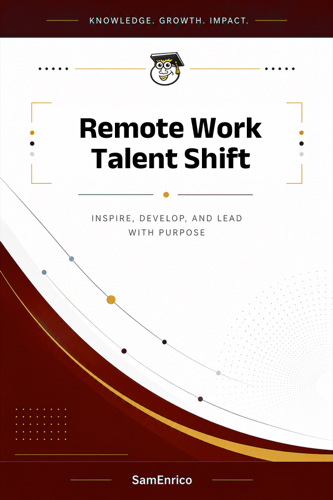
Remote Work Talent Shift eBook
Analyzes how distributed work changes geographic t
Analyzes how distributed work changes geographic talent pools.
Formats
Free sample
Chapter 1: The 50-Mile Lie--–- On a Tuesday morning in March 2021, Maria Chen did something that would have been impossible eighteen months earlier. She poured a cup of coffee, walked past her home office window overlooking the pine trees of rural Mississippi, and accepted a job offer from a San Francisco-based startup. Her salary: $175,000 as a senior UX designer. Her commute: zero steps to a car, zero minutes on a highway, zero dollars for parking. Her location: a town of 4,000 people, two hours from the nearest airport, where the median household income was $42,000.Maria had spent fifteen years building her career in design agencies across the Southeast, always bumping against the same invisible ceiling.
She knew she was good—her portfolio had won awards, her user testing metrics consistently beat industry averages, and her referral network was full of satisfied clients. But every time she applied for a role at a top-tier tech company, she hit the same wall: the job description said "San Francisco preferred" or "must be willing to relocate to the Bay Area" or simply "local candidates only." Maria had a mortgage, a partner with a local job, and two children in the local school system. Relocating was not an option. So she stayed put, earning $85,000 at a regional firm, knowing she was worth twice that but unable to access the market that would pay it.Then the pandemic happened. And everything broke.What changed was not Maria's skill set.
What changed was not her ambition or her work ethic. What changed was a set of assumptions—held by managers, reinforced by HR systems, embedded in hiring software—that had gone unchallenged for nearly a century. The assumption that talent must live within commuting distance of a headquarters. The assumption that remote workers are less productive. The assumption that "culture" requires bodies in chairs, visible to a manager's wandering eye.
Those assumptions, it turned out, were not laws of nature. They were habits. And when a global health crisis made them impossible to maintain, they collapsed with stunning speed.Maria's story is not exceptional. By 2023, data from the Bureau of Labor Statistics showed that nearly 30% of all paid workdays in the United States were performed from home—up from less than 5% in 2019. More importantly, the geographic distribution of that work had fundamentally changed.
In 2019, if you wanted a high-wage technology job, you had to live in one of five metropolitan areas: San Francisco, New York, Seattle, Boston, or Los Angeles. By 2023, high-wage remote jobs were being performed in all fifty states, with the fastest growth occurring in places that had previously been locked out of the knowledge economy: rural Mississippi, central Alabama, the Ozarks of Arkansas, the Rust Belt towns of Ohio and Pennsylvania. A worker in Jackson, Mississippi could now earn the same salary as a worker in Jackson, Wyoming—not in every case, but in enough cases to reshape the economic geography of the nation.This book is about that reshaping. It is about the collapse of geographic gravity and the emergence of a new map of talent. It is about the winners—the workers, companies, and cities that have embraced the shift—and the losers, who are still clinging to an old model that is already dead.
And it is about you: whether you lead a team of five or five thousand, whether you live in a Tier 1 city or a Remote Haven or a struggling midsize town, whether you are a CEO trying to hire or a worker trying to get hired. The talent shift has already happened. The only question is whether you will understand it in time.The Assumption That Held for a Century For most of the twentieth century, the connection between place and work was so obvious that no one thought to question it. Factories needed workers within walking or streetcar distance. Offices needed clerks who could sort paper files and answer switchboards.
Even when computers arrived, they were mainframes—room-sized machines that lived in corporate basements, requiring their human operators to sit nearby. The commuter suburb, the interstate highway system, the five-day workweek—all of these reinforced the same basic equation: talent was local, and local meant commuting distance.By the 1990s, that equation had calcified into what economists call a "commuting zone." Formally defined as a geographic area where most residents work locally and most local workers reside within the zone, commuting zones were the invisible borders that governed hiring for generations. The typical commuting zone in the United States had a radius of about fifty miles—the maximum distance a worker could reasonably travel in an hour each way. Within that radius, companies competed for talent. Outside that radius, workers were effectively invisible.The numbers are staggering.
A 2019 analysis of job postings on Linked In found that 84% of all job listings for professional roles included some form of geographic restriction—"must be located in," "local candidates only," "relocation required." For roles paying above $100,000, that number rose to 91%. Companies were not just preferring local candidates; they were systematically excluding the vast majority of the American workforce from consideration. If you lived in the wrong zip code, you could be the best candidate in the world, and you would never even get a phone screen.This was not irrational, exactly. Geographic restrictions were a heuristic—a mental shortcut that saved managers time and cognitive effort. Instead of evaluating thousands of candidates from across the country, a hiring manager could filter by city and winnow the pool to a manageable few dozen.
Instead of worrying about time zones, tax withholding, or the logistics of shipping laptops, a manager could simply require local presence and avoid those headaches entirely. The system worked, after a fashion, for the companies that sat at the center of the major commuting zones. It just worked terribly for everyone else.But heuristics have a way of becoming dogma. And by 2020, the fifty-mile assumption had been repeated so many times, by so many managers, in so many job descriptions, that it had acquired the force of natural law. "You can't hire remote workers because they won't be productive." "You can't build culture without an office." "You can't manage what you can't see." These statements were treated as truths, even though there was little evidence for them and substantial evidence against them.
A 2015 study of a Chinese travel agency had found that remote workers were 13% more productive than their office-bound counterparts. A 2014 meta-analysis of remote work research had found that telecommuting was associated with higher job satisfaction, lower turnover, and reduced stress. The evidence existed. It was just ignored.The Forced Experiment of 2020Then came March 2020. And the assumptions broke.What happened in those weeks was not a planned transition.
It was not a thoughtful pilot program or a carefully staged rollout. It was a panic. Companies that had spent years insisting that remote work was impossible told their entire workforces to go home and stay there—often with less than 48 hours' notice. Laptops were grabbed from desks. Monitors were unplugged and carried to cars.
IT departments that had never supported VPNs for more than a handful of executives suddenly had to equip thousands of employees for…
This is the end of the free sample. Get the eBook to keep going. Buy now
About this book
Details
- Author
- Pinckney Filiberto
- Publisher
- SamEnrico
- Language
- English
- Genre
- Non-Fiction, Forecast & Outlook, Remote Work
- Released
- 2026-06-06
- Pages (approx.)
- 153
- Available as
- eBook, Audiobook

Read better in the ZLOADR app
Your eBooks on your phone or tablet. Sign in with your SamEnrico account and start reading.
More by Pinckney Filiberto
 Meditation for First Responder AnxietyPinckney Filiberto$11.99
 Mindfulness Meditation Walking PracticePinckney Filiberto$11.99
 Library Study Stress GuidePinckney Filiberto$11.99
 Narcissistic Parent RecoveryPinckney Filiberto$11.99
 Family Boundary WorkbookPinckney Filiberto$11.99
 Cryptocurrency Supply DemandPinckney Filiberto$11.99
 Metta For Addiction RecoveryPinckney Filiberto$11.99
 The Dark Money Playbook: How a Shadow Network Funded the Tea Party RevolutionPinckney Filiberto$11.99
 Growing DracunculusPinckney Filiberto$11.99
 The Mineral Guide to ChromitePinckney Filiberto$11.99
 Telling Employees About Founder DepressionPinckney Filiberto$12.99
 Mentor for Negotiation SkillsPinckney Filiberto$12.99
You may also like
 Hong Kong Handover 1997Dunn Johnnie$11.99
 Zumba For Postnatal Recovery CourseNeal Christian$11.99
 Zumba for BeginnersLadner Nikia$11.99
 YouTube Comment Mining GuideHumes Pandora$12.99
 Worry Box MeditationCarlin Rudy$11.99
 Workplace Stress MeditationNguyen Lynn$11.99
 Workplace Stress and Sleep RepairHawley Ivory$11.99
 Workplace Perfectionism CureDelaney Jeffry$11.99
 Workplace Injustice Anger GuideWallen Isabelle$11.99
 Work Addiction and Burnout LinkGreenwood Ester$11.99
 Women in Yoga and WellnessBeattie Galina$11.99
 Women in Stand Up ComedyChun Evangeline$11.99