
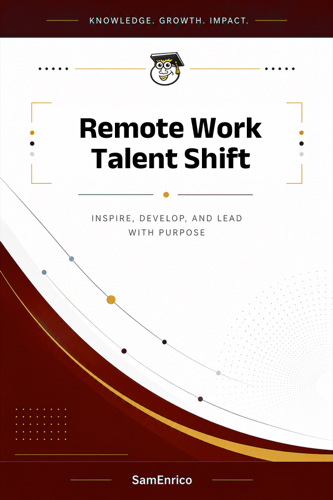
Non-FictionForecast & OutlookRemote Work
Remote Work Talent Shift Audiobook
Analyzes how distributed work changes geographic t
Analyzes how distributed work changes geographic talent pools.
Formats
Free sample
Chapter 1: The 50-Mile Lie--–- On a Tuesday morning in March 2021, Maria Chen did something that would have been impossible eighteen months earlier. She poured a cup of coffee, walked past her home office window overlooking the pine trees of rural Mississippi, and accepted a job offer from a San Francisco-based startup. Her salary: $175,000 as a senior UX designer. Her commute: zero steps to a car, zero minutes on a highway, zero dollars for parking. Her location: a town of 4,000 people, two hours from the nearest airport, where the median household income was $42,000.Maria had spent fifteen years building her career in design agencies across the Southeast, always bumping against the same invisible ceiling.
She knew she was good—her portfolio had won awards, her user testing metrics consistently beat industry averages, and her referral network was full of satisfied clients. But every time she applied for a role at a top-tier tech company, she hit the same wall: the job description said "San Francisco preferred" or "must be willing to relocate to the Bay Area" or simply "local candidates only." Maria had a mortgage, a partner with a local job, and two children in the local school system. Relocating was not an option. So she stayed put, earning $85,000 at a regional firm, knowing she was worth twice that but unable to access the market that would pay it.Then the pandemic happened. And everything broke.What changed was not Maria's skill set.
What changed was not her ambition or her work ethic. What changed was a set of assumptions—held by managers, reinforced by HR systems, embedded in hiring software—that had gone unchallenged for nearly a century. The assumption that talent must live within commuting distance of a headquarters. The assumption that remote workers are less productive. The assumption that "culture" requires bodies in chairs, visible to a manager's wandering eye.
Those assumptions, it turned out, were not laws of nature. They were habits. And when a global health crisis made them impossible to maintain, they collapsed with stunning speed.Maria's story is not exceptional. By 2023, data from the Bureau of Labor Statistics showed that nearly 30% of all paid workdays in the United States were performed from home—up from less than 5% in 2019. More importantly, the geographic distribution of that work had fundamentally changed.
In 2019, if you wanted a high-wage technology job, you had to live in one of five metropolitan areas: San…
This is the end of the free sample. Get the Audiobook to keep going. Buy now
About this book
Details
- Author
- Pinckney Filiberto
- Publisher
- SamEnrico
- Language
- English
- Genre
- Non-Fiction, Forecast & Outlook, Remote Work
- Released
- 2026-06-06
- Pages (approx.)
- 153
- Available as
- eBook, Audiobook

Listen in the VoxFlicks app
Audiobooks and audio dramas wherever you go. Sign in with your SamEnrico account and press play.
More by Pinckney Filiberto
 Meditation for First Responder AnxietyPinckney Filiberto$11.99
 Mindfulness Meditation Walking PracticePinckney Filiberto$11.99
 Library Study Stress GuidePinckney Filiberto$11.99
 Narcissistic Parent RecoveryPinckney Filiberto$11.99
 Family Boundary WorkbookPinckney Filiberto$11.99
 Cryptocurrency Supply DemandPinckney Filiberto$11.99
 Metta For Addiction RecoveryPinckney Filiberto$11.99
 The Dark Money Playbook: How a Shadow Network Funded the Tea Party RevolutionPinckney Filiberto$11.99
 Growing DracunculusPinckney Filiberto$11.99
 The Mineral Guide to ChromitePinckney Filiberto$11.99
 Telling Employees About Founder DepressionPinckney Filiberto$12.99
 Mentor for Negotiation SkillsPinckney Filiberto$12.99
You may also like
 Hong Kong Handover 1997Dunn Johnnie$11.99
 Zumba For Postnatal Recovery CourseNeal Christian$11.99
 Zumba for BeginnersLadner Nikia$11.99
 YouTube Comment Mining GuideHumes Pandora$12.99
 Worry Box MeditationCarlin Rudy$11.99
 Workplace Stress MeditationNguyen Lynn$11.99
 Workplace Stress and Sleep RepairHawley Ivory$11.99
 Workplace Perfectionism CureDelaney Jeffry$11.99
 Workplace Injustice Anger GuideWallen Isabelle$11.99
 Work Addiction and Burnout LinkGreenwood Ester$11.99
 Women in Yoga and WellnessBeattie Galina$11.99
 Women in Stand Up ComedyChun Evangeline$11.99