
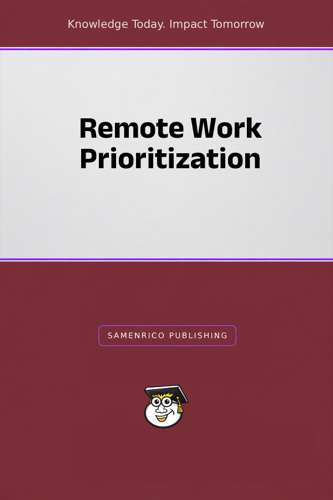
Non-FictionSelf-HelpPrioritization
Remote Work Prioritization eBook
Decides what matters most without office cues.
by Skelton Bev
Decides what matters most without office cues.
Formats
Free sample
Chapter 1: The Motion Trap–- The email arrived at 7:14 AM. You weren't even at your desk yet, but your phone buzzed against the nightstand. A Slack notification. A calendar invite. A @here mention in a channel you'd been added to overnight.
By the time you poured your coffee, you had seventeen unread messages. None of them were urgent. All of them felt urgent. And so, without thinking, you opened the first one. Then the second.
Then the third. By 9:00 AM, you had replied to twelve emails, reacted with a thumbs-up to six Slack messages, and accepted four meeting invitations. You felt busy. You felt productive. You felt like you were working.But were you?At 5:00 PM, you closed your laptop with a sigh.
Your eyes were tired. Your back ached from hunching over the kitchen table. And yet, when you tried to name what you had actually accomplished—not just done, but finished—your mind went blank. You had answered people. You had reacted to things.
You had kept the plates spinning. But the one thing you told yourself you would do this week? The big project? The strategic memo? The proposal that could lead to a promotion?
It was still sitting there, untouched, exactly where you left it on Monday.Welcome to the motion trap.This chapter is about the single most dangerous illusion in remote work: the belief that activity equals productivity. In an office, this illusion was sustained by environmental cues—the sight of colleagues typing, the sound of footsteps in the hallway, the performative rush of a coffee run at 3:00 PM. Remote work strips away those cues. Suddenly, no one can see you typing. No one knows if you answered that email at 8:00 AM or 8:00 PM.
The theater is gone. And for many remote workers, that loss creates a panic: If no one can see me working, how will anyone know I'm working?The answer, as this book will show, is that you don't want anyone to see you working. You want them to see the results of your work. But before we can get there, we have to dismantle the most deeply ingrained habit of the office era: mistaking motion for action.The Great Unlearning: Why Your Office Habits Are Failing You Let's start with a simple experiment. Think back to the last time you were in a physical office.
Picture your desk, the hallway, the breakroom. Now answer this question: What did "looking busy" look like?You probably have a mental image immediately. It might be a colleague walking quickly between meetings, a stack of papers on a desk, a person frowning at their screen with intensity, or someone staying late after everyone else has left. These are cues—visual signals that the brain interprets as "this person is working hard." In an office environment, these cues are so powerful that they can override actual output. You have probably worked with someone who contributed very little but was highly skilled at looking busy.
They always had a document open. They always replied to emails within sixty seconds. They always had something to say in meetings. And yet, at the end of the quarter, their results were mediocre at best.This is not a moral failing. It is a feature of how human brains process social information.
We are wired to pay attention to visible signals because, for most of human history, visible signals were reliable indicators of survival value. If someone was moving quickly, they were likely hunting or fleeing. If someone was surrounded by resources (food, tools, shelter), they were likely successful. The modern office hijacks these ancient circuits. A person walking fast with a coffee might simply be avoiding a conversation, not closing a deal.
A person typing furiously might be reorganizing their folder structure, not writing a proposal. A person staying late might be scrolling through social media, not solving a critical problem.Remote work removes these visual cues. Your manager cannot see your facial expression. Your colleagues cannot hear your keyboard. Your team has no idea whether you are in a deep state of concentration or watching a tutorial on sourdough baking.
For some people, this freedom is liberating. For many, it is terrifying. Without the ability to look busy, how will anyone know you are busy?The answer is that you don't want them to know you are busy. You want them to know you are effective. And effectiveness has nothing to do with how you look and everything to do with what you produce.Motion vs.
Action: The Core Distinction That Changes Everything This book draws a hard, bright line between two concepts that most people treat as identical: motion and action.Motion is any activity that feels like work but does not produce a tangible, completed deliverable. Motion is rearranging files on your desktop. Motion is color-coding your email folders. Motion is attending a meeting that could have been an email. Motion is rewriting the same sentence five times without finishing the paragraph.
Motion is researching tools you will never buy. Motion is organizing your calendar for the third time this week. Motion is responding to every Slack message within thirty seconds. Motion feels productive because it requires effort, attention, and often time. But motion does not move the needle.
Motion leaves you at the end of the day with nothing to show except exhaustion.Action is any activity that produces a completed, measurable output. Action is finishing the first draft of a report. Action is closing a support ticket. Action is shipping a code update. Action is sending a signed contract.
Action is recording a completed training video. Action is publishing a blog post. Action is making a decision that unblocks a colleague. Action leaves a trace. At the end of the day, you can point to something and say, "That did not exist this morning, and now it does."Here is the brutal truth that most productivity books dance around: the office environment systematically rewarded motion over action.
Think about the last performance review you received. How much of it was based on visible activity (attendance, responsiveness, meeting participation) versus measurable output (projects completed, revenue generated, problems solved)? For most knowledge workers, the ratio is skewed heavily toward the former. This is not because managers are lazy or stupid. It is because measuring action is harder than observing motion.
Anyone can see that you replied to an email. It takes more work to verify that the email actually led to a sale.Remote work flips this dynamic. When you are not in the office, motion becomes invisible. Your manager cannot see you rearranging files. They cannot hear you typing.
They have no idea if you replied to that email at 8:00 AM or 8:00 PM. All they can see is the output you share—the finished document, the closed ticket, the delivered project. Remote work does not just allow you to focus on action; it forces you to focus on action, because motion no longer provides the social proof it once did.This is why so many people struggle with the transition to remote work. They have spent years building habits optimized for the office environment—habits that…
This is the end of the free sample. Get the eBook to keep going. Buy now
About this book
Details
- Author
- Skelton Bev
- Publisher
- SamEnrico
- Language
- English
- Genre
- Non-Fiction, Self-Help, Prioritization
- Released
- 2026-06-05
- Pages (approx.)
- 153
- Available as
- eBook, Audiobook

Read better in the ZLOADR app
Your eBooks on your phone or tablet. Sign in with your SamEnrico account and start reading.
More by Skelton Bev
 Design Thinking ArtifactsSkelton Bev$11.99
 Mountain Visualization SleepSkelton Bev$11.99
 Withdrawal Sleep ProtocolSkelton Bev$11.99
 Napoleon s Egyptian CampaignSkelton Bev$11.99
 Cross Functional CreativitySkelton Bev$11.99
 Emotional Validation for SelfSkelton Bev$11.99
 Blue Zone Grandparent GuideSkelton Bev$11.99
 Silenced No More: The Fight for Victims' Voices in the UKSkelton Bev$11.99
 Plato and Aristotle: The Boys Who Changed the WorldSkelton Bev$11.99
 How to Produce Toilet Tank LeversSkelton Bev$11.99
 How to Start a Pile Driving Business (Beginners Guide)Skelton Bev$11.99
 ARIPO Trademark Registration SystemSkelton Bev$12.99
You may also like
 Hong Kong Handover 1997Dunn Johnnie$11.99
 Zumba For Postnatal Recovery CourseNeal Christian$11.99
 Zumba for BeginnersLadner Nikia$11.99
 YouTube Comment Mining GuideHumes Pandora$12.99
 Worry Box MeditationCarlin Rudy$11.99
 Workplace Stress MeditationNguyen Lynn$11.99
 Workplace Stress and Sleep RepairHawley Ivory$11.99
 Workplace Perfectionism CureDelaney Jeffry$11.99
 Workplace Injustice Anger GuideWallen Isabelle$11.99
 Work Addiction and Burnout LinkGreenwood Ester$11.99
 Women in Yoga and WellnessBeattie Galina$11.99
 Women in Stand Up ComedyChun Evangeline$11.99