
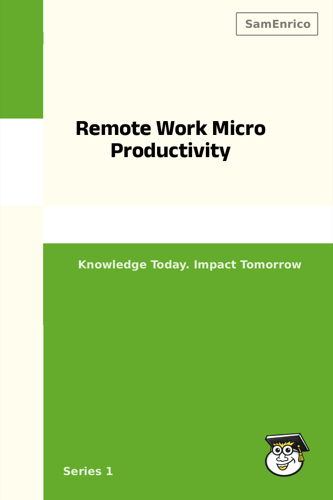
Remote Work Micro Productivity eBook
Uses stolen minutes between tasks efficiently.
Uses stolen minutes between tasks efficiently.
Formats
Free sample
Chapter 1: The Sandwich Economy--–- The notification arrives at 10:47 AM, just as you are beginning to untangle a complex problem. It is a Slack message. It is not urgent. But you look anyway. Thirty seconds later, you return to the original problem, but something has changed.
The thread is loose. The solution that was forming in your mind has evaporated. You spend the next eleven minutes retracing your mental steps, and by the time you find the thread again, another notification arrives. This is not a failure of discipline. This is the hidden structure of remote work, and until you understand it, no productivity system will save you.The greatest lie of the modern workplace is not that hard work guarantees success.
It is more insidious than that. The lie is that productive work requires long, unbroken stretches of time. We have been told that real work happens in four-hour blocks, that deep focus requires a morning with no meetings, that creative breakthroughs only come when the calendar is empty. This belief has created a silent epidemic of procrastination among remote workers. Not the lazy kind of procrastination where one watches Netflix instead of working.
The more dangerous kind. The kind where you sit at your desk, staring at your screen, waiting for the perfect conditions that never arrive.You know this feeling. You have a ninety-minute gap between meetings. Not enough time to "really get into" the big project, you tell yourself. So you check email.
You reorganize your folders. You scroll through Slack. Then the next meeting begins, and the ninety minutes have vanished. You have done nothing of consequence. The problem is not that you lacked time.
The problem is that you were waiting for a mythical creature called the Unbroken Hour.This book begins with a radical proposition: the unbroken hour does not exist, has never existed, and should never be your goal. The most productive remote workers do not wait for long stretches of focus. They do something far more powerful. They learn to work in the gaps. They master what this book calls the Sandwich Economy—the hidden currency of the fifteen minutes before a meeting, the five minutes after a call ends early, the two minutes while a document loads, the ninety seconds between tasks when most people scroll mindlessly.The Arithmetic of Stolen Minutes Let us do a simple calculation.
The average remote worker has between ten and twenty "transition gaps" per day. These are the moments between scheduled tasks: after a meeting ends and before you start the next one, while waiting for a colleague to join a call, after finishing an email and before opening the next one. Most people treat these gaps as dead time. They check their phone. They refresh social media.
They stare into space.Each gap averages between two and seven minutes. Taken together, these stolen minutes total between forty-five minutes and two hours per day. That is not a rounding error. That is between four and ten hours per week. That is between two hundred and five hundred hours per year.
You are currently burning hundreds of hours of potential productive time because you believe those minutes are too small to matter.But the arithmetic alone does not tell the full story. The real power of stolen minutes is not just their cumulative quantity. It is their strategic quality. A stolen minute used correctly is not worth one minute. It is worth much more because of a psychological phenomenon we will explore throughout this book: momentum.When you complete a small task in a stolen minute, you do not just finish that task.
You trigger a neurological reward that makes the next task easier. You build a chain of small completions that becomes harder to break than it is to maintain. Conversely, when you waste a stolen minute on mindless scrolling, you do not just lose that minute. You break the chain. You reinforce the habit of passivity.
Each wasted stolen minute makes the next one easier to waste.The Meeting Sandwich Phenomenon The most valuable stolen minutes in any remote workday are not random. They cluster around meetings in a pattern this book calls the Meeting Sandwich. The Meeting Sandwich consists of three layers: the fifteen minutes before a meeting begins, the meeting itself, and the fifteen minutes after the meeting ends. Most people treat the bread of this sandwich—the minutes before and after—as worthless. They scroll.
They stretch. They wait.The most productive remote workers treat these minutes as gold.The fifteen minutes before a meeting are unique because they come with a hard deadline. You know exactly when the meeting will start. This deadline creates what psychologists call "productive urgency"—a mild adrenaline response that cuts through perfectionism and indecision. You cannot start a large project because you only have fifteen minutes.
But you can start something small. You can draft the first three bullet points of a proposal. You can outline one section of a report. You can clear ten low-value emails from your inbox.The fifteen minutes after a meeting are equally valuable but for a different reason. Your brain is still in "work mode." The context of the meeting is fresh.
The transition cost to start another task is minimal. This is why the most successful remote workers have a rule: they never check their phone or open social media immediately after a meeting. They ride the momentum of the meeting directly into the next task.Here is a concrete example. Imagine you have a team meeting from 2:00 PM to 2:30 PM. The fifteen minutes before the meeting (1:45 PM to 2:00 PM) are not "waiting time." They are a focused micro-sprint.
You spend those fifteen minutes drafting a status update that you would otherwise have written after the meeting. The meeting ends at 2:30 PM. Instead of checking your phone, you spend the fifteen minutes from 2:30 PM to 2:45 PM replying to three emails that were blocking your afternoon. By 2:45 PM, you have completed thirty minutes of productive work that most people would have lost entirely. You have not worked longer.
You have simply stolen back time that was already yours.Why Waiting for the Unbroken Hour Is Procrastination Let us name what is really happening when you wait for a three-hour block to start the important project. That is not patience. That is not strategic timing. That is procrastination dressed in professional clothing.The psychology here is well understood. When a task feels large and the available time feels small, your brain experiences a discomfort called "anticipatory anxiety." To escape this discomfort, you tell yourself a story: "I will do this task when I have more time." The story feels productive because you are not avoiding the task entirely—you are just delaying it.
But the delay never ends. The three-hour block rarely comes. And when it does come, you are too exhausted from the day to use it well.This is the trap. Waiting for perfect conditions is a form of avoidance that masquerades as discipline. The antidote is to abandon the requirement for perfect conditions entirely.
Instead of asking "Do I have enough time to finish this task?" ask a different question: "What is the smallest…
This is the end of the free sample. Get the eBook to keep going. Buy now
About this book
Details
- Author
- Mcmahan Desire
- Publisher
- SamEnrico
- Language
- English
- Genre
- Non-Fiction, Self-Help, Micro Tasks
- Released
- 2026-06-10
- Pages (approx.)
- 132
- Available as
- eBook, Audiobook

Read better in the ZLOADR app
Your eBooks on your phone or tablet. Sign in with your SamEnrico account and start reading.
More by Mcmahan Desire
 Night Stalker Autopsy ReportsMcmahan Desire$11.99
 Email Tracking ManagementMcmahan Desire$11.99
 Stop Smoking Self Hypnosis ManualMcmahan Desire$11.99
 Franchising Your Local Brand Across Borders Workforce LawsMcmahan Desire$11.99
 The Lost Legion: Survival in the AlpsMcmahan Desire$11.99
 Silent Code: The Untold Siege of the Achille LauroMcmahan Desire$11.99
 Understanding Cutis Verticis Gyrata Mental DeficiencyMcmahan Desire$17.99
 SEO Strategy One PagerMcmahan Desire$12.99
 Green Hydrogen Tax CreditMcmahan Desire$12.99
 How to Start a Hobby in MeteorologyMcmahan Desire$11.99
 Bid CoordinatorMcmahan Desire$11.99