
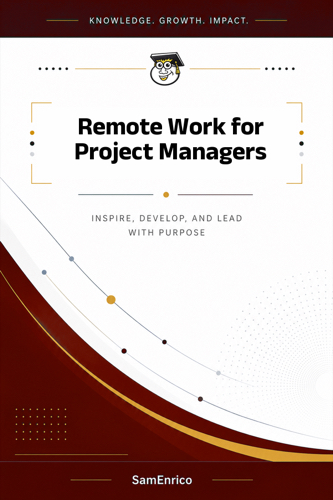
Remote Work for Project Managers eBook
Tracks tasks across distributed teams.
Tracks tasks across distributed teams.
Formats
Free sample
Chapter 1: The Death of Walking Around--–- Maria had been a project manager for eleven years. She knew every trick. She could walk into a team room, scan three faces, and know exactly which developer was stuck, which designer was waiting on approvals, and which deadline was about to slip. She didn’t need a report. She didn’t need a meeting.
She just walked. That was her superpower.Then her company went remote.Within six weeks, two projects missed their deadlines. One task had been blocked for five full days without anyone telling her. A developer in Poland had finished his work early, but the designer in Brazil never started because she didn’t know. The handoff had fallen into a silent gap between time zones.
Maria didn’t discover any of this until the client asked, “Where is our deliverable?”Maria wasn’t lazy. She wasn’t incompetent. She was invisible.Her team was invisible too. The work was happening – or not happening – inside a black box that she could no longer see into. The old tools didn’t work.
The old habits failed. The old assumption that she would know because she would see – that assumption was gone.This book is for every Maria. Every project manager who built their career on visibility – on being able to glance, listen, and sense – and then had that visibility ripped away when their team went remote. This book is not about Zoom etiquette. It is not about “culture” or “engagement” or “how to run a virtual icebreaker.” Those things matter, but they are not the core problem.The core problem is this: You cannot manage what you cannot see.When your team is distributed across time zones, homes, coffee shops, and coworking spaces, the old management model – Management by Walking Around (MBWA) – dies.
It does not adapt. It does not translate. It simply stops working. What replaces it is something entirely different: Management by Visibility (MBV).This chapter explains why MBWA died, why remote teams suffer from what this book calls the Visibility Gap, and how shifting your identity from “people manager” to “visibility architect” is the single most important change you will make as a remote project manager.The Watercooler Was Never Just a Watercooler Let’s be honest about what worked in the office.When you walked past a developer’s desk and saw them staring at their screen with their hand on their chin, you knew they were thinking. When you saw them scrolling through Stack Overflow, you knew they were debugging.
When you saw them leaning back in their chair, you knew they were waiting. These were not formal status reports. They were not meetings. They were not even conversations. They were just… signals.
Hundreds of tiny signals per day, absorbed unconsciously, that told you the state of the project.The watercooler – that cliché of office life – was never just about water. It was about unplanned visibility. You bumped into someone in the hallway. You overheard a conversation. You saw a whiteboard that hadn’t been erased yet.
You noticed that the sticky note hadn’t moved in two days. All of this information flowed to you without you asking for it. The cost of that information was zero. The value was enormous.Peter Drucker, the father of modern management, once wrote that “you cannot manage what you cannot measure.” But in the office, we measured without instruments. We used our eyes, our ears, and our intuition.
That was fine when everyone was in the same building.Remote work destroys that.Not because remote workers are lazy or hiding. Not because technology is inadequate. But because the physical signals that told you everything – the furrowed brow, the empty desk, the untouched whiteboard – are now gone. In their place is a void. And into that void rushes anxiety.The Visibility Gap: The Silent Killer of Remote Projects The Visibility Gap is the space between “work happening” and “project manager knowing about it.” In a colocated office, that gap is measured in minutes.
A developer gets blocked at 10:00 AM. By 10:15 AM, you have walked past their desk, noticed the frustration, and asked “What’s up?” The gap is fifteen minutes.In a remote setting, that same gap can be days.A developer in Ukraine gets blocked at 10:00 AM their time. They post a question in Slack. The PM is in Chicago, still asleep. By the time the PM wakes up at 8:00 AM Chicago time (4:00 PM Ukraine time), the developer has gone home for the day.
The PM answers the question. The developer sees it the next morning. The blocker is resolved at 10:00 AM the following day. The gap is twenty-four hours.Now multiply that gap across ten tasks, five team members, and three time zones. The project is not late because anyone is slow.
The project is late because the Visibility Gap turned every handshake into a delay.The Visibility Gap has three components. Understand these, and you understand 80% of remote project failure.Component 1: The Silent Blocker A blocker occurs when someone cannot proceed because they are waiting on something – an answer, an asset, an approval, a decision. In the office, silent blockers are rare because you can see the stuck person. In remote work, silent blockers are the default. The developer does not want to “bother” anyone.
The designer assumes the PM will check in. The writer thinks “I’ll just figure it out myself.” None of them say anything. The blocker sits silently in the task tracker, if it is recorded at all, and no one notices for days.Component 2: The Broken Handoff A handoff occurs when Task A must be completed before Task B can begin. In the office, handoffs are visible. You see Task A move to the “Done” column on the whiteboard.
You see the assignee of Task B pick up the sticky note. In remote work, handoffs are invisible. Task A is marked Done at 4:00 PM. Task B’s assignee is in a meeting. They check the board the next morning.
They start at 10:00 AM. The handoff that took five minutes in the office now takes sixteen hours. Multiply that across ten handoffs, and you have lost a week.Component 3: The Anxiety Spiral Remote team members experience two forms of anxiety. First: “Does anyone see my work?” When a developer completes a task but no one acknowledges it, they feel invisible. This anxiety leads to over-communication – constant “just checking in” messages, unnecessary pings, and status updates delivered via every channel available.
Second: “Is anyone else working?” When a team member cannot see their colleagues making progress, they assume the worst. This anxiety leads to under-performance – “I’ll wait until someone asks” becomes the default mode. Both anxieties widen the Visibility Gap. The more anxious people are, the less they communicate clearly. The less they communicate clearly, the more anxious everyone becomes.
It is a vicious cycle.The Visibility Gap is not a technology problem. It is a design problem. You cannot close it with a better tool or a faster internet connection. You close it by redesigning how work is structured, tracked, and communicated. That is what this book teaches.MBWA Is Dead.…
This is the end of the free sample. Get the eBook to keep going. Buy now
About this book
Details
- Author
- Macias Farrah
- Publisher
- SamEnrico
- Language
- English
- Genre
- Non-Fiction, Self-Help, Project
- Released
- 2026-06-05
- Pages (approx.)
- 149
- Available as
- eBook, Audiobook

Read better in the ZLOADR app
Your eBooks on your phone or tablet. Sign in with your SamEnrico account and start reading.
More by Macias Farrah
 LGBTQ+ Affirming Detox GuideMacias Farrah$11.99
 Hotel Room Sleep PracticeMacias Farrah$11.99
 Design Thinking for ReportsMacias Farrah$11.99
 DBT for Eating DisordersMacias Farrah$11.99
 Set Point Theory GuideMacias Farrah$11.99
 Empathy Burnout PreventionMacias Farrah$11.99
 Cleopatra Alliance BuildingMacias Farrah$11.99
 The Forgotten Code: Breaking the Enigma of the Voynich ManuscriptMacias Farrah$11.99
 Shadows of the Kabuki Stage: Japan's 18th-Century Theater RevolutionMacias Farrah$11.99
 Service Providers Guide to Addiction CounselingMacias Farrah$11.99
 How to Produce Tool AccessoriesMacias Farrah$11.99
 How to Produce Interior Acrylic LaTeX PaintMacias Farrah$11.99
You may also like
 Hong Kong Handover 1997Dunn Johnnie$11.99
 Zumba For Postnatal Recovery CourseNeal Christian$11.99
 Zumba for BeginnersLadner Nikia$11.99
 YouTube Comment Mining GuideHumes Pandora$12.99
 Worry Box MeditationCarlin Rudy$11.99
 Workplace Stress MeditationNguyen Lynn$11.99
 Workplace Stress and Sleep RepairHawley Ivory$11.99
 Workplace Perfectionism CureDelaney Jeffry$11.99
 Workplace Injustice Anger GuideWallen Isabelle$11.99
 Work Addiction and Burnout LinkGreenwood Ester$11.99
 Women in Yoga and WellnessBeattie Galina$11.99
 Women in Stand Up ComedyChun Evangeline$11.99