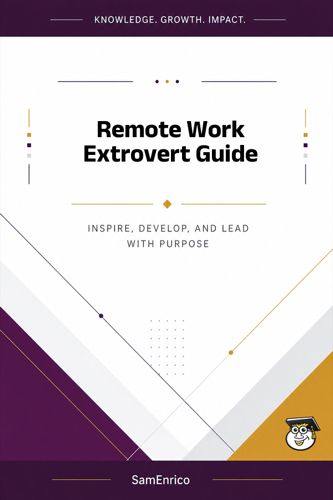
Remote Work Extrovert Guide eBook
Finds social outlets outside work.
Finds social outlets outside work.
Formats
Free sample
Chapter 1: The Invisible Drain--–- You were supposed to love remote work. Everyone told you so. No commute, comfortable clothes, flexibility, more time with family, the ability to live anywhere. And on paper, you did love it. For the first few weeks, maybe even months, it felt like freedom.
You slept later, ate better, avoided the soul-crushing rush hour traffic. You told your friends, “I could never go back.”Then something shifted.It wasn’t dramatic. There was no single bad day, no crisis, no moment where you threw your laptop across the room. It was slower than that. More insidious.
A gradual fading, like a photograph left in the sun.You started feeling tired in the middle of the afternoon for no reason. Not physically tired—you were sleeping fine. A different kind of tired. A hollow, buzzing, restless tired that made you want to crawl out of your own skin.You started checking your phone more often. Not for anything specific.
Just… checking. Opening Slack to see if anyone had said something. Refreshing email. Scrolling social media. Closing the app.
Opening it again two minutes later.You started feeling irritable. Things that never bothered you before—your partner’s chewing, the neighbor’s dog, a slow-loading website—suddenly felt unbearable. You snapped at people, then apologized, then snapped again.You started doubting yourself. “Maybe I’m not cut out for remote work.” “Maybe I’m depressed.” “Maybe I’m just lazy.” You tried all the standard advice. You bought a standing desk.
You started meditating. You set a strict morning routine. Nothing helped.If any of this sounds familiar, I have news for you: there is nothing wrong with you.You are not lazy. You are not broken. You are not secretly an introvert who just hasn’t accepted it yet.You are an extrovert who has walked into a trap that almost no one is talking about.
I call it the Invisible Drain.This chapter is about understanding that trap—how it works, why it’s so hard to see, and why every solution you’ve tried so far has failed. Because once you understand what’s actually happening inside your brain and body, you can stop blaming yourself and start fixing the real problem.The Great Misunderstanding About Extroverts Here’s what most people believe about extroverts: they’re loud, they love parties, they talk a lot, and they never want to be alone.Here’s what most people get wrong: extroversion isn’t about being loud. It’s about where you get your energy.The simplest way to understand the difference between introverts and extroverts is this:Introverts recharge their energy by being alone or in low-stimulation environments. Social interaction, even enjoyable social interaction, drains their battery. They need solitude to recover.Extroverts recharge their energy by being with other people or in high-stimulation environments.
Solitude, even pleasant solitude, drains their battery. They need social interaction to recover.Notice what this definition does not say. It does not say that extroverts are always talking. It does not say that extroverts hate being alone. It does not say that extroverts are shallow or attention-seeking.It says something much simpler and more profound: extroverts need external stimulation to feel normal.When an extrovert is alone for too long, their energy doesn’t just stay the same.
It decreases. It leaks. It drains away like water from a cracked bowl. And here’s the cruelest part: they often don’t notice it happening until they’ve already hit empty.The drain is invisible.Why Remote Work Is an Extrovert’s Perfect Storm Before remote work, most extroverts didn’t have to think about managing their social energy. The office provided it automatically.Think about a typical pre-remote work day for an extrovert:You commuted with other people (ambient presence)You walked through a busy lobby (more ambient presence)You stopped at the kitchen and chatted with a colleague (micro-interaction)You had a morning meeting (active interaction)You worked at your desk while hearing other people talk around you (ambient presence)You had lunch with coworkers (active interaction)You stopped by someone’s desk to ask a question (micro-interaction)You debriefed with a work friend at the end of the day (active interaction)You commuted home with other people (ambient presence)By the time you got home, your social battery was full.
Not because you were constantly “performing” or “networking,” but because your environment was constantly providing the low-level social stimulation your brain craves.Now compare that to a typical remote work day:You wake up alone You walk to your home office alone (ten feet, not a commute)You join a Zoom call where everyone is muted except the person speaking (virtual presence, which is different—we’ll get to that in Chapter 6)You work alone for three hours You eat lunch alone while scrolling your phone You work alone for another four hours You close your laptop and walk ten feet back to your living room By the end of this day, your social battery is not full. It’s not even half full. It’s critically low. And you can’t figure out why because you were “productive.” You answered all your emails. You attended all your meetings.
You did your work.But your brain doesn’t care about productivity. Your brain cares about stimulation. And it didn’t get enough.The Science of the Invisible Drain What’s actually happening inside your brain when you experience the Invisible Drain? Let me walk you through it.Your brain has a network called the default mode network (DMN). This is the system that activates when you’re not focused on an external task—when you’re daydreaming, ruminating, or just letting your mind wander.
The DMN is also associated with self-referential thought, meaning it’s the part of your brain that thinks about you.For most people, a little bit of DMN activity is normal. But for extroverts, prolonged isolation causes the DMN to become overactive. You start thinking about yourself too much. You ruminate. You worry.
You feel restless and dissatisfied without being able to pinpoint why.Here’s what happens when you introduce social stimulation: the DMN calms down. Your brain shifts its attention outward. You stop thinking about yourself and start engaging with the world. This feels like relief, like a cool cloth on a hot forehead.This isn’t pop psychology. This is measurable neuroscience.
Studies using functional MRI have shown that extroverts show greater brain activation in response to social stimuli, and that this activation is associated with positive mood and energy. Introverts, by contrast, show greater activation in response to solitary activities.When you work from home alone all day, your brain is essentially running on the wrong fuel. It’s like putting diesel in a gasoline engine. It might run for a while, but it’s going to sputter and fail.The Two Kinds of Silence (This Matters More Than You Think)Before we go any further, I need to make a distinction that will save you years of confusion. Not all silence is the same.Isolation Silence is what happens when you are completely alone.…
This is the end of the free sample. Get the eBook to keep going. Buy now
About this book
Details
- Author
- Shelley Letty
- Publisher
- SamEnrico
- Language
- English
- Genre
- Non-Fiction, Self-Help, Extroversion
- Released
- 2026-06-05
- Pages (approx.)
- 147
- Available as
- eBook, Audiobook

Read better in the ZLOADR app
Your eBooks on your phone or tablet. Sign in with your SamEnrico account and start reading.
More by Shelley Letty
 Phthalate Free Fragrance GuideShelley Letty$11.99
 Retirement Housing Zoning and PermitsShelley Letty$11.99
 Sleep As Prevention MedicineShelley Letty$11.99
 Success Without Burnout for HealthcareShelley Letty$11.99
 Parent Loss and ReliefShelley Letty$11.99
 Remote Work Procrastination CureShelley Letty$11.99
 Assertive Job InterviewingShelley Letty$11.99
 The Insects That Spoke: How Flies Solved Australia’s Oldest Cold CaseShelley Letty$11.99
 Donatello: The Sculptor Who Breathed Life into StoneShelley Letty$11.99
 How to Start a Ethanol (synthetic) Business (Beginners Guide)Shelley Letty$11.99
 How to Produce Lipcolor RemoverShelley Letty$11.99
 A Collector's Handbook to the Messerschmitt Tg500 TigerShelley Letty$11.99