
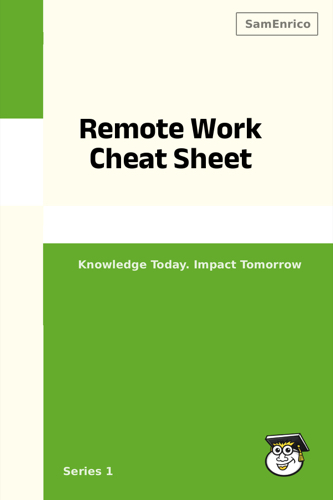
Free sample
Chapter 1: The Productivity Lie--–- Every day, millions of highly educated, well-paid professionals walk into buildings, sit at desks, and proceed to accomplish almost nothing of value for the next eight hours. They answer emails that didn't need to be answered. They attend meetings that could have been memos. They wait for managers to stop by, for colleagues to finish chatting, for the printer to warm up, for the 3 PM slump to pass. And at 5 PM, they pack their bags, drive home, and tell their families they're exhausted.
They are not lazy. They are not incompetent. They are victims of the greatest unexamined assumption in modern work: that being seen equals being productive.This chapter dismantles that assumption. It is not an abstract philosophical argument. It is a practical, evidence-based takedown of the traditional office as a productivity machine—because the evidence shows the office is not a productivity machine at all.
It is an interruption factory. And once you understand why, you will never look at "face time" the same way again. You will also be equipped with the tools to explain this to skeptical bosses, colleagues, or your own doubting inner voice. By the end of this chapter, you will have a new framework for understanding what remote work actually enables—not flexible hours, not a shorter commute, but something far more valuable: the chance to do your best work without constantly being pulled away from it.The Sacred Cow of Face Time Let us start with a simple question. Why do most managers want employees in the office?
Ask them directly, and they will give answers like "collaboration," "company culture," or "spontaneous innovation." These sound reasonable. They sound like the language of leadership. But watch what those same managers do when pressed. Ask them to define collaboration, and they will say "people talking to each other." Ask them to define culture, and they will say "shared values and behaviors." Ask them to define spontaneous innovation, and they will say "unplanned conversations that lead to ideas."None of these definitions require an office. People can talk to each other on Zoom.
Shared values can be documented in a wiki. Unplanned conversations can happen on Slack. So why the insistence on physical presence?The honest answer—the one most managers will never say out loud—is anxiety. Managerial anxiety is the engine that drives return-to-office mandates. When a manager cannot see their team working, they feel a low-grade, persistent fear that nothing is getting done.
This fear has nothing to do with actual output. It has everything to do with the human need for visual confirmation. We are wired to trust what we can see. A silent Slack channel feels like abandonment. A quiet office floor feels like a problem.
But a room full of people typing furiously—even if half of them are shopping for dog food—feels like productivity.This is the sacred cow of face time. It is sacred because questioning it feels dangerous. If you tell your boss you want to work from home, you worry they will think you are lazy. If you close your office door to focus, you worry colleagues will think you are antisocial. If you skip a meeting to do deep work, you worry you will be seen as not a team player.
These fears are not irrational. They are rational responses to a system that rewards visibility over value.But the system is wrong. The evidence is overwhelming.The Cognitive Cost of Context Switching In 2014, researchers at the University of California, Irvine, conducted a landmark study on workplace interruptions. They followed knowledge workers for three weeks, tracking every time they were pulled away from a task. The results were staggering.
The average worker was interrupted every eleven minutes. And here is the critical finding: after an interruption, it took an average of twenty-three minutes to return to the original task with the same level of focus.Twenty-three minutes. Not thirty seconds. Not "just a quick check." Twenty-three minutes of cognitive recovery every time someone stops by your desk, every time a Slack notification pops up, every time your email chimes.This phenomenon is called context switching. Your brain does not switch tasks like a computer.
When you are deep in a spreadsheet, analyzing data, and someone asks a question about a different project, your brain does not simply pause one file and open another. It must disengage from the first task, suppress the active neural networks, activate new networks for the second task, process the interruption, then reverse the entire process to return to the first task. Each switch costs time, energy, and accuracy.The office is designed to maximize context switching. Open floor plans mean anyone can interrupt anyone. "Collaborative culture" means leaving your chat open to all messages.
"Responsive" means answering emails within minutes. Every one of these supposedly positive workplace norms is actually a tax on your cognitive bandwidth.Consider a typical office worker's day. They arrive at 9 AM and check email immediately—already a context switch away from any planned work. Then a colleague stops by to ask a "quick question" about a different project. Then a meeting starts.
The meeting is thirty minutes but only fifteen minutes are relevant. Then back to the desk, but now they have to remember where they were before the meeting. Then email again. Then a Slack message from their manager. Then lunch.
Then the afternoon slump, which makes context switching even more costly. By 5 PM, they have accomplished perhaps two hours of actual focused work. The other six hours were interruption, recovery, and the exhausted limbo in between.This is not a bug in the office design. It is a feature. The office is optimized for visible busyness, not for actual output.
And the people who suffer most are the ones doing the deepest, most valuable work.The M&M Effect: Managers and Meetings If context switching is the disease, meetings are the primary vector. The average professional spends thirty-one hours per month in meetings. More than half of those meetings are rated by attendees as unnecessary. Yet they continue. Why?Because meetings serve a function that has nothing to do with getting work done.
They serve managerial anxiety.Let us call this the M&M Effect: Managers and Meetings are locked in a codependent cycle. A manager feels anxious about a project. Instead of trusting the team to do their jobs, the manager calls a meeting. In the meeting, the team reports status updates. The manager feels reassured because they have seen the team working.
The meeting ends. The team has lost an hour of productive time. Nothing has actually moved forward. But the manager's anxiety is temporarily relieved. So they schedule another meeting for next week.The tragedy is that status updates do not require meetings.
A written status update posted to a shared channel takes five minutes to write and two minutes to read. A meeting about status updates takes sixty minutes and consumes the time of everyone in the room. But the written update does not relieve managerial anxiety because the manager cannot see people writing it. The meeting does relieve anxiety because the…
This is the end of the free sample. Get the eBook to keep going. Buy now
About this book
Details
- Author
- Hope Strickland
- Publisher
- SamEnrico
- Language
- English
- Genre
- Non-Fiction, Self-Help / Reference
- Released
- 2026-06-11
- Pages (approx.)
- 142
- Available as
- eBook, Audiobook

Read better in the ZLOADR app
Your eBooks on your phone or tablet. Sign in with your SamEnrico account and start reading.
More by Hope Strickland
 Comparison to Other HeistsHope Strickland$11.99
 Twitch Subscriber Spending ControlHope Strickland$11.99
 Lying Down Body Scan ScriptHope Strickland$11.99
 Infant Nonverbal Cues GuideHope Strickland$11.99
 Utility Shutoff PreventionHope Strickland$11.99
 Napping Master GuideHope Strickland$11.99
 Doe Network Cold Case TeamsHope Strickland$11.99
 The Last Broadcast: The Night the BBC Defied a DictatorHope Strickland$11.99
 The Fur Trader's Heart: Love and Empire on the Canadian FrontierHope Strickland$11.99
 How to Produce Nail SuppliesHope Strickland$11.99
 How to Produce an Access Control Card ReaderHope Strickland$11.99
 Growing Calamagrostis (Reed Grass, Smallweed)Hope Strickland$11.99
You may also like
 Memory Palace ChecklistCastaneda Latoria$11.99
 Pain Meditation Cheat SheetMilner Libby$11.99
 Anticipatory Grief Cheat SheetHoyt Krysten$11.99
 Pattern Recognition ChecklistMusgrove Fidelia$11.99
 Difficult Conversation ChecklistKimbrell Wilhelmina$11.99
 Nightmare Cheat SheetSimms Isaiah$11.99
 Remote Work ChecklistShayne Gandy$11.99
 Interruption ChecklistGoldstein Daren$11.99
 Difficult Conversation Cheat SheetKohn Joshua$11.99
 Anticipatory Grief ChecklistFord Jason$11.99
 Scripting ChecklistLowry Maisie$11.99
 Resilience ChecklistDelgado Josh$11.99