
Non-FictionSelf-HelpAssertiveness
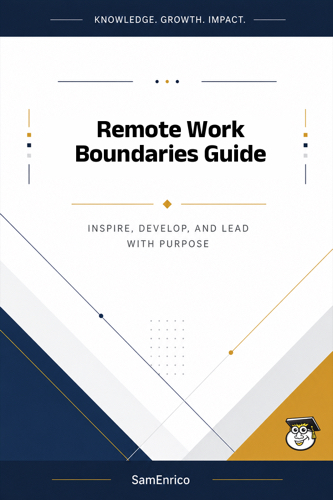
Remote Work Boundaries Guide eBook
Says no to after hours requests.
Says no to after hours requests.
Formats
Free sample
Chapter 1: The 10 PM Spiral--–- The laptop was still warm. Maya had closed it at 5:15 PM, kissed her toddler goodnight at 7:30, sat down for dinner with her partner at 8:00, and then—without thinking—opened it again at 9:45 PM. Now it was 10:12, and she was staring at a Slack message from a colleague in a later time zone: “Hey, sorry for the late ask, but could you just quickly review the Q3 slides? Need them by tomorrow AM. Thanks!”Her heart rate climbed.
Her jaw tightened. The glass of wine beside her went untouched. Her partner had already gone to bed, and she could hear the soft rhythm of their breathing from the other room. Maya was alone with the glowing screen and the quiet, insistent demand.She typed: “Sure, give me 20 minutes.”Then she sat back and wondered: How did I get here?The Epidemic No One Is Talking About Maya is not real. But her story is being lived out, in some form, by millions of remote workers every single night.
The specifics change—sometimes it is a spreadsheet, sometimes a deck, sometimes a single question that could have waited until morning—but the pattern is identical. The laptop opens after hours. The anxiety spikes. The boundary dissolves.And then, the quiet shame.If you are reading this book, you already know the feeling. You have already told yourself, “I’ll just check one message.” You have already answered a Slack at 9 PM because you were afraid of seeming lazy.
You have already brought your laptop to the couch, the bed, the dinner table, the vacation rental, the waiting room, the parking lot.Here is the truth that no one tells you in those corporate "wellness" webinars: You are not weak. You are not lazy. You are not failing at remote work.You are trapped in a system that was never designed for human beings.Remote work was sold to us as liberation. No commute. No open-plan office.
No forced small talk by the water cooler. We would work from coffee shops, from mountain cabins, from our own back porches. We would have time for hobbies, for family, for sleep. The promise was freedom.But something strange happened on the way to liberation. The boundaries didn't disappear.
They inverted.In an office, you go home. The building locks. The lights turn off. There is a physical, undeniable end to the workday. Even if you wanted to keep working, you couldn't—not without a key, not without setting off an alarm.
The architecture of the office protected you from yourself.Remote work erased that architecture. There is no building to leave. There is no light switch to flip. The office is now a glowing rectangle that lives in your pocket, on your kitchen counter, next to your bed. And because the office is always there, the expectation creeps in—first as a suggestion, then as a norm, then as an unspoken demand—that you should always be available.This book is about how to take back your life.
But before we get to the how, we need to understand the what. What is actually happening to your brain, your body, and your career when you open that laptop at 10 PM? Why does it feel so impossible to say no? And why does "just setting boundaries" fail almost every time?The Physics of the Glowing Rectangle Let us begin with the biology.Your brain is not a machine. It is an organ, and like every other organ, it has limits.
It requires rest, recovery, and cycles of activity and stillness. One of the most well-established findings in neuroscience is the ultradian rhythm—a 90- to 120-minute cycle during which your brain moves from high focus to natural fatigue. You have experienced this rhythm thousands of times without naming it: the way your attention sharpens for about an hour and a half, then drifts. The way you start making small errors after two hours of continuous work. The way a five-minute break restores your clarity.When you work after hours, you are not working at full capacity.
You are working in the trough of your ultradian cycle. Your prefrontal cortex—the part of your brain responsible for decision-making, impulse control, and complex reasoning—is already tired. This is why late-night work takes longer. This is why you reread the same email three times. This is why you send messages at 11 PM that you regret at 9 AM.But the ultradian rhythm is only the beginning.Cortisol is a hormone that your body releases in response to stress.
In small doses, it is helpful—it sharpens your senses, mobilizes energy, and helps you respond to threats. In sustained doses, it is destructive. Chronically elevated cortisol is linked to insomnia, hypertension, weakened immune function, anxiety disorders, depression, and memory impairment.Here is what the research shows: checking work messages after hours elevates cortisol. Not because the messages are urgent. Not because the work is meaningful.
But because the possibility of a request triggers the same stress response as an actual threat. Your brain cannot distinguish between a lion charging at you and a Slack notification from your boss. Both activate the amygdala. Both release cortisol. Both prepare your body for fight or flight.The problem, of course, is that you cannot fight or flee from a Slack message.
So the cortisol sits there. It accumulates. It degrades your sleep, your mood, your patience with your children, your ability to focus during actual working hours.You are not being "productive" when you work late. You are borrowing against your future health at predatory interest rates.The 24/7 Hamster Wheel The phrase "work-life balance" has become so overused that it has lost all meaning. But the concept it points to—the idea that work and life should be separate, that one should not consume the other—is not trivial.
It is essential.Remote work has not destroyed work-life balance. It has done something more insidious: it has convinced us that work-life balance is no longer necessary.Think about the language we use. "I'll just check one thing." "Let me quickly respond." "I'm just catching up." The word "just" is doing enormous work here. It minimizes. It normalizes.
It turns an intrusion into an errand.But here is what is actually happening: the boundary between work and life has not been blurred. It has been cannibalized. Work is eating life, one "quick check" at a time.The data is stark. A 2021 study published in the Journal of Applied Psychology found that remote workers who checked email after hours reported significantly lower well-being, higher emotional exhaustion, and more work-family conflict than those who did not. A 2022 meta-analysis of 47 studies on after-hours work communication concluded that "availability expectations" are one of the strongest predictors of burnout—stronger than workload, stronger than autonomy, stronger even than job insecurity.The mechanism is straightforward: when you are expected to be available after hours, you never truly leave work.
Your brain remains in a state of low-grade vigilance, scanning for threats, waiting for the next ping. This is called anticipatory stress, and it is just as damaging as the stress of actually working.You do not…
This is the end of the free sample. Get the eBook to keep going. Buy now
About this book
Details
- Author
- Gladden Grover
- Publisher
- SamEnrico
- Language
- English
- Genre
- Non-Fiction, Self-Help, Assertiveness
- Released
- 2026-06-06
- Pages (approx.)
- 129
- Available as
- eBook, Audiobook

Read better in the ZLOADR app
Your eBooks on your phone or tablet. Sign in with your SamEnrico account and start reading.
More by Gladden Grover
 Housing Equity Release for RetireesGladden Grover$11.99
 The Mobile Repair GenerationGladden Grover$11.99
 Homicide Detective Burnout GuideGladden Grover$11.99
 Social Anxiety Support GroupsGladden Grover$11.99
 Resort Conversation GuideGladden Grover$11.99
 Active Listening for Social WorkersGladden Grover$11.99
 Glooskap's Quest: The Stone Giant and the First DawnGladden Grover$11.99
 Love in the Shadow of War: The Opera Letters of Nellie Melba and Frederick BakerGladden Grover$11.99
 How to Start a Coke (wholesale) Business (Beginners Guide)Gladden Grover$11.99
 Pelvic Tilt RegulationGladden Grover$12.99
 How to Produce a Washing MachineGladden Grover$11.99
 Service Providers Guide to Information BrokersGladden Grover$11.99
You may also like
 Hong Kong Handover 1997Dunn Johnnie$11.99
 Zumba For Postnatal Recovery CourseNeal Christian$11.99
 Zumba for BeginnersLadner Nikia$11.99
 YouTube Comment Mining GuideHumes Pandora$12.99
 Worry Box MeditationCarlin Rudy$11.99
 Workplace Stress MeditationNguyen Lynn$11.99
 Workplace Stress and Sleep RepairHawley Ivory$11.99
 Workplace Perfectionism CureDelaney Jeffry$11.99
 Workplace Injustice Anger GuideWallen Isabelle$11.99
 Work Addiction and Burnout LinkGreenwood Ester$11.99
 Women in Yoga and WellnessBeattie Galina$11.99
 Women in Stand Up ComedyChun Evangeline$11.99