
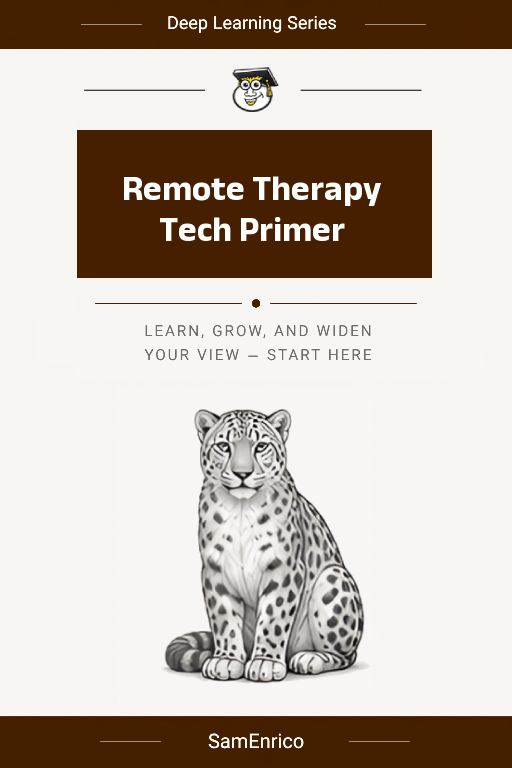
Non-FictionMental WealthMental Health EquityTech Guide
Remote Therapy Tech Primer eBook
Access global therapists via affordable apps (7 Cu
by Rankin Hyman
Access global therapists via affordable apps (7 Cups, MindDoc, Wysa) designed for low-bandwidth regions. Covers data privacy on weak networks, free tier options, and offline journaling.
Formats
Free sample
Chapter 1: The Waiting Room Is Dead--–- The screen flickered to life on a cracked Mobicel phone in rural Kenya. Grace, a community health worker, had not slept well. Her younger sister had stopped eating three days ago, and the nearest therapist was a six-hour bus ride away—a journey that would cost nearly a week’s wages. Grace opened an app called 7 Cups. No video loaded.
No spinning wheel of buffering. Just text, plain and simple, moving across a 2G network like a handwritten note passed under a door. Within minutes, she was typing her fears to a trained listener in another country. The response came back not instantly, but within the hour. It was not a cure.
It was not a diagnosis. It was something she had not expected to find: a human voice, rendered in pixels, that said, “I hear you.”This is not a story about technology saving the world. It is a story about the end of waiting rooms.For more than a century, the waiting room was the unavoidable gatekeeper of mental health care. You called. You waited on hold.
You scheduled an appointment six to eight weeks out. You drove twenty, forty, sometimes ninety minutes to a beige office with outdated magazines. You sat in a plastic chair, heart racing, watching the clock, wondering if you would actually say the words you had rehearsed in the car. And then, after forty-five minutes, you paid $150, drove home, and did it all again next week—if you were lucky.That model worked for a narrow slice of humanity: the insured, the mobile, the financially stable, the geographically fortunate. For everyone else, therapy was a luxury good, like a vacation home or a foreign sports car.
But over the past decade, something fundamental shifted. The waiting room did not evolve. It died.In its place emerged a chaotic, contradictory, and profoundly hopeful ecosystem of remote therapy apps. Some are free. Some cost more than in-person therapy.
Some are staffed by volunteer listeners with no formal training. Others use artificial intelligence that has never felt a single emotion but can recite the entire cognitive behavioral therapy (CBT) manual from memory. They operate on 2G networks in the Global South and on gigabit fiber in New York City. They store your deepest secrets on servers that may or may not be encrypted. They sell your metadata to advertisers while simultaneously saving lives.This chapter is about that new world.
It is the foundation of everything that follows in this book. Before we can talk about privacy (Chapters 5–8), or offline journaling (Chapters 9–10), or AI companions (Chapter 11), we must first understand the landscape: what remote therapy actually is, how it works on weak networks, and why the old trade-offs (synchronous versus asynchronous, human versus automated, cheap versus secure) have been replaced by a new set of choices that no single app can resolve alone.Let us begin by burying the waiting room for good.The Great Unbundling of Therapy Traditional in-person therapy is a bundled product. When you walk into a therapist’s office, you receive several services at once: (1) a human relationship, (2) clinical expertise, (3) a private physical space, (4) real-time interaction, and (5) legal confidentiality protections under laws like HIPAA. You cannot unbundle these. You cannot say, “I want the human relationship but not the physical office, and I only want to pay for fifteen minutes.” The bundle is the model.Remote therapy apps have exploded that bundle into pieces.
Consider the difference between three popular services:7 Cups: Volunteer listeners (not licensed therapists) provide emotional support via asynchronous text. No video. No audio. No real-time requirement. Free with optional donation.
Operates in 189 countries.Wysa: An AI chatbot delivers CBT exercises via text. No human involved unless you upgrade to a paid coaching tier. Responses are immediate but algorithmic. Free tier available.Talkspace: Licensed therapists provide messaging-based therapy, often with weekly check-ins. Includes video sessions at higher tiers.
Requires payment (typically 65–65–65–99 per week) and real identity verification. Only available in the United States.These three apps represent three completely different answers to the question: “What is therapy, anyway?” For 7 Cups, therapy is a listening ear. For Wysa, therapy is structured exercises. For Talkspace, therapy is a clinical relationship delivered asynchronously. None is wrong.
None is complete. Each unbundled a different piece of the traditional package and rebuilt it for a smartphone.This unbundling is the single most important fact about remote therapy. It means that no single app will ever be right for every person or every problem. It also means that the old barrier—the waiting room, the drive, the $150 copay—has been replaced by a new barrier: choice overload. How do you choose between a free AI chatbot and a paid human therapist?
How do you know whether you need a listener or a clinician? These are the questions this book answers, starting with the most fundamental distinction of all: synchronous versus asynchronous therapy.Synchronous vs. Asynchronous: The Core Trade-Off Every remote therapy interaction falls into one of two categories, and understanding this distinction will shape every decision you make in the chapters ahead.Synchronous therapy happens in real time. You type a message, the other person responds immediately. You speak, they listen.
It mimics the rhythm of a face-to-face conversation, complete with the pressure to respond quickly, the comfort of shared silence, and the risk of interruption. Video sessions (Talkspace premium tier, Better Help) are synchronous. So are live chat sessions (some 7 Cups listener shifts). The advantage is emotional immediacy: you feel seen in the moment. The disadvantage is fragility: synchronous interactions break when the network breaks, when the other person steps away, or when life intervenes.Asynchronous therapy happens over time.
You write a message, send it, and wait—hours or days—for a response. You can think, revise, and edit. You are not performing in real time. This is the default mode for most text-based therapy apps, including the basic tiers of Talkspace and 7 Cups. The advantage is resilience: asynchronous messages can be stored locally and sent when a signal returns (see Chapter 4 for the technical details).
The disadvantage is loneliness: waiting for a response can feel like shouting into a void, especially in moments of acute distress.Here is the trade-off that no app marketing will tell you: Asynchronous therapy works better for low-bandwidth regions and for thoughtful, reflective work. Synchronous therapy works better for crisis and for the experience of being witnessed. Neither is superior. They are different tools for different jobs.Consider Grace again, the health worker in Kenya. She has a 2G connection that drops in and out.
A synchronous video call is impossible—her phone would buffer for ten minutes and then crash. A synchronous text chat is possible but stressful: she might type a long response, hit send, and watch the message fail because the network dropped at that exact second. Asynchronous messaging, however, is nearly foolproof. She types her message offline, the app saves it locally, and when the network briefly returns, the message goes out. She receives a response hours later, reads it, and thinks about it before replying.
The delay is not a bug; it is a feature. It gives her time to process.Now consider Marcus, a software…
This is the end of the free sample. Get the eBook to keep going. Buy now
About this book
Details
- Author
- Rankin Hyman
- Publisher
- SamEnrico
- Language
- English
- Genre
- Non-Fiction, Mental Wealth, Mental Health Equity, Tech Guide
- Released
- 2026-05-30
- Pages (approx.)
- 145
- Available as
- eBook, Audiobook

Read better in the ZLOADR app
Your eBooks on your phone or tablet. Sign in with your SamEnrico account and start reading.
More by Rankin Hyman
 Career Goal Action Planning GuideRankin Hyman$11.99
 Assertiveness Recovery PlanRankin Hyman$11.99
 Phobia and Relationships GuideRankin Hyman$11.99
 Instagram Broadcast Channel GuideRankin Hyman$11.99
 Retirement Housing Budgeting WorkbookRankin Hyman$11.99
 Hops & Heists: The Untold Story of the Beer Barons' Gold RushRankin Hyman$11.99
 Understanding Interstitial PneumoniaRankin Hyman$17.99
 Europe B2B Purchasing OutlookRankin Hyman$12.99
 Customer Service EngineerRankin Hyman$11.99
 How to Start a Hobby in MonopolyRankin Hyman$11.99
You may also like
 Hong Kong Handover 1997Dunn Johnnie$11.99
 Zumba For Postnatal Recovery CourseNeal Christian$11.99
 Zumba for BeginnersLadner Nikia$11.99
 YouTube Comment Mining GuideHumes Pandora$12.99
 Worry Box MeditationCarlin Rudy$11.99
 Workplace Stress MeditationNguyen Lynn$11.99
 Workplace Stress and Sleep RepairHawley Ivory$11.99
 Workplace Perfectionism CureDelaney Jeffry$11.99
 Workplace Injustice Anger GuideWallen Isabelle$11.99
 Work Addiction and Burnout LinkGreenwood Ester$11.99
 Women in Yoga and WellnessBeattie Galina$11.99
 Women in Stand Up ComedyChun Evangeline$11.99