
Non-FictionProfessional's Cheat SheetVirtual Communication
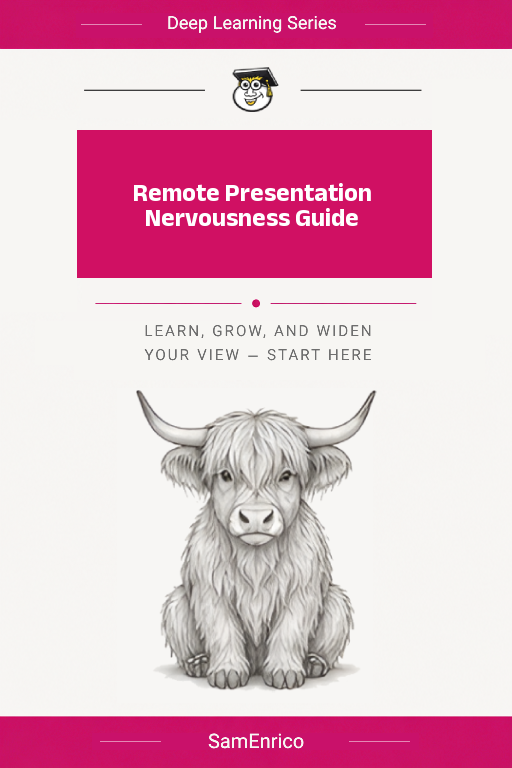
Remote Presentation Nervousness Guide eBook
Overcome public speaking anxiety for remote presen
by Kang Cheri
Overcome public speaking anxiety for remote presentations. Breathing techniques and confidence builders.
Formats
Free sample
Chapter 1: The Ghost in the Grid...--–- The first time it happened, you probably thought something was wrong with your internet.You checked the connection. You restarted the router. You moved closer to the modem. But the problem wasn’t bandwidth. The problem was something far stranger, far more ancient, and far more personal.
The problem was that you looked at a grid of faces—colleagues, clients, strangers—and your brain did something unexpected. It froze. Not a dramatic, Hollywood-style freeze where you drop your coffee and run. A quiet, internal freeze. Your mind went blank.
Your voice tightened. Your palms sweated even though your hands were resting on a keyboard. And you thought: Why is this so hard? I’ve spoken in front of people before. I’ve given presentations in conference rooms.
I’ve even enjoyed it sometimes. But this… this feels different.You were right. It is different.Remote presenting is not simply in-person presenting with the commute removed. It is a fundamentally different psychological and physiological experience. The rules change.
The feedback loops disappear. The audience becomes a grid of frozen expressions or, worse, black boxes with initials. And you are left staring at a tiny camera lens that offers no nod, no smile, no reassurance. Just a black circle of glass reflecting your own uncertainty back at you.This chapter is called The Ghost in the Grid because that is exactly what remote anxiety feels like: a presence that isn’t there, a judgment that hasn’t been spoken, a fear that has no clear source. You are not afraid of the people on the call.
Most of them are neutral or friendly. You are afraid of something else entirely. You are afraid of the interface. You are afraid of the silence. You are afraid of the version of yourself that lives inside the thumbnail.By the end of this chapter, you will understand why remote anxiety is unique, why it triggers different mechanisms than in-person nervousness, and—most importantly—why none of this makes you weak, broken, or unprepared.
You will learn to separate technical problems from psychological ones. And you will take the first step toward mastering the ghost.The Paradox of the Screen Let us begin with a simple paradox. In-person public speaking is objectively more dangerous in evolutionary terms. A room full of strangers could, in your ancestral environment, have meant threat. They could have rejected you, exiled you, or harmed you.
And yet, many people find in-person speaking easier than remote presenting. Why?Because in-person speaking provides constant, rich feedback. You see head nods. You hear murmurs of agreement. You read body language in real time.
Your brain uses that feedback to adjust pacing, tone, and content. It is a dance. You lead, the audience responds, and you adjust accordingly.Remote presenting removes almost all of that feedback. You are left with a grid of faces that may be frozen due to bandwidth, or neutral because people are multitasking, or entirely absent because cameras are off. Your brain, starved of its usual social radar, begins to fill the gaps with worst-case assumptions.
They look bored. They look angry. They look like they wish they were anywhere else. But here is the truth: you do not actually know what they are thinking. You are guessing.
And your brain, wired for survival, guesses the worst.This is the paradox of the screen. The screen removes physical danger but creates psychological ambiguity. And ambiguity, for the human brain, is often more stressful than clear threat. A growling dog is scary, but you know what to do. A silent, frozen grid of faces offers no clear action.
So you freeze.The Three Unique Triggers of Remote Anxiety Remote anxiety is not one thing. It is a cluster of triggers that interact and amplify each other. Based on synthesis of the top-selling books on public speaking fear and remote communication, three triggers stand out as uniquely digital.Trigger One: Latency Latency is the micro-delay between speaking and hearing. In person, sound travels at the speed of physics, but your brain does not perceive a delay. On a video call, even a 0.2-second delay disrupts your natural conversational rhythm.
You say something. You wait. The other person’s face reacts slightly later than expected. You feel, inexplicably, as though you are interrupting or being ignored.The problem is not the delay itself. The problem is that your brain expects immediate feedback.
When it does not arrive, it interprets the gap as social rejection. This is not a character flaw. It is a feature of your neural wiring. The same circuits that help you navigate a conversation in person are now being fed incomplete data. And they are doing their best with that incomplete data—which means filling in the blanks with anxiety.Trigger Two: Lack of Feedback Loops In any normal conversation, you are constantly adjusting.
You speak louder if someone seems distant. You soften your tone if someone looks confused. You speed up if the audience is nodding along. You slow down if they look lost. These micro-adjustments happen automatically, below the level of conscious thought.On a video call, those feedback loops are severed.
You cannot see if someone is leaning forward with interest or leaning back with boredom. You cannot hear the subtle intake of breath that signals a question. You cannot feel the energy of the room. Instead, you are speaking into a void, hoping your message is landing.This absence of feedback is exhausting. It requires you to maintain a constant state of alertness without any of the rewards that alertness usually brings.
And over time, that exhaustion turns into anxiety. You begin to doubt everything. Am I talking too long? Did they understand that point? Should I repeat myself?Trigger Three: Self-View This is the most uniquely digital trigger of all.
In person, you cannot see yourself while you speak. You are aware of your body, of course, but you are not watching a live video feed of your own face. On a remote call, you are. And that self-view doubles the spotlight effect.The spotlight effect is a well-documented psychological phenomenon. Humans tend to overestimate how much others notice and remember about them.
In person, this effect is moderate. On video, it is amplified because you are constantly watching yourself. Every raised eyebrow, every slight slouch, every nervous lip-lick becomes magnified in your own perception. You think: Everyone can see that. Everyone is judging that.But here is the secret: they are not.
Most people are watching themselves. Most people are worried about their own thumbnail. The audience is not nearly as attentive to your minor flaws as you assume. The spotlight effect is a trick of perception, not a reality.In-Person Nervousness vs. Virtual Paralysis Let us be precise about terminology.
Traditional public speaking anxiety—glossophobia—produces a predictable set of symptoms. Racing heart. Sweaty palms. Dry mouth. Shaking hands.
Butterflies in the stomach. These symptoms are uncomfortable, but they are also familiar. They have been studied for decades. They respond to standard interventions like deep breathing, practice, and cognitive reframing.Virtual paralysis is different. The symptoms overlap…
This is the end of the free sample. Get the eBook to keep going. Buy now
About this book
Details
- Author
- Kang Cheri
- Publisher
- SamEnrico
- Language
- English
- Genre
- Non-Fiction, Professional's Cheat Sheet, Virtual Communication
- Released
- 2026-06-01
- Pages (approx.)
- 140
- Available as
- eBook, Audiobook

Read better in the ZLOADR app
Your eBooks on your phone or tablet. Sign in with your SamEnrico account and start reading.
More by Kang Cheri
 Unit Economics Calculator GuideKang Cheri$11.99
 Sexual Addiction Recovery for TeensKang Cheri$11.99
 Message Framing for SalesKang Cheri$11.99
 Same Sex Relationship EsteemKang Cheri$11.99
 How to Become a GluerKang Cheri$11.99
 Learn to Play the Jarana MosquitoKang Cheri$11.99
 Manila HarvestingKang Cheri$11.99
You may also like
 Hong Kong Handover 1997Dunn Johnnie$11.99
 Zumba For Postnatal Recovery CourseNeal Christian$11.99
 Zumba for BeginnersLadner Nikia$11.99
 YouTube Comment Mining GuideHumes Pandora$12.99
 Worry Box MeditationCarlin Rudy$11.99
 Workplace Stress MeditationNguyen Lynn$11.99
 Workplace Stress and Sleep RepairHawley Ivory$11.99
 Workplace Perfectionism CureDelaney Jeffry$11.99
 Workplace Injustice Anger GuideWallen Isabelle$11.99
 Work Addiction and Burnout LinkGreenwood Ester$11.99
 Women in Yoga and WellnessBeattie Galina$11.99
 Women in Stand Up ComedyChun Evangeline$11.99