
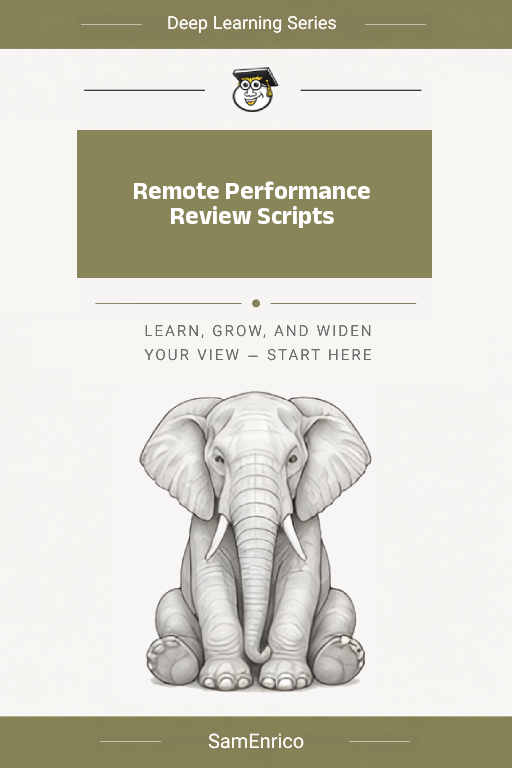
Remote Performance Review Scripts eBook
Use proven scripts for remote performance review c
by Weeks Tona
Use proven scripts for remote performance review conversations. Start, discuss, and close effectively.
Formats
Free sample
Chapter 1: The Dashboard Lie--–- Let me tell you something most leadership books won’t: your project dashboard is lying to you. Not maliciously. Not even intentionally. But it is lying all the same. The green checkmarks, the on-time delivery flags, the hours logged—these are not performance.
They are shadows of performance. And when you sit across a Zoom screen from an employee and read those shadows aloud like sacred scripture, you are not managing. You are auditioning for a role in a tragedy where everyone already knows the ending.I learned this lesson the hard way, in a Tuesday morning review that still makes me wince three years later. Maria was a senior designer on my distributed team—brilliant, quiet, and based in Austin while I managed from Chicago. Her Asana dashboard showed 94% task completion.
Her Figma files were always delivered on the timestamp. By every metric we had installed like little digital tripwires, Maria was a star. So when I opened her quarterly review with a slide showing those green bars and said, “Great numbers this quarter, Maria,” she didn’t smile. She didn’t nod. She stared slightly to the left of her camera—the universal Zoom signal for someone who has already left the conversation but hasn’t yet closed the laptop.“Those numbers don’t include the three all-nighters I pulled because the scope changed without notice,” she said.
“And they don’t include the fact that I’m updating my resume.”I froze. The dashboard didn’t have a column for “quiet quitting.” There was no metric for “manager failed to notice burnout.” The data said success. The human said goodbye.That was the moment I understood the foundational problem of remote performance reviews. We have confused visibility with measurement. We have mistaken activity for achievement.
And we have built entire review systems on the assumption that the numbers on a screen are the same as the work done by a human being in a room we cannot see. They are not the same. They have never been the same. And until we admit that, every remote review conversation we hold will be built on a foundation of sand.The Annual Letter That Kills Trust Before we go any further, let me name something uncomfortable. Most of you reading this have already conducted a remote performance review that damaged your relationship with an employee.
You didn’t mean to. You followed the template. You pulled the data. You used the HR-approved language. And yet something felt wrong—a stiffness in the conversation, a defensive answer to a neutral question, a silence that lasted one second too long.That feeling was trust leaving the room.Here is what happens in the traditional remote review, the kind that 73% of distributed teams still use according to recent data from the Remote Work Analytics Institute.
The manager spends forty-five minutes compiling metrics from five different tools—Jira, Slack, Google Analytics, Salesforce, and the dreaded self-assessment form that everyone fills out in the parking lot of their own exhaustion. The employee spends the twenty-four hours before the meeting rehearsing defenses for things they don’t even remember doing wrong. The meeting opens with some version of “How are you?” The employee says “Fine” while their camera shows a face that is anything but. Then the manager shares their screen—always a screen share, as if the blue light of a spreadsheet will sanctify the words—and reads aloud from the document.“In Q2, your ticket closure rate decreased by 8%.”“I see you logged 142 hours in the CRM.”“Your peer feedback mentioned two instances of missed deadlines.”And the employee, who cannot see the manager’s full body language because the camera cuts off at the sternum, who cannot tell if the manager is angry or just tired, who has no contextual information about why those tickets were delayed or why the CRM hours dipped during a company-wide reorg—that employee hears only one thing: You are not enough.This is not a review. This is a ritualized humiliation conducted over unstable Wi-Fi.Why Written Summaries Make Everything Worse Some managers, sensing the inadequacy of the live conversation, try to fix the problem by sending a written summary in advance.
“I’ll email you my notes,” they say, “so you can come prepared.” On the surface, this seems reasonable. Transparency, right? No surprises? But here is what actually happens when you send the written summary.The employee receives a document titled “Q3 Performance Review – John.” It lands in their inbox at 4:47 PM on a Friday. They open it on their phone while waiting for a coffee.
They see a bulleted list of their failures—presented as “opportunities for growth” but read as failures nonetheless. They spend the entire weekend spiraling, rehearsing counterarguments, showing the document to their spouse who says “that seems harsh” which confirms their worst fears. By the time Monday’s review meeting arrives, they are not a collaborative partner. They are a defendant who has already been convicted in absentia.The written summary fails for three specific reasons that are unique to remote work.First, text lacks tone. A phrase like “we need to see more initiative” can be read as developmental feedback or as a career-threatening indictment depending entirely on the reader’s mental state at the moment of reading.
And because remote employees spend more time alone with their thoughts than office workers do, they are statistically more likely to catastrophize ambiguous language.Second, written summaries freeze the conversation in time. When you speak to someone live, you can adjust based on their reaction. You see a furrowed brow and you clarify. You hear a defensive edge and you soften. A document cannot do any of this.
It is a fossil of your thinking, preserved in amber, impossible to revise in real time.Third, and most damaging, written summaries encourage a performance of objectivity that is actually a performance of distance. Managers write in formal, legally-safe language because they know the document might be read by HR or used in a future PIP. That language—“exhibited inconsistency in deliverable timelines”—is not communication. It is armor. And when you wear armor into a conversation, the person across from you has no choice but to put on their own.Proximity Bias: The Silent Killer of Remote Ratings If there is one concept you take from this chapter, let it be this: proximity bias is the single greatest threat to fair performance reviews in a remote or hybrid environment.Proximity bias is the unconscious tendency to rate visible employees higher than invisible ones, regardless of actual output.
It is the reason the person who sits near the manager’s desk gets “exceeds expectations” while the person working silently from three time zones away gets “meets expectations” for the same work. It is not malice. It is cognitive ease. The brain prefers what it sees.Here is how proximity bias distorts remote reviews in practice.Imagine two employees: Sarah and David. Both are software engineers.
Both close the same number of tickets. Both receive the same positive client feedback. But Sarah speaks up in every team meeting.…
This is the end of the free sample. Get the eBook to keep going. Buy now
About this book
Details
- Author
- Weeks Tona
- Publisher
- SamEnrico
- Language
- English
- Genre
- Non-Fiction, Professional's Cheat Sheet, HR Playbook
- Released
- 2026-06-01
- Pages (approx.)
- 156
- Available as
- eBook, Audiobook

Read better in the ZLOADR app
Your eBooks on your phone or tablet. Sign in with your SamEnrico account and start reading.
More by Weeks Tona
 Pay It Forward Immigrant PhilanthropyWeeks Tona$11.99
 Veterans EQ ReintegrationWeeks Tona$11.99
 Silent Treatment Self EsteemWeeks Tona$11.99
 The Bodyweight Exercise PrimerWeeks Tona$11.99
 The Ballot and the Blade: How a Forgotten Election Sparked a RevolutionWeeks Tona$11.99
 10 Ways to Use Egg White (Recipe Book)Weeks Tona$11.99
 Learn to Play the GayageumWeeks Tona$11.99
 IT Sales ExecutiveWeeks Tona$11.99
You may also like
 Remote Performance Review ToolsGainey Annelle$12.99
 Remote Performance Review ChecklistMccool Nelda$12.99
 Asynchronous Performance Review TemplateCard Milan$12.99
 Time Zone Performance Review SchedulingGuyton Reyna$12.99
 Remote Performance Review Best PracticesWilks Cecile$12.99
 Remote Performance Reviews GuideBaumann Andera$12.99
 Remote Performance Review Bias GuideKirk Cordelia$12.99
 Remote Performance Review Follow UpMorrissey Concetta$12.99
 Remote Performance Review CalibrationBatten Alexandria$12.99