
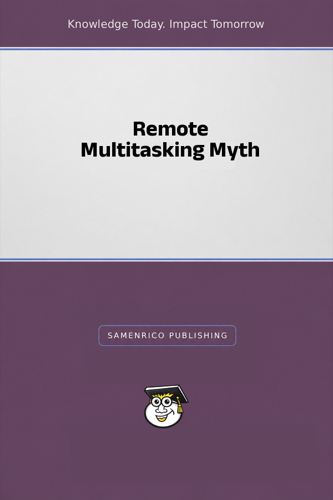
Non-FictionSelf-HelpMultitaskingFocus
Remote Multitasking Myth eBook
Stop task switching and focus on one thing at a ti
Stop task switching and focus on one thing at a time.
Formats
Free sample
Chapter 1: The Switching Cost--–- It begins with a ping. A soft, almost pleasant chime that arrives like a polite tap on the shoulder. You are writing an email—something important, something that requires your full attention. But the ping arrives, and before you have finished the sentence you were composing, your eyes have already drifted to the corner of the screen. Slack.
A colleague has asked a question. Nothing urgent. Nothing that could not wait twenty minutes. But the ping is there, and so is the tiny, invisible pressure to respond.You answer quickly. Thirty seconds.
Then you return to the email. But something has changed. The sentence you were writing feels foreign now. You read it again. Delete a word.
Add another. The flow is gone. What would have taken you four minutes to finish will now take eleven. And you will not remember the ping that started it all, because another ping will arrive soon, and another, and by the end of the day you will have switched tasks nearly three hundred times without ever deciding to do so.This is not a failure of willpower. It is not laziness, or poor time management, or a lack of discipline.
It is the architecture of your brain colliding with the architecture of modern remote work. And the collision is not neutral. It is expensive. Every time you switch, you pay a toll. Most remote workers pay that toll hundreds of times per day, and they never see the receipt.The myth of multitasking has been debunked in laboratories for decades, but it refuses to die because it feels true.
It feels efficient to answer a message while listening to a meeting. It feels productive to toggle between a spreadsheet and a chat window. But feelings are not data. And the data is clear: the human brain cannot process two streams of attention simultaneously. What we call multitasking is actually task-switching.
And task-switching carries a cost that is measurable, predictable, and devastating to deep work.This chapter is not about fixing the problem. That will come later. This chapter is about understanding the problem at its source: the neurological, cognitive, and physiological price of switching. You cannot solve what you refuse to measure. And you cannot measure what you refuse to see.The Anatomy of a Switch Let us begin with a simple experiment that you can conduct right now, without leaving this page.
Think of a number between one and ten. Hold it in your mind. Now think of a fruit that begins with the letter A. Now recall the number. Was it still there?
For most people, the number faded during the fruit search. That fleeting loss is a switch cost in miniature.In cognitive neuroscience, a task switch is defined as the act of disengaging from one mental context and engaging with another. The disengagement is not instantaneous. The brain must inhibit the previous task's rules, goals, and active memories. Then it must retrieve or reconstruct the new task's context.
Then it must reorient attention. Each of these sub-steps takes time—milliseconds, but milliseconds add up.The late psychologist and Nobel laureate Daniel Kahneman, in his landmark work Thinking, Fast and Slow, described two operating systems in the brain. System 1 is fast, automatic, and effortless. It recognizes faces, drives familiar routes, and answers two plus two. System 2 is slow, deliberate, and effortful.
It calculates complex math, evaluates arguments, and sustains concentration on a difficult problem.Task-switching always involves System 2. Even switching between two seemingly simple tasks—checking email and entering data—requires the deliberate system to disengage and re-engage. System 1 cannot handle the handoff. This is why you cannot truly multitask while driving, even if talking on the phone feels easy. The moment the conversation requires any cognitive effort, your driving suffers.
The data on this is so robust that hands-free phone use while driving is banned in many countries not because of the phone, but because of the switch.In the remote work environment, switches are not occasional. They are continuous. Each notification is a cue to disengage. Each open tab is an invitation to switch. And each switch, no matter how small, extracts a toll.The Three Components of Switch Cost Research stretching back to the 1990s, particularly the work of psychologists Joshua Rubinstein, David Meyer, and Jeffrey Evans at the University of Michigan, has broken switch cost into three measurable components.Time cost.
This is the most obvious. When you switch from Task A to Task B, you lose the time required to reorient. But the hidden loss is the time required to reorient back to Task A when you return. Studies using reaction-time tests show that even practiced switchers lose an average of 200 to 400 milliseconds per switch. That does not sound like much.
But multiply it by two hundred switches per day, and you have lost nearly two minutes to pure switching overhead. That is the visible cost. The invisible cost is larger.Accuracy cost. When you switch under pressure, you make more mistakes. A 2001 study published in the Journal of Experimental Psychology found that participants who switched between tasks made twice as many errors as those who completed the same tasks sequentially.
In a remote work context, this means the email you wrote while half-listening to a meeting contained a typo or a misunderstanding. The spreadsheet you updated while glancing at Slack contained a transposed number. The code you wrote while answering a quick question contained a bug. These errors are rarely attributed to switching. They are blamed on haste, or fatigue, or bad luck.
But they are switch costs.Working memory cost. This is the most insidious. Working memory is the brain's scratchpad—the limited space where you hold information temporarily while you use it. Switching flushes that scratchpad. Every time you leave a task, you lose the fragile context you had built.
The half-formed idea evaporates. The chain of reasoning breaks. The sentence you were about to write vanishes.This is why you return to an email and cannot remember what you meant to say. This is why you open a browser tab and forget why you opened it. The information was there a moment ago.
Then you switched. And it was gone.The Forty Percent Rule The most startling finding in switch-cost research comes from a 2005 study by Gloria Mark at the University of California, Irvine. Mark and her colleagues observed knowledge workers in their natural environments and measured how long they stayed on a task before switching. The average was three minutes. Three minutes.
They also measured how long it took to return to the original task at the same level of focus after an interruption. The average was twenty-three minutes.Let that sink in. A three-minute interruption costs twenty-three minutes of recovery time. This is not because people are lazy. It is because the brain does not return to a task instantly.
It must first disengage from the interruption, then re-establish the previous context, then overcome the inertia of the new distraction. The process is slow, effortful, and largely unconscious.Mark's research also revealed that interruptions do not need to be long to be damaging. Even a…
This is the end of the free sample. Get the eBook to keep going. Buy now
About this book
Details
- Author
- Leighton Tayna
- Publisher
- SamEnrico
- Language
- English
- Genre
- Non-Fiction, Self-Help, Multitasking, Focus
- Released
- 2026-06-07
- Pages (approx.)
- 125
- Available as
- eBook, Audiobook

Read better in the ZLOADR app
Your eBooks on your phone or tablet. Sign in with your SamEnrico account and start reading.
More by Leighton Tayna
 Say No Without Guilt WorkbookLeighton Tayna$11.99
 Mindfulness for EntrepreneursLeighton Tayna$11.99
 The Daily Artist Habit WorkbookLeighton Tayna$11.99
 Loneliness After DivorceLeighton Tayna$11.99
 The Blood and Glory of the 1494 Derby: Florence vs. Milan in the Age of Renaissance RivalryLeighton Tayna$11.99
 AMA for Pre Launch CommunityLeighton Tayna$12.99
 MOOC Certificate Stacking StrategyLeighton Tayna$12.99
 Learn to Play the Alto HornLeighton Tayna$11.99
 Asset Protection AgentLeighton Tayna$11.99
 How to Start a Pharmaceutical Society Business (Beginners Guide)Leighton Tayna$11.99
You may also like
 Hong Kong Handover 1997Dunn Johnnie$11.99
 Zumba For Postnatal Recovery CourseNeal Christian$11.99
 Zumba for BeginnersLadner Nikia$11.99
 YouTube Comment Mining GuideHumes Pandora$12.99
 Worry Box MeditationCarlin Rudy$11.99
 Workplace Stress MeditationNguyen Lynn$11.99
 Workplace Stress and Sleep RepairHawley Ivory$11.99
 Workplace Perfectionism CureDelaney Jeffry$11.99
 Workplace Injustice Anger GuideWallen Isabelle$11.99
 Work Addiction and Burnout LinkGreenwood Ester$11.99
 Women in Yoga and WellnessBeattie Galina$11.99
 Women in Stand Up ComedyChun Evangeline$11.99