
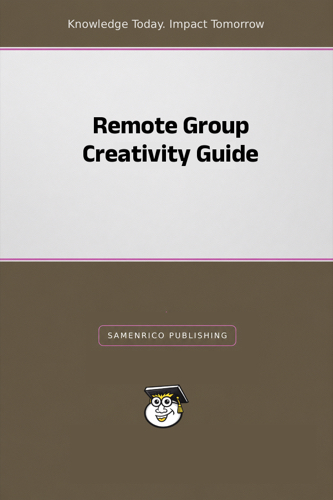
Remote Group Creativity Guide eBook
Foster innovation when team members work apart.
by Lord Caroll
Foster innovation when team members work apart.
Formats
Free sample
Chapter 1: The Proximity Trap--–- The email arrived at 9:47 AM on a Tuesday. “Effective immediately, all teams will return to the office three days per week. Creativity requires collision. The hallway conversations. The whiteboard sessions.
The magic of being together.” The CEO had signed it himself. Within hours, Slack channels erupted. Some celebrated. Most mourned. But one senior designer—we’ll call her Priya—did something unusual.
She opened a spreadsheet and started tracking something the CEO had never considered: every single creative idea her team had generated in the past twelve months, along with exactly where and when each idea had occurred.The results were inconvenient. Of the seventeen ideas that had moved to prototype, twelve had originated not in a conference room or a hallway, but in a text-based Slack thread that had unfolded over three days while three team members were in different time zones. Two more had come from a single asynchronous Loom video that a junior designer had recorded at 11 PM from her kitchen table. Only three had emerged from in-person meetings. The CEO had demanded a return to the office based on nostalgia, not evidence.
Priya’s spreadsheet was about to start a revolution.This book exists because Priya’s story is not an exception. It is the rule that most leaders have not yet discovered. The belief that proximity is the engine of creativity is the most expensive myth in modern work. It costs companies billions in real estate, drives attrition among top talent, and—most critically—it blinds leaders to the actual sources of innovation when team members work apart.The Proximity Trap is the cognitive bias that convinces us that people who are near each other will inevitably produce better ideas than people who are far apart. It feels true because creativity often looks chaotic in the moment—people gesturing at whiteboards, finishing each other’s sentences, leaning over laptops.
But what looks like magic is often something much more mundane: pattern matching, groupthink, and the dominance of whoever speaks first or loudest.This chapter is the diagnosis. Before we build the rituals, tools, and habits that unlock remote creativity—the rest of this book is dedicated to exactly that—we must first dismantle the false god of proximity. We must understand why the office whiteboard is a symbol not of collaboration but of captured attention. We must confront the hard truth that “accidental creativity” (the hallway conversation, the coffee machine run-in) is not a reliable engine for innovation; it is a lottery ticket. And we must reframe the entire conversation around a new principle: intentionality.Because here is the paradox that gives this book its title.
Distance destroys accidental creativity. But in doing so, it forces something far more valuable. It forces us to design for creativity. To be purposeful about who is invited, how ideas are captured, when silence is golden, and how decisions are made. A remote team that masters intentionality will consistently outperform a co-located team that relies on proximity as a crutch.
The evidence is already here. Most leaders just haven’t looked at the spreadsheet.The Invention of the Hallway Conversation Let us be honest about the mythology of office creativity. The story goes something like this: two employees bump into each other near the coffee machine. They chat about the weekend. One mentions a problem they have been wrestling with.
The other, who works in a completely different department, happens to have a solution from an unrelated project. By the end of the day, a breakthrough is born. This is the “watercooler moment.” It is the most romanticized image in corporate culture.And it does happen. Rarely. Approximately once every 347 coffee machine interactions, according to one organizational behavior study that actually attempted to measure this phenomenon.
The rest of the time, the hallway conversation produces gossip, status updates, or pleasant but inconsequential social bonding. Which is fine. Social bonding is valuable. But it is not innovation.The problem is that leaders have confused correlation with causation. They see that innovative companies often have lively offices.
They assume the office caused the innovation. In reality, innovative companies attract passionate people who would be innovative in a broom closet. The office is a stage, not a script.Consider the evidence from the past decade of distributed work. Automattic, the company behind Word Press, has been fully remote since 2005. They have acquired Tumblr, built a portfolio of products used by forty-three percent of the web, and consistently ranked as one of the most innovative companies in tech.
They have no headquarters. No hallways. No coffee machines. What they have instead is a meticulously designed system for asynchronous decision-making, a culture of written documentation, and a belief that creativity emerges from deep focus, not casual interruption.Or consider Git Lab, the all-remote developer platform that went public in 2021. Their handbook is over 10,000 pages long—not because they love bureaucracy, but because they have replaced every implicit assumption of the office with explicit, intentional process.
When a Git Lab employee has an idea, they do not wait for a hallway encounter. They open a merge request, tag the relevant stakeholders, and give everyone forty-eight hours to respond. The result is not slower innovation. It is more democratic, more traceable, and often faster than a meeting where three people talk and twelve listen.The proximity trap convinces us that we need the chaos of the office to be creative. But chaos is not creativity.
Chaos is chaos. Creativity is the structured collision of diverse perspectives, psychological safety, and time for incubation. All of those can be built remotely. Most of them are actively undermined by the open office floor plan, which is now widely understood by environmental psychologists to reduce productivity and increase stress.We have been sold a story. It is time to write a new one.Proximity Bias: The Invisible Tax on Distributed Teams Proximity bias is the systematic tendency to evaluate people who are physically closer to us as more competent, committed, and creative than people who are farther away.
It operates almost entirely beneath conscious awareness. A manager in a hybrid office will unconsciously assume that the employee three desks away—the one they see typing furiously—is working harder than the remote employee whose Slack status has been “away” for twelve minutes because they were refilling their water.But proximity bias is not merely unfair. It is counterproductive. Because the visible employee is not necessarily the more effective employee. They are simply the more visible employee.
The remote employee, freed from performative work, may be generating breakthrough ideas during their “away” time. But if those ideas never reach the manager because the manager assumes remote workers are less valuable, the entire organization loses.Let us examine the research. A 2021 study published in Nature examined the creative output of over 20,000 research scientists before and after their laboratories moved to fully remote operations during the pandemic. The researchers expected a decline in novel ideas. Instead, they found that the rate of truly novel scientific breakthroughs—ideas that were distinct from previous work—increased by thirty-three percent.
The explanation? Without the constant pressure of hallway interactions and spontaneous interruptions, scientists had more time for deep reading, reflection…
This is the end of the free sample. Get the eBook to keep going. Buy now
About this book
Details
- Author
- Lord Caroll
- Publisher
- SamEnrico
- Language
- English
- Genre
- Non-Fiction, Self-Help, Remote
- Released
- 2026-06-08
- Pages (approx.)
- 158
- Available as
- eBook, Audiobook

Read better in the ZLOADR app
Your eBooks on your phone or tablet. Sign in with your SamEnrico account and start reading.
More by Lord Caroll
 Dream Apocalypse LogLord Caroll$11.99
 Home Country Summer VisitsLord Caroll$11.99
 Micro Expressions GuideLord Caroll$11.99
 Calm Parenting Anger ManagementLord Caroll$11.99
 Stop Home Distractions GuideLord Caroll$11.99
 Small Talk for Quiet PeopleLord Caroll$11.99
 Progressive Overload GuideLord Caroll$11.99
 The Arsenic Kingpins: Poison, Profit, and the Fall of a Prohibition-Era EmpireLord Caroll$11.99
 David Hockney: Painting the Yorkshire Wolds - A Digital Revolution in Landscape ArtLord Caroll$11.99
 Tyrolite MiningLord Caroll$11.99
 How to Start a Costumes for Women and Girls Business (Beginners Guide)Lord Caroll$11.99
 How to Produce Office Supply ManualsLord Caroll$11.99
You may also like
 Hong Kong Handover 1997Dunn Johnnie$11.99
 Zumba For Postnatal Recovery CourseNeal Christian$11.99
 Zumba for BeginnersLadner Nikia$11.99
 YouTube Comment Mining GuideHumes Pandora$12.99
 Worry Box MeditationCarlin Rudy$11.99
 Workplace Stress MeditationNguyen Lynn$11.99
 Workplace Stress and Sleep RepairHawley Ivory$11.99
 Workplace Perfectionism CureDelaney Jeffry$11.99
 Workplace Injustice Anger GuideWallen Isabelle$11.99
 Work Addiction and Burnout LinkGreenwood Ester$11.99
 Women in Yoga and WellnessBeattie Galina$11.99
 Women in Stand Up ComedyChun Evangeline$11.99