
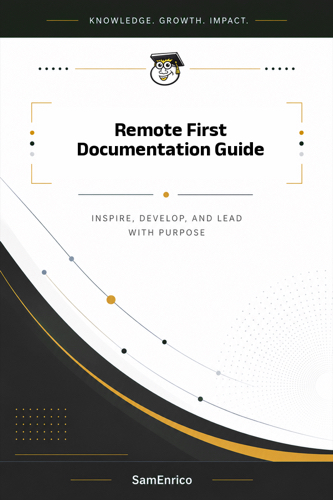
Remote First Documentation Guide eBook
Write clear processes and policies so remote worke
Write clear processes and policies so remote workers aren't left guessing.
Formats
Free sample
Chapter 1: The Watercooler Lie--–- The email arrived at 9:47 AM on a Tuesday. Sarah, a senior product manager at a fast-growing Saa S company, had just settled into her first deep work block of the day. She was three paragraphs into a product requirements doc when a Slack notification pinged. A junior designer in her remote-first team had a question: "Hey Sarah, quick one – what's the approval process for customer-facing copy again? I remember you mentioned something in the all-hands last week but I can't find the doc."Sarah sighed.
She had answered this exact question four times in the last two months. She typed back: "No worries – it's Legal first, then me, then CEO if it's pricing-related. I'll send you the link." She spent 90 seconds searching her own bookmarks, found the doc, pasted the link, and returned to her PRD. But the interruption had done its damage. It took her 23 minutes to fully re-engage with the document she had been writing.
By the time she found her flow again, another ping arrived.By Friday, Sarah had answered the same question three more times. She had spent 47 minutes that week repeating herself. Across the company, ten other managers were having the same experience. None of them realized that the accumulated cost of these "quick questions" was equivalent to a full-time employee's salary – spent entirely on saying the same words over and over.This is the watercooler lie. It is the false belief that asking verbally (or via Slack) is faster and more efficient than writing things down.
It is the hidden tax that remote teams pay every single day, and most don't even know they are paying it.The Myth of the Efficient Question The watercooler was never efficient. It was just familiar. In traditional office environments, walking to a colleague's desk to ask a question felt quick. The answer was immediate. The problem was solved in thirty seconds.
But this perception of efficiency is an illusion. It ignores three invisible costs that remote work magnifies dramatically.The first invisible cost is interruption recovery. Neuroscientists have known for decades that the human brain does not switch tasks seamlessly. When you are interrupted during a complex cognitive task – writing a strategy document, debugging code, analyzing data – it takes an average of 23 minutes and 15 seconds to return to your original level of focus. This is not laziness or lack of discipline; it is the biological reality of how attention works.
Every "quick question" is not thirty seconds of your time. It is thirty seconds plus twenty-three minutes of recovery. Multiply that by five interruptions per day, and you have lost nearly two hours of productive capacity to what felt like five minutes of answering.The second invisible cost is the repetition tax. When information lives in people's heads instead of documents, the same question gets answered by the same person multiple times. Sarah's 47 minutes of repetition in a single week is not an outlier.
A study of remote teams found that the average manager spends 4.3 hours per week answering questions they have answered before. At a fully burdened cost of $80 per hour, that is $344 per week, $17,888 per year, per manager. For a company with twenty managers, that is over $350,000 annually – enough to hire three additional employees.The third invisible cost is the silent attrition. The most expensive questions are the ones that never get asked. When documentation is missing or untrustworthy, employees – especially new hires, introverts, and those in non-dominant time zones – simply stop asking.
They guess. They assume. They work around. And sometimes, they make costly mistakes. A developer who cannot find the deployment checklist invents their own steps and accidentally pushes unapproved code to production.
A customer support agent who cannot find the refund policy invents their own threshold and gives away $500 instead of $50. A new hire who cannot find the expense policy submits a receipt incorrectly and waits six weeks for reimbursement, then quietly updates their resume.These costs are invisible because they never show up as a line item on a budget. But they are real. And they are avoidable.The Asynchronous Mindset: A Definition The asynchronous mindset is the recognition that writing things down is not a cost – it is an investment. It is the discipline of asking, "Where will this answer live permanently?" before answering any question.
It is the commitment to creating documentation that serves not just the person asking, but everyone who will ask in the future.This mindset is not natural. It is learned. Human beings are wired for synchronous communication. For most of our evolutionary history, the fastest way to share information was to speak it. Writing was slow, laborious, and limited to specialists.
But remote work has inverted this calculus. In a distributed team, the person asking a question may be in a different time zone, awake while you sleep. The colleague who needs the answer next week may not even be hired yet. Synchronous communication – talking, pinging, calling – is now the slow option because it requires two people to be present at the same time. Asynchronous communication – writing, recording, documenting – is the fast option because it works while you sleep.The asynchronous mindset requires a shift in three specific behaviors.First, default to writing.
When someone asks you a question verbally or via Slack, your first instinct should not be to answer. It should be to ask: "Is this answer already written somewhere?" If yes, send the link. If no, write the answer in a permanent location first, then send the link. This feels slower in the moment because it adds thirty seconds of writing. But it saves minutes or hours in the future because you will never answer that question again.Second, distrust memory.
Your memory is not a reliable database. What you remember today you may forget tomorrow. What is clear to you now may be ambiguous to someone else. Every time you rely on memory instead of documentation, you are betting that you will never be interrupted, never get sick, never go on vacation, never leave the company. That is a bad bet.
Documentation is not about distrusting people; it is about respecting that people have limits.Third, treat every question as a signal. When someone asks you something that feels obvious or repetitive, resist the urge to feel annoyed. Instead, feel grateful. They have just identified a gap in your documentation. Each question is a free audit of your knowledge base.
The Two-Question Rule – which will appear throughout this book – is the simplest diagnostic tool: if a question is asked twice, the answer belongs in a doc. Not "maybe." Not "if we have time." It belongs in a doc, period.Living Documentation: What It Is and What It Is Not In many books about knowledge management, you will encounter the term "evergreen documentation" – the idea that content can be created once and remain useful forever. This concept is a well-intentioned lie. No document remains accurate forever. Processes change.
Tools change. People change. A document that is not maintained is not evergreen; it is a fossil. And fossils mislead.This book uses the term Living Documentation instead. Living Documentation acknowledges three truths that evergreen documentation ignores.First truth: all…
This is the end of the free sample. Get the eBook to keep going. Buy now
About this book
Details
- Author
- Levin Marquis
- Publisher
- SamEnrico
- Language
- English
- Genre
- Non-Fiction, Business Brief, Documentation
- Released
- 2026-06-06
- Pages (approx.)
- 136
- Available as
- eBook, Audiobook

Read better in the ZLOADR app
Your eBooks on your phone or tablet. Sign in with your SamEnrico account and start reading.
More by Levin Marquis
 Franciscan Friars First Rule WorkbookLevin Marquis$11.99
 Financial Enabling Recovery CourseLevin Marquis$11.99
 NVC Guilt Shame HealingLevin Marquis$11.99
 Boundary Violation Recovery GuideLevin Marquis$11.99
 The Unseen Heroes: How Ordinary People Built the InternetLevin Marquis$11.99
 Jaguar’s Whisper: The Secret Language of the Olmec Colossal HeadsLevin Marquis$11.99
 Hybrid Black Poplar HarvestingLevin Marquis$11.99
 Understanding Epidermolysis Bullosa Dystrophica, Bart TypeLevin Marquis$17.99
 How to Start a Automobile Association Touring Department Business (Beginners Guide)Levin Marquis$11.99
 Harvard Extension Career ImpactLevin Marquis$12.99
 Nomador House Sitting GuideLevin Marquis$12.99
You may also like
 Remote Retreats Documentation GuideCoughlin Talia$11.99
 Meeting Notes SystemFaber Elenore$11.99
 Meeting Minutes Template HandbookValerio Christena$11.99
 Meeting Minutes One PagerTurley Shirlene$11.99
 Legal Documentation for Cross BorderSchindler Estella$12.99
 Bank API Documentation ReadingBush Tammy$12.99
 Proof of Payment GuideLord Caroll$12.99
 Export Documentation for Shea CoffeeDeleon Suzann$12.99