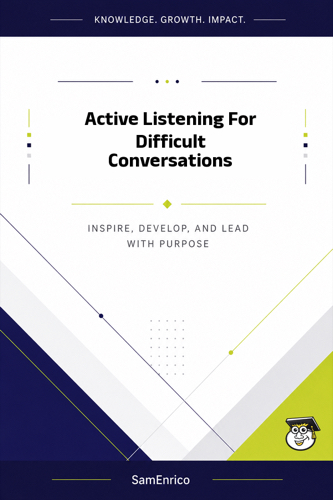
Remote Difficult Conversations eBook
Handle layoffs and sensitive topics virtually usin
by Barbee Alva
Handle layoffs and sensitive topics virtually using this practical guide.
Formats
Free sample
Chapter 1: The Coward's Zoom...--–- The first time Sarah cried at work, she was not being fired. She was doing the firing.The year was 2021. Sarah was a vice president of marketing at a fast-growing tech startup that had raised a Series B round eighteen months earlier, hired aggressively, and was now, like hundreds of other companies, facing the brutal arithmetic of a market correction. Her boss, the CEO, had given her a list of seven names. Her people.
People she had recruited, mentored, celebrated birthdays with over blurry Zoom cocktails, and watched struggle through the isolation of remote work."You need to tell them today," the CEO had said. "And do it over video. We don't want anyone driving while getting this news."Sarah nodded. She closed the door to her home office. She opened her calendar and typed seven invites.
Subject line: "Quick check-in." Duration: 15 minutes. She did not write anything else. She did not want to alarm them.The first call was with Marcus, her marketing director of four years. Marcus had moved across the country during the pandemic to be closer to his aging parents. He had bought a house.
He had a three-year-old daughter who sometimes wandered into his frame during meetings, and Sarah had always thought it was charming.The call started. Sarah smiled. "Hey Marcus, how was your weekend?"Marcus said it was good. They talked about his daughter's new bike for forty-five seconds. Then Sarah's face changed.
She looked down at her notes. She said, "So, things are changing, and your role is impacted."Marcus went silent. His face did not move. Sarah, panicked by the silence, kept talking. She talked about restructuring.
She talked about market conditions. She talked for what felt like an eternity but was actually ninety seconds. Then she said, "HR will send you an email with next steps," and she ended the call.She did not turn her camera off during the call because it had never been on. She had hidden behind a dark screen, speaking into a void, because she was terrified that if Marcus saw her face, he would see that she was crying.Marcus sat in his home office, staring at a blank screen. He had no idea what had just happened.
"Your role is impacted" could mean anything. Was he laid off? Demoted? Put on probation? He did not know.
He assumed the worst—that he was being fired for performance—because Sarah had never said otherwise. He spent the next six months unemployed, depressed, and telling everyone who would listen that Sarah was a coward.Sarah spent the next six months avoiding Marcus's name, feeling sick every time she saw his face on an old team photo, and wondering if there was a better way.There was. She just did not know it yet.This book is for the Sarahs of the world. Not to make you feel guilty—you are reading this book, which means you already care more than most. But to give you a better way.
A way to deliver devastating news remotely and have the other person say, years later, "That was handled with dignity."It starts with understanding why the screen changes everything.The Amplification Effect Let us name the problem before we solve it.A "crucial conversation"—a term popularized by the bestselling authors of Crucial Conversations—has three defining characteristics: high stakes, strong emotions, and differing opinions. In person, these conversations are hard enough. You can read body language. You can reach out and touch a shoulder (if appropriate). You can sit in silence together without the silence feeling like a technical glitch.Remote, these conversations are not merely transferred.
They are transformed. The screen acts as an amplifier of existing tensions.Consider what happens when you cannot see a full range of body language. Your brain, which evolved to read faces and postures in physical space, suddenly has incomplete data. What does it do? It fills in the gaps with worst-case assumptions.
A neutral pause becomes "they don't care." A delayed response becomes "they're lying." A sideways glance at a second monitor becomes "they're not paying attention."This is not a character flaw. It is biology. Your brain is trying to protect you from threat, and in the absence of complete information, it defaults to the most threatening interpretation.Researchers have studied this phenomenon extensively. In a 2021 study published in the Journal of Applied Psychology, participants who had difficult conversations over video reported significantly higher levels of anxiety and perceived hostility than those who had the same conversations in person. The reason was not the content of the conversation—it was the medium.
The screen stripped away the subtle cues that signal safety: a slight head tilt, a softening of the eyes, a shared breath.This is the first thing you must understand: when you deliver difficult news over video, you are not just having a hard conversation. You are having a hard conversation with one hand tied behind your back.The Empathy Gap The second thing you must understand is what this book calls the Empathy Gap.Empathy—the ability to understand and share the feelings of another—is not just an emotional skill. It is a biological process. When you are in physical proximity to another person, your brain releases oxytocin, sometimes called the "bonding hormone." Oxytocin reduces your brain's threat response and increases your ability to feel what another person is feeling.Physical proximity also triggers mirror neurons—brain cells that fire both when you perform an action and when you observe someone else performing that action. When you see someone cry, your mirror neurons fire as if you were crying.
When you see someone flinch, you feel a ghost of that flinch.Remote, these mechanisms are weakened. Your brain releases less oxytocin. Your mirror neurons have less to work with. The result is a measurable reduction in prosocial behavior—a tendency to be colder, more abrupt, and less compassionate than you would be in person.This is not an excuse for cruelty. It is a warning.
The Empathy Gap means you have to work harder to be as kind as you intend to be.Here is the evidence. A 2019 study from the University of Michigan analyzed thousands of performance reviews and found that managers were 37 percent more likely to use harsh or critical language in written feedback than in face-to-face feedback. Another study, this one from Stanford, found that negotiators who communicated via video were 22 percent more likely to reach an impasse than those who negotiated in person—not because the content changed, but because the negotiators on video perceived each other as less trustworthy.The Empathy Gap is particularly dangerous during layoffs. When you cannot see the full weight of what you are doing to another human being, it becomes easier to dehumanize them. To think of them as a line item on a budget rather than a person with a mortgage, a child, a dream.The most infamous example of this dehumanization is the Better.com scandal, which we will dissect in detail in Chapter 10.
But for now, know this: the CEO who fired 900 people on a three-minute Zoom call did not wake up…
This is the end of the free sample. Get the eBook to keep going. Buy now
About this book
Details
- Author
- Barbee Alva
- Publisher
- SamEnrico
- Language
- English
- Genre
- Non-Fiction, Self-Help, Difficult Talks
- Released
- 2026-06-06
- Pages (approx.)
- 148
- Available as
- eBook, Audiobook

Read better in the ZLOADR app
Your eBooks on your phone or tablet. Sign in with your SamEnrico account and start reading.
More by Barbee Alva
 BPH versus Prostate CancerBarbee Alva$11.99
 Body Scan for Cancer FatigueBarbee Alva$11.99
 Carson Ocean Warning RevivalBarbee Alva$11.99
 Notarization of DocumentsBarbee Alva$11.99
 Creative Confidence for MarketersBarbee Alva$11.99
 In The Heights BlockBarbee Alva$11.99
 The 2016 Cubs: Breaking the Curse of the Billy GoatBarbee Alva$11.99
 The Last Stand of the Ainu: A Forgotten ResistanceBarbee Alva$11.99
 How to Produce Other Electrical EquipmentBarbee Alva$11.99
 How to Produce Combs and BrushesBarbee Alva$11.99
 Anatolian Shepherd Dogs: Guardian of FlocksBarbee Alva$11.99
 NYC Pop Up Retail PrimerBarbee Alva$12.99