
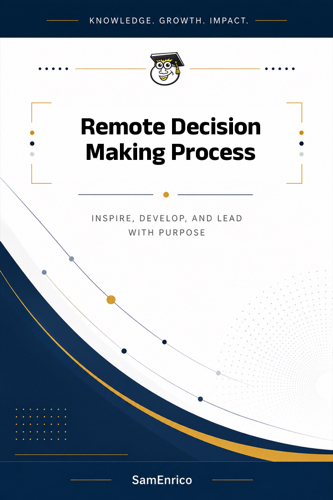
Non-FictionSelf-HelpDecision Making
Remote Decision Making Process eBook
Use async voting and documentation to reach consen
Use async voting and documentation to reach consensus without endless meetings.
Formats
Free sample
Chapter 1: The Meeting Hangover–- Sarah Chen had been staring at her calendar for exactly four minutes and seventeen seconds when she realized something had gone terribly wrong. It was Monday, 8:47 AM. Her calendar showed thirty-one meetings scheduled for the week ahead. Thirty-one. That was not a typo.
She scrolled. Monday: back-to-back from 9 AM to 6 PM with a thirty-minute “lunch break” that was actually a working lunch. Tuesday: slightly better, only six meetings, but one of them was a three-hour “strategic alignment workshop.” Wednesday: eight meetings, including a 4 PM call with London that would keep her online until 7 PM her time. Thursday: a merciful five meetings, but two of them were with the same eight people discussing the same agenda they had discussed the previous Thursday. Friday: seven meetings, culminating in a 3 PM “weekly wrap-up” that everyone knew would run until at least 5:30.Thirty-one meetings.
Average duration: fifty-two minutes. Total meeting hours: twenty-seven. Sarah worked a forty-hour week. Sixty-seven percent of her time would be spent in meetings. And what had she actually decided in last week’s thirty-two meetings?
She struggled to remember. The budget reallocation? That had been kicked to “next quarter.” The vendor selection? Still pending more data. The product roadmap?
They had agreed to “circle back” after the “offline conversation” that never happened.Sarah closed her laptop, walked to the bathroom, locked the door, and sat on the floor. She was not crying. She was calculating. Twenty-seven hours of meetings. Twelve people on her team.
Average fully-loaded cost per person: $120,000 per year, or roughly $60 per hour. Twenty-seven hours times twelve people times $60 equaled $19,440. Her team would spend nearly twenty thousand dollars this week on meetings. And for that twenty thousand dollars, what would they produce? A few shared documents.
A lot of nodding. Several “great point, let’s table that” deferrals. And exactly zero decisions that could not have been made in writing.Sarah had become the thing she never wanted to be: a professional meeting attendee. She had not been hired to sit in rooms (virtual or physical) and watch other people talk. She had been hired to solve problems, build products, and lead a team.
But somewhere between her promotion and the present day, the meetings had metastasized. One meeting begat another. The weekly status meeting created a follow-up meeting. The follow-up meeting created a “pre-read” meeting to prepare for the next weekly status meeting. The organization had become a machine that consumed time and produced exhaustion.This chapter is for everyone who has ever looked at their calendar and felt a quiet sense of dread.
It is for the manager who spends their evenings doing the actual work that was supposed to get done during the day. It is for the individual contributor who has learned to keep their camera off during the eleventh meeting of the week so they can finally respond to the emails that piled up while they were listening to someone read slides. And it is for the executive who has begun to suspect that the organization’s most expensive line item is not software or office space or travel—it is the time wasted in meetings that decide nothing.Because here is the uncomfortable truth that the meeting-industrial complex does not want you to understand: most meetings do not make decisions. They simulate decision-making. They create the appearance of progress without the substance.
And the cost of this simulation is far higher than anyone admits.The Hidden Math of the Meeting Economy Let us begin with a simple exercise. Take out your calendar right now—the actual calendar, not the idealized version in your head. Count how many meetings you attended in the past five working days. Be honest. Include the ones that ran over.
Include the ones where you were only there for the last fifteen minutes. Include the “quick syncs” that were not on your calendar but happened anyway.Got the number? Multiply it by the average number of people in those meetings. Now multiply by your organization’s average fully-loaded hourly cost (salary plus benefits, office space, software, recruiting amortization, and management overhead—a conservative rule of thumb is to add forty percent to base salary). That number is what your organization spent last week on meetings.
If you work at a company of one hundred people and each person attends an average of fifteen meetings per week with eight attendees each, your organization is spending over three million dollars per year on meetings. Not on the work that happens after meetings. On the meetings themselves.Sarah’s twenty-seven-hour week was not unusual. Research from Harvard Business Review, based on a study of over seventy thousand knowledge workers, found that the average manager spends twenty-three hours per week in meetings. That number has increased by nearly fifty percent since 2020.
And here is the kicker: the same study found that only nine percent of meeting time is spent on actual decision-making. The other ninety-one percent is status updates, performative agreement, silent document-reading, technical troubleshooting, social bonding, and the unique form of psychological torture known as “watching someone share their screen while they slowly scroll through an email inbox.”Let us break down that twenty-three-hour week. Ninety-one percent of twenty-three hours is approximately twenty-one hours. Nine percent is two hours. The average manager spends twenty-one hours per week in meetings that do not produce decisions, and two hours in meetings that do.
And because of how meetings are scheduled—back-to-back, with no time for reflection—those two decision-making hours are often the least effective two hours of the week, occurring when everyone is already exhausted and eager to leave.This is the hidden math. The meeting economy has a productivity tax that no one tracks and no one audits. It is the largest unmanaged expense in most organizations.The Context-Switching Catastrophe But the cost of meetings is not only measured in hours. It is measured in the destruction of cognitive continuity. Every time a meeting interrupts a block of focused work, the brain does not simply pause and resume.
It performs a complex and expensive operation called context-switching, and the recovery time is brutal.The most cited research on this topic comes from the University of California, Irvine, where computer scientist Gloria Mark spent years studying how knowledge workers actually spend their time. Her findings are devastating for the meeting-heavy organization. After a typical interruption—a Slack message, an email notification, or a meeting invitation—it takes an average of twenty-three minutes and fifteen seconds to return to the original task at the same level of focus. Not fifteen minutes. Not “a few minutes.” Twenty-three minutes and fifteen seconds.Now apply that to Sarah’s week of thirty-one meetings.
Even if each meeting was perfectly scheduled with no overlap, the context-switching cost of shifting from work to meeting to work again would add approximately 713 minutes—nearly twelve hours—of recovery time. Her forty-hour week, in real cognitive terms, was actually a fifty-two-hour week. She was working the equivalent of an extra day and a half just to recover from the interruptions caused by her calendar.This is why so many knowledge workers report feeling exhausted despite “only” working eight…
This is the end of the free sample. Get the eBook to keep going. Buy now
About this book
Details
- Author
- Valencia Marnie
- Publisher
- SamEnrico
- Language
- English
- Genre
- Non-Fiction, Self-Help, Decision Making
- Released
- 2026-06-09
- Pages (approx.)
- 159
- Available as
- eBook, Audiobook

Read better in the ZLOADR app
Your eBooks on your phone or tablet. Sign in with your SamEnrico account and start reading.
More by Valencia Marnie
 Masturbation Compulsion Recovery GuideValencia Marnie$11.99
 Exercise Induced Menstrual ChangesValencia Marnie$11.99
 The MBSR for Cancer SupportValencia Marnie$11.99
 The Unseen Brushstrokes: How Yayoi Kusama Defied the Art World with Dots and InfinityValencia Marnie$11.99
 Dream Rehearsal for Insomnia PTSDValencia Marnie$11.99
 Pixel Pioneers: The Untold Battle of the 8-Bit RevolutionValencia Marnie$11.99
 Understanding Hecht–Scott SyndromeValencia Marnie$17.99
 Student Visa Success For Dubai GuideValencia Marnie$12.99
 Africa Renewable Energy OutlookValencia Marnie$12.99
 CuratorValencia Marnie$11.99
 How to Start a Ceiling Coverings Made of Plastic Business (Beginners Guide)Valencia Marnie$11.99
You may also like
 Hong Kong Handover 1997Dunn Johnnie$11.99
 Zumba For Postnatal Recovery CourseNeal Christian$11.99
 Zumba for BeginnersLadner Nikia$11.99
 YouTube Comment Mining GuideHumes Pandora$12.99
 Worry Box MeditationCarlin Rudy$11.99
 Workplace Stress MeditationNguyen Lynn$11.99
 Workplace Stress and Sleep RepairHawley Ivory$11.99
 Workplace Perfectionism CureDelaney Jeffry$11.99
 Workplace Injustice Anger GuideWallen Isabelle$11.99
 Work Addiction and Burnout LinkGreenwood Ester$11.99
 Women in Yoga and WellnessBeattie Galina$11.99
 Women in Stand Up ComedyChun Evangeline$11.99