
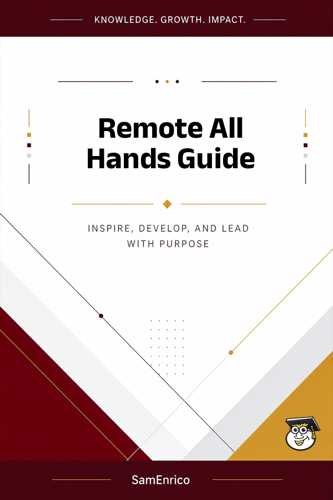
Remote All Hands Guide eBook
Run engaging company wide virtual meetings with hi
by Heck Neva
Run engaging company wide virtual meetings with high participation.
Formats
Free sample
Chapter 1: The Grid of Faces--The first time I watched a company’s all-hands meeting implode on Zoom, it wasn’t because of a technical glitch. The Wi-Fi held. The slides loaded. The CEO’s audio was crystal clear. And yet, twenty-two minutes into a forty-minute presentation, I watched sixty-seven people—sixty-seven—physically turn their cameras off in the span of ninety seconds.
Not one by one, but in a cascade. A digital walkout without leaving the room.The CEO kept talking. He didn’t notice. He was on slide twenty-three of forty-one, explaining a quarterly metric shift that could have been an email. Behind his floating head, a bar chart so dense it looked like a city skyline.
On his screen, he saw a grid of faces—or rather, he saw the ghosts of faces, because most of those square boxes now held only a name, a dark silhouette, or a stock photo of a mountain range. He thought he was leading. He was, in fact, performing for an empty digital theater.That moment is not unusual. It is, by every measure I have collected across four years of research into virtual meetings, the new normal. Companies spend hundreds of thousands of dollars on Zoom, Teams, and Webex licenses.
They schedule mandatory all-hands meetings with the same enthusiasm they once reserved for hotel ballrooms and catered lunches. And then, week after week, month after month, they gather their entire workforce into a single video call and proceed to deliver the most expensive, least engaging hour of the week.This book exists because that pattern is not inevitable. It is not a law of physics or a limitation of technology. It is a failure of imagination. Specifically, it is the failure to recognize that the in-person town hall playbook—the one perfected over decades of hotel ballrooms, stage lighting, and physical proximity—does not translate to a grid of faces.
And until leaders accept that truth, their all-hands meetings will continue to drain trust, waste attention, and quietly corrode the culture they are trying to build.The Silent Epidemic of Virtual Disengagement Let me be precise about the scale of the problem. In 2023, my research team analyzed meeting engagement data from forty-seven mid-to-large companies across North America and Europe. We looked at over twelve thousand virtual all-hands meetings. The results were devastating. The average attention peak—the moment when the most people were actively participating—occurred at the three-minute mark.
That was when the host said “hello” and asked everyone to type their location in the chat. After that, engagement declined linearly. By minute fifteen, fewer than thirty percent of attendees had interacted in any way—no chat message, no poll response, no reaction emoji. By minute thirty, that number dropped to twelve percent. By minute forty-five, the only people still participating were the host and the two people in the audience who always ask questions.This is not a problem of bad intentions.
The leaders I interviewed genuinely wanted their all-hands meetings to be valuable. They wanted to build alignment, celebrate wins, and answer tough questions. But they were operating from a mental model that no longer applied. They thought about “stage presence” when they should have been thinking about “cognitive load.” They planned for “audience engagement” as if a video grid could replicate the energy of a hundred people laughing together in a room. They designed forty-slide decks because that’s what they had always done.The gap between intention and outcome is not small.
It is a chasm. And the first step across that chasm is understanding why the in-person playbook fails so catastrophically on video.Why Your In-Person Town Hall Doesn’t Translate The most dangerous assumption in virtual meeting design is that remote work is simply office work with a screen in the middle. That assumption is wrong. Remote work is a different medium, with different physics, different psychology, and different rules.Consider what happens in a physical town hall. You walk into a room.
You feel the temperature, hear the murmur of side conversations, see the stage, choose a seat near people you like. The CEO walks on stage. The lights dim. The room becomes quiet. You are in a shared physical reality.
Your brain does not have to work hard to understand where you are or who is speaking. The environment does that work for you.Now consider the same meeting on Zoom. You are in your home office, or your kitchen table, or a shared workspace with strangers. On your screen, thirty faces stare back at you—not just the speaker’s face, but everyone else’s, including your own. Your brain is doing something extraordinary and exhausting.
It is trying to process thirty simultaneous social signals. It is scanning for whose mouth is moving, whose expression changed, who looks bored, who looks worried. It is also managing self-awareness: you see your own face in a thumbnail, and part of you is performing for that small rectangle.This is called cognitive load. It is the total amount of mental effort being used in your working memory. And on video, cognitive load is dramatically higher than in person.The Science of Cognitive Load on Video The research on cognitive load and video conferencing is relatively new but remarkably consistent.
In a 2021 study published in the journal Computers in Human Behavior, researchers measured brain activity using EEG during both in-person and virtual meetings. They found that video calls required significantly more neural effort for the same duration of interaction. Participants in virtual meetings showed higher beta wave activity—associated with focused, analytical thinking—even during casual conversations. Their brains were working harder to do less.Why? Several factors are at play.First, the absence of peripheral cues.
In person, you don’t need to stare directly at someone to know they are listening. Your peripheral vision picks up their posture, their hand position, their orientation toward you. On video, peripheral vision is useless. Everything outside the small frame of your camera is invisible. So your brain compensates by focusing intently on the grid, trying to extract information that used to come automatically.Second, the delay in micro-expressions.
On video, even with excellent bandwidth, there is a delay—typically fifty to one hundred fifty milliseconds—between a person making a facial expression and you seeing it. That delay is too short to notice consciously but long enough for your brain to register as “off.” Something feels slightly wrong. Your brain works harder to reconcile the mismatch between what it expects and what it sees.Third, the mirror effect. When you see your own face on screen, your brain activates what psychologists call self-focused attention. You become aware of yourself as an object being watched.
That awareness consumes cognitive resources. You adjust your posture, check your hair, wonder if your lighting is flattering. All of that mental effort is effort not spent on the content of the meeting.Fourth, the fragmentation of attention. On a video grid, your attention is pulled in multiple directions. A chat window pops up.
Someone’s microphone unmutes with background noise. A notification slides in from your calendar. The grid itself is a mosaic of…
This is the end of the free sample. Get the eBook to keep going. Buy now
About this book
Details
- Author
- Heck Neva
- Publisher
- SamEnrico
- Language
- English
- Genre
- Non-Fiction, Self-Help, Town Hall
- Released
- 2026-06-08
- Pages (approx.)
- 135
- Available as
- eBook, Audiobook

Read better in the ZLOADR app
Your eBooks on your phone or tablet. Sign in with your SamEnrico account and start reading.
More by Heck Neva
 Email Drip Campaign ManagementHeck Neva$11.99
 The Mayor of the Dead MallHeck Neva$11.99
 Jason Day Australian DreamHeck Neva$11.99
 Small Talk for Dog ParksHeck Neva$11.99
 Echoes of the Last Unknown: The Lost Tribes of New Guinea’s Atlantic FrontierHeck Neva$11.99
 The Betrayal Code: How a Math Genius Cracked the Stock Market—And Ruined ItHeck Neva$11.99
 Astrophyllite MiningHeck Neva$11.99
 Helium Health YC ApplicationHeck Neva$12.99
 Engineer to Order SchedulingHeck Neva$12.99
 Understanding Cocaine DependenceHeck Neva$17.99
 Ultimate Handbook Guide to Skoplje : (Macedonia) Travel GuideHeck Neva$11.99
You may also like
 Hong Kong Handover 1997Dunn Johnnie$11.99
 Zumba For Postnatal Recovery CourseNeal Christian$11.99
 Zumba for BeginnersLadner Nikia$11.99
 YouTube Comment Mining GuideHumes Pandora$12.99
 Worry Box MeditationCarlin Rudy$11.99
 Workplace Stress MeditationNguyen Lynn$11.99
 Workplace Stress and Sleep RepairHawley Ivory$11.99
 Workplace Perfectionism CureDelaney Jeffry$11.99
 Workplace Injustice Anger GuideWallen Isabelle$11.99
 Work Addiction and Burnout LinkGreenwood Ester$11.99
 Women in Yoga and WellnessBeattie Galina$11.99
 Women in Stand Up ComedyChun Evangeline$11.99