
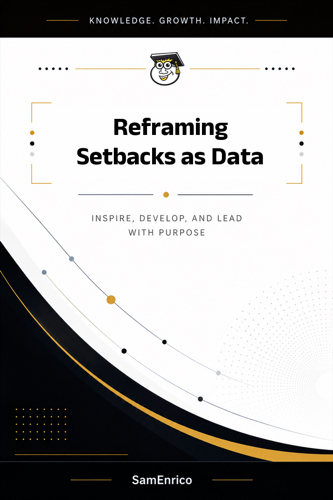
Reframing Setbacks as Data eBook
View disappointments as information not personal f
View disappointments as information not personal failures.
Formats
Free sample
Chapter 1: The Feedback Illusion--–- You are driving home from work when the check engine light illuminates on your dashboard. What do you do? If you are like most people, you experience a flash of annoyance, perhaps a flicker of anxiety about cost and inconvenience. But you do not, under any circumstances, conclude that you are a bad person. You do not spiral into an identity crisis.
You do not spend the next three hours replaying every decision you have ever made about car maintenance. You simply note the light, make a mental note to check the manual, and schedule a diagnostic appointment. The light is information. It is data. It is not a verdict on your character.Now imagine a different scenario.
You submit a proposal at work and your boss responds with critical feedback. Or you ask someone on a date and they decline. Or you apply for a position and receive a rejection letter. In these moments, something fundamentally different happens inside your nervous system. The check engine light becomes a trial.
The data becomes a judgment. The event becomes an identity.This book is about closing that gap. It is about learning to treat the disappointments of life the way you already treat the warning lights on your dashboard: as information, not as identity. It is about becoming the kind of person who, in the moments that matter most, can say: "This is not a verdict. This is data.
What does it tell me?"The problem is not that you are weak or fragile or incapable of handling criticism. The problem is that your brain was not designed for the world you are asking it to navigate. Your neurobiology evolved to treat social rejection as a survival threat, to interpret uncertainty as danger, and to conflate failure with exclusion from the tribe. In the ancestral environment, these were the same thing. If the tribe rejected you, you died.
If you failed at a critical task, the group suffered. Your brain never evolved a clean distinction between "I did something wrong" and "I am wrong."That distinction is the single most important skill you can develop. Without it, every setback becomes an indictment. With it, every setback becomes a lesson. This chapter introduces the foundational practice of this book: separating the event from the story, the data from the verdict, the setback from the self.The Neurobiology of Being Wrong Let us begin with a simple fact: your brain cannot tell the difference between failing a math test and being chased by a tiger.
Not really. Not at the level of the threat-detection system that evolved over millions of years.The amygdala, a small almond-shaped cluster of nuclei deep in the temporal lobe, functions as the brain's smoke detector. It scans the environment for potential threats and activates the fight-or-flight response when it detects something dangerous. The remarkable thing about the amygdala is that it operates before conscious awareness. You do not decide to feel threatened.
You feel threatened, and then your conscious mind catches up, inventing a story to explain why.Here is what decades of neuroscience research have demonstrated: the amygdala activates to social threats—rejection, criticism, public embarrassment—with the same intensity and speed as it activates to physical threats. A study by Eisenberger and Lieberman at UCLA showed that the dorsal anterior cingulate cortex, the region associated with the distressing aspect of physical pain, activates when people experience social exclusion. Being left out of a game of cyberball—a meaningless computer game where a virtual ball is tossed between avatars—produces neural activity indistinguishable from the experience of physical injury.This is not a metaphor. Your brain processes social failure as physical pain.Now consider the implications. When your boss criticizes your work, your brain does not calmly register "helpful feedback for improvement." It registers a threat.
When your partner expresses disappointment, your brain does not process "data about preferences and expectations." It processes potential exclusion from a critical attachment relationship. When you make a mistake in front of colleagues, your brain does not think "opportunity to learn." It thinks "danger."This is the first thing you need to understand: your immediate response to failure is not a character flaw. It is not a lack of resilience or a sign of weakness. It is your neurobiology doing exactly what it evolved to do. The problem is that the world has changed faster than your brain can evolve.
You are using a survival system designed for the savanna to navigate performance reviews, dating apps, and quarterly earnings reports.The good news is that you are not trapped by your biology. Awareness of the mechanism is the first step to overriding it. You cannot prevent the amygdala from activating—that is automatic. But you can learn to recognize the activation, pause before responding, and refuse to accept the default narrative that your brain is offering you.The Story Problem Here is what happens in the milliseconds after a setback. Your brain registers the event—the critical email, the declined invitation, the failed presentation—and immediately begins constructing a story to make sense of it.
This story is not optional. The brain abhors a vacuum of meaning. When something unexpected happens, the interpretive machinery kicks in automatically, weaving sensory data into a coherent narrative.The problem is not that you tell stories. The problem is that you forget that you are telling stories. The narrative becomes transparent.
You look at the event and see not your interpretation of it but the event itself. The story becomes reality.Consider the difference between these two descriptions of the same event:Description A: "I submitted the proposal late. The client chose another vendor."Description B: "I am lazy and unprofessional. I always ruin everything. The client rejected me because I am not good enough."The first description contains observable facts.
The second contains interpretations, generalizations, identity claims, and predictions about the future. But here is the crucial insight: in the moment, Description B does not feel like interpretation. It feels like truth. It feels like you are simply seeing reality clearly for the first time.This is what cognitive psychologists call "naive realism"—the belief that you see the world as it really is, without distortion or bias. Naive realism is why two people can witness the same event and describe it in completely different ways, each convinced that the other is either lying or delusional.
Your brain does not experience its own interpretations as interpretations. It experiences them as perceptions.The gap between event and story is where this entire book lives. Learning to see that gap—to notice the split second between what happened and what you are telling yourself about what happened—is the foundational skill of setback mastery. Without it, you are at the mercy of every automatic interpretation your brain generates. With it, you become capable of choosing your response rather than merely reacting.The Two-Column Exercise Let us make this concrete.
The most important tool in this chapter is also the simplest. It requires nothing more than a piece of paper and a pen. I call it the Two-Column Exercise, and it is…
This is the end of the free sample. Get the eBook to keep going. Buy now
About this book
Details
- Author
- Lipscomb Marisha
- Publisher
- SamEnrico
- Language
- English
- Genre
- Non-Fiction, Self-Help, Cognitive Reframing
- Released
- 2026-06-10
- Pages (approx.)
- 154
- Available as
- eBook, Audiobook

Read better in the ZLOADR app
Your eBooks on your phone or tablet. Sign in with your SamEnrico account and start reading.
More by Lipscomb Marisha
 Teresas Book of FoundationsLipscomb Marisha$11.99
 IBS And Histamine IntoleranceLipscomb Marisha$11.99
 Conflict Resolution ScriptsLipscomb Marisha$11.99
 Quit Buddies and AccountabilityLipscomb Marisha$11.99
 Body Language For PresentationsLipscomb Marisha$11.99
 Benzodiazepine Detox ProtocolLipscomb Marisha$11.99
 Parent of Child with ADHDLipscomb Marisha$11.99
 Love Letters from the Southern Alps: The Daring Correspondence of New Zealand’s First Mountain GuidesLipscomb Marisha$11.99
 The Jade Phoenix and the Moonlit ScholarLipscomb Marisha$11.99
 How to Become a Power OperatorLipscomb Marisha$11.99
 How to Produce InterfacingLipscomb Marisha$11.99
 How to Produce a Tractor PTO AugerLipscomb Marisha$11.99
You may also like
 The Power Of ReframingAiello Lacy$11.99
 The Positive Reframe HandbookKearns Annice$11.99
 Observations Vs Evaluations GuideWhipple Julieann$11.99
 Disappointment Reappraisal GuideSotelo Elia$11.99
 Road Rage Cooling Off ScriptPeterman Drusilla$11.99
 Reframing Failure as FeedbackRichie Raeann$11.99
 Cognitive Reframing For RageBeall Edgardo$11.99
 Rewriting Negative Self Talk ManualDoherty Matilde$11.99
 Disrupt Then Reframe TechniqueArce Johnna$11.99