
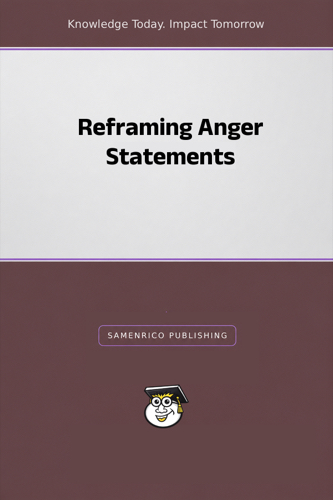
Free sample
Chapter 1: The Smoldering Cursor--The cursor blinked on Sarah’s screen at 11:17 PM. She had been staring at it for forty-seven seconds—not that she was counting. Her fingers rested on the keyboard, frozen in the millimeter of space between impulse and destruction. The email she had just drafted was four sentences long. It was precise.
It was devastating. It was, she believed with every fiber of her being, entirely true.“It’s incredible that you would deliberately undermine me after I did all the work. Everyone on the team knows I led this project. Your email was disrespectful, unprofessional, and frankly, I’m tired of covering for you. Don’t expect me to clean up your messes anymore.”Her colleague Mark had just sent a department-wide email taking credit for a six-month initiative that Sarah had conceived, planned, and executed.
He had been absent for three of those months on paternity leave. He had contributed exactly one spreadsheet and two questions in a meeting he joined late. And now, at 11:15 on a Tuesday night, he had hit “send” on a message that began, “I’m proud to share the results of a project I’ve been leading…”Sarah’s face was hot. Her jaw ached from clenching. Her heart pounded against her ribs like a prisoner demanding release.
She could hear her own breathing—shallow, rapid, the kind of breathing that happens before a scream or a sob. Every cell in her body was screaming the same message: SEND IT. SHE DESERVES TO KNOW. SHE NEEDS TO HEAR THE TRUTH.The cursor blinked.This is the moment this book is about. Not the anger—everyone has anger.
Not the trigger—injustices happen every day. This book is about the cursor. The pause. The thin, fragile, almost invisible thread that separates the person you were in that moment from the person you become the next morning. Sarah had not yet hit send.
But she was close. So close that she could feel the click in her imagination. She could see the email leaving her outbox. She could feel the relief she was certain would follow.She was wrong about that relief. And that is why she paused.The Lie We Believe About Anger Here is the first hard truth of this book: anger lies to you.
Not sometimes. Not when you’re tired or hungry or stressed. Always. Anger is not a truth-teller. It is a first responder.
And first responders are terrible at writing final reports.When a firefighter arrives at a burning building, they do not immediately know the cause. They do not know who is at fault. They know only one thing: there is heat, there is smoke, and something is wrong. Their job is to contain the immediate danger, not to assign blame. The investigation comes later.
The nuance comes later. The full story comes later. But the first responder—the one who kicks down the door and sprays water everywhere—does not have the luxury of a complete picture.Anger is exactly the same. It arrives fast, loud, and certain. It tells you that you know exactly what happened, exactly who is at fault, and exactly what needs to be done to fix it.
It tells you that silence is weakness, that patience is complicity, and that sending the message will bring relief. Every single one of these statements is biologically false.Let me say that again, because it is the most important sentence in this chapter: Every single thing anger tells you in the first ninety seconds is biologically false.Not morally false. Not philosophically debatable. Biologically false. Your brain, in those first ninety seconds, is literally not capable of telling you the truth.
The hardware has been temporarily rerouted. The logic center has gone offline. What you are experiencing is not wisdom—it is a chemical event with a megaphone.The Anger Loop: How Your Brain Betrays You To understand why anger lies, you have to understand what the chapter calls “The Anger Loop.” This is not a metaphor. It is a neurological sequence that has been measured in dozens of peer-reviewed studies, and it happens every single time you experience an angry reaction.Step One: The Trigger The loop begins with a trigger. For Sarah, the trigger was Mark’s email.
For you, it might be a partner who left dishes in the sink, a child who talked back, a driver who cut you off, a boss who dismissed your idea, a friend who forgot your birthday. The trigger is always the same kind of event: a perceived injustice, a crossed boundary, a violated expectation, or a threat to your status or safety.Here is what is crucial to understand about the trigger: your brain does not distinguish between physical threats and social threats. The same neural circuitry that evolved to detect a predator in the bushes also detects a colleague taking credit for your work. Your boss’s dismissive tone activates the same pathways as a physical shove. Your partner’s forgotten promise triggers the same stress response as a near-miss car accident.
This is not a design flaw—it is an evolutionary feature. For most of human history, social exclusion meant death. Being rejected from the tribe meant being eaten by something with larger teeth. Your brain is still running that ancient software, and it errs on the side of screaming when it should whisper.Step Two: Physiological Arousal The trigger activates your amygdala—two small, almond-shaped clusters of neurons deep in your brain that function as your threat-detection system. The amygdala does not think.
It does not deliberate. It reacts. Within milliseconds of the trigger, it sends an emergency signal to your hypothalamus, which in turn activates your sympathetic nervous system. The result is a flood of cortisol and adrenaline.This is the fight-or-flight response, and it is dramatic. Your heart rate increases by 30 to 50 percent.
Your blood pressure spikes. Your breathing becomes shallow and rapid. Your pupils dilate. Your digestive system shuts down (which is why you cannot eat when you are truly angry). Your peripheral vision narrows, creating a kind of tunnel vision that focuses only on the threat.
Your hearing changes—you stop processing tone of voice and volume, and you begin to filter only for threat-related sounds.Most importantly, your prefrontal cortex—the part of your brain responsible for impulse control, long-term planning, and rational decision-making—begins to downregulate. Its activity decreases by up to 50 percent during the first ninety seconds of an anger response. You are, quite literally, less intelligent when you are angry. Not figuratively. Not metaphorically.
Literally. Your IQ does not drop, but your access to your IQ does. The part of you that says “maybe I should wait” or “what if I’m missing information” or “how will I feel about this tomorrow” is temporarily offline.Step Three: The Cognitive Label Here is where the lie begins. As the physiological arousal peaks, your brain desperately needs to make sense of what is happening. It needs a story.
And because your prefrontal cortex is offline, it reaches for the simplest, most available story: someone is to blame.This is the cognitive label. “This is…
This is the end of the free sample. Get the eBook to keep going. Buy now
About this book
Details
- Author
- Nabors Charmaine
- Publisher
- SamEnrico
- Language
- English
- Genre
- Non-Fiction, Self-Help / Reframing
- Released
- 2026-06-06
- Pages (approx.)
- 121
- Available as
- eBook, Audiobook

Read better in the ZLOADR app
Your eBooks on your phone or tablet. Sign in with your SamEnrico account and start reading.
More by Nabors Charmaine
 Sitting with SensationsNabors Charmaine$11.99
 Lagos Pop Up CostsNabors Charmaine$11.99
 Elder Law Attorney GuideNabors Charmaine$11.99
 Workplace Vacation PlanningNabors Charmaine$11.99
 SAD In Adolescents GuideNabors Charmaine$11.99
 Team Flow State SecretsNabors Charmaine$11.99
 Resilience for Product ManagersNabors Charmaine$11.99
 The Royal Ballet of the Golden Age: Grace and Grandeur in the Courts of AfricaNabors Charmaine$11.99
 Where the Sun Never Sets: The Lost City of Helike’s TwinNabors Charmaine$11.99
 How to Produce Lawn Mower CoversNabors Charmaine$11.99
 Teamwork Agile WorkspaceNabors Charmaine$12.99
 Texas Nonprofit FilingNabors Charmaine$12.99
You may also like
 Hong Kong Handover 1997Dunn Johnnie$11.99
 Zumba For Postnatal Recovery CourseNeal Christian$11.99
 Zumba for BeginnersLadner Nikia$11.99
 YouTube Comment Mining GuideHumes Pandora$12.99
 Worry Box MeditationCarlin Rudy$11.99
 Workplace Stress MeditationNguyen Lynn$11.99
 Workplace Stress and Sleep RepairHawley Ivory$11.99
 Workplace Perfectionism CureDelaney Jeffry$11.99
 Workplace Injustice Anger GuideWallen Isabelle$11.99
 Work Addiction and Burnout LinkGreenwood Ester$11.99
 Women in Yoga and WellnessBeattie Galina$11.99
 Women in Stand Up ComedyChun Evangeline$11.99