
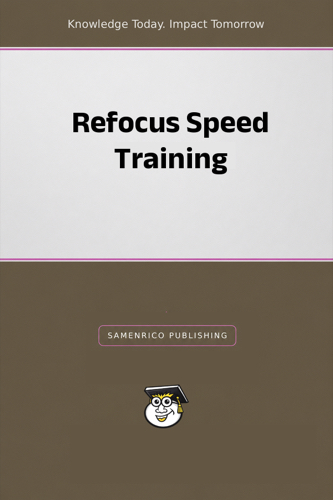
Refocus Speed Training eBook
Reduce time needed to regain concentration after u
by Utley Isaias
Reduce time needed to regain concentration after unavoidable interruptions.
Formats
Free sample
Chapter 1: The Twenty-Three Minute Lie--–- What if I told you that answering a one-minute text message actually costs you twenty-four minutes of your workday? Not because the text takes a minute to read and respond to—that part is obvious—but because the return trip, the journey back to what you were doing before your phone buzzed, takes an astonishing twenty-three minutes and fifteen seconds. You lose nearly half an hour to a sixty-second interruption. And this is happening to you dozens of times every single day.This is not an exaggeration. This is not a motivational speaker's hyperbole.
This is peer-reviewed, replicated, and devastatingly accurate data from the University of California, Irvine, where Professor Gloria Mark spent years observing knowledge workers in their natural environments. She placed tracking software on their computers, watched their screens, and documented every single time they switched tasks. What she found should terrify anyone who needs to think for a living.The average office worker stays on a single task for approximately three minutes before being interrupted or switching voluntarily. Three minutes. That is barely enough time to read a single email, let alone enter a state of deep concentration.
And after each interruption—whether it is a colleague tapping your shoulder, a phone call from your child's school, or the ping of a Slack message—it takes an average of twenty-three minutes and fifteen seconds to return to the original task with the same depth of focus you had before the interruption occurred.Let me say that again in plain language. If someone interrupts you for sixty seconds, you lose almost twenty-four minutes of productive time. The interruption itself is the smallest part of the cost. The real cost is the recovery. And most people never actually recover.
They simply move on to the next task, leaving a trail of half-finished work, open mental loops, and mounting cognitive debt that compounds with every passing hour.By two o'clock in the afternoon, the average knowledge worker has accumulated so much cognitive residue from so many incomplete task switches that the prefrontal cortex—the part of your brain responsible for attention, planning, and impulse control—is running on fumes. You feel tired. You feel stupid. You stare at your screen and cannot remember what you were doing. This is not a character flaw.
This is not laziness. This is neuroscience. And it is happening to you right now.THE COST OF THE QUICK QUESTIONLet me give you a concrete example. Imagine you are a senior accountant named Sarah. It is ten-seventeen in the morning.
Sarah is deep in a spreadsheet, reconciling three months of expenses for a major client. She has been working on this task for forty-five minutes. She is in what psychologists call a state of flow—fully absorbed, time disappearing, the work feeling almost effortless.Her phone buzzes. It is her daughter's school. She answers.
The conversation lasts thirty-seven seconds. Her daughter forgot her lunch money. Sarah texts her husband to bring it. That takes another twenty-two seconds. She puts the phone down.
She looks at the spreadsheet.It is now ten-fifty-five AM.For thirty-eight minutes, Sarah has been staring at the same cell in the spreadsheet, reading the same three numbers, unable to remember what she was doing before the phone rang. She scrolls up. She scrolls down. She opens a different tab to see if that jogs her memory. It does not.
She feels stupid. She feels frustrated. She considers taking an early lunch.Sarah is not stupid. Sarah is human. And Sarah just lost thirty-eight minutes of her life to a fifty-nine-second interruption.This is the twenty-three-minute lie.
The lie is the assumption that an interruption costs only the duration of the interruption. The truth is that the cost is almost entirely in the recovery. And the recovery is not a simple matter of picking up where you left off. Your brain is not a book. You cannot close it, answer the phone, and open it again to the same page.
Your brain is more like a complex engine that must be completely shut down and restarted every time you switch tasks. And restarting takes time.THE SWITCH COST EFFECTThe technical term for what Sarah experienced is the switch cost effect. Every time your brain moves from Task A to Task B, it must perform a series of cognitive operations that are invisible to you but incredibly expensive in terms of time and mental energy.First, your brain must disengage from Task A. This sounds simple, but it is not. Task A is not just a single thought.
It is a network of associated concepts, working memory contents, goals, subgoals, and contextual cues. When you are deep in a task, your brain has activated a specific neural configuration—a unique pattern of firing neurons that represents exactly where you are in that task, what you have already done, what you need to do next, and what tools or information you need to do it.When an interruption occurs, that neural configuration does not simply dissolve. It persists. It continues to fire in the background, consuming mental resources, while your brain attempts to configure a new pattern for Task B. This is why after an interruption you often feel a lingering sense of having forgotten something important, or why you keep thinking about the original task even while trying to focus on the new one.
Your brain is still holding onto Task A because you never properly closed it.Second, your brain must configure itself for Task B. This requires activating a completely different neural configuration, retrieving the relevant information from long-term memory, establishing new goals and subgoals, and orienting your attention to the new context. This process alone takes anywhere from a few seconds to a minute, depending on how different Task B is from Task A.Third—and this is the part that most people forget—your brain must eventually reconfigure itself back to Task A. This is not a simple reversal of the first two steps. When you return to Task A, you are not returning to the same neural configuration you had before.
That configuration has been partially overwritten, partially degraded, and partially suppressed by the intervening work on Task B. You must essentially rebuild Task A from scratch, using whatever clues you left behind and whatever remains in your working memory.This rebuilding process is what takes twenty-three minutes. And during those twenty-three minutes, you are not working at full capacity. You are not thinking clearly. You are not creative, insightful, or efficient.
You are operating at perhaps forty percent of your cognitive potential, grinding through the work of reconstruction while feeling increasingly frustrated that you cannot just get back to where you were.THE THREE-MINUTE PROBLEMIf the switch cost effect were a rare occurrence, it would be merely annoying. But it is not rare. It is constant. Gloria Mark's research found that the average office worker switches tasks every three minutes. Let me put that number in perspective.If you work an eight-hour day, and you switch tasks every three minutes, that means you switch tasks approximately one hundred and sixty times per day.…
This is the end of the free sample. Get the eBook to keep going. Buy now
About this book
Details
- Author
- Utley Isaias
- Publisher
- SamEnrico
- Language
- English
- Genre
- Non-Fiction, Self-Help
- Released
- 2026-06-10
- Pages (approx.)
- 137
- Available as
- eBook, Audiobook

Read better in the ZLOADR app
Your eBooks on your phone or tablet. Sign in with your SamEnrico account and start reading.
More by Utley Isaias
 Sarcoma Survivor MemoirUtley Isaias$11.99
 Migraine and Bright Light SensitivityUtley Isaias$11.99
 The Stress and Fibromyalgia GuideUtley Isaias$11.99
 Vitamin C Immune Boosting GuideUtley Isaias$11.99
 NVC for Graduate StudentsUtley Isaias$11.99
 Justin Timberlake FutureUtley Isaias$11.99
 Food Addiction and PregnancyUtley Isaias$11.99
 Blue Zone Manual ToolsUtley Isaias$11.99
 Paper Son: The Forgotten Children of Angel IslandUtley Isaias$11.99
 The Poet Who Defied Kings: The Life and Legacy of Al-MutanabbiUtley Isaias$11.99
 Tangaroa's Wrath: The Great Wave That Swallowed IslandsUtley Isaias$11.99
 Growing Laburnum (Laburnum)Utley Isaias$11.99
You may also like
 Hong Kong Handover 1997Dunn Johnnie$11.99
 Zumba For Postnatal Recovery CourseNeal Christian$11.99
 Zumba for BeginnersLadner Nikia$11.99
 YouTube Comment Mining GuideHumes Pandora$12.99
 Worry Box MeditationCarlin Rudy$11.99
 Workplace Stress MeditationNguyen Lynn$11.99
 Workplace Stress and Sleep RepairHawley Ivory$11.99
 Workplace Perfectionism CureDelaney Jeffry$11.99
 Workplace Injustice Anger GuideWallen Isabelle$11.99
 Work Addiction and Burnout LinkGreenwood Ester$11.99
 Women in Yoga and WellnessBeattie Galina$11.99
 Women in Stand Up ComedyChun Evangeline$11.99