
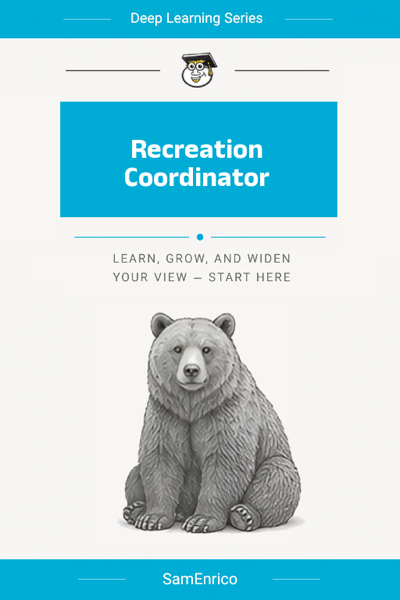
Non-FictionInformativeEducational
Recreation Coordinator eBook
A Coursebook on Recreation Coordinator
by Breaux Elana
A Coursebook on Recreation Coordinator
Formats
Free sample
Chapter 1: The Hidden Architect...--The first time Maria Sanchez walked into the shuttered community gym on a cold Tuesday morning in February, the smell of mildew and forgotten ambition hit her before the silence did. Fluorescent lights buzzed overhead, flickering against walls that hadn’t seen paint since the Clinton administration. A single basketball hoop hung crookedly at one end, its net long since reduced to a few tattered strings. In the corner, a stack of rusted folding chairs leaned against a radiator that had stopped working sometime during the George W. Bush era.
This was not what she had imagined when she accepted the position of Recreation Coordinator for the city of Harrisonburg—a small post-industrial town that had once thrived on textile mills and now survived on tax revenue from a struggling Walmart and the fading hope that something might bring the young people back.Maria was twenty-six years old, three years out of graduate school with a master’s degree in park and recreation management, and she had spent those three years as an assistant coordinator in a wealthy suburban district forty miles away. There, she had overseen yoga classes for stay-at-home parents, competitive travel soccer for kids whose families drove German SUVs, and summer camps where the biggest crisis was a gluten-free lunch order gone wrong. She had been good at that job—efficient, organized, well-liked. But she had also felt a gnawing emptiness, a sense that she was orchestrating activities for people who would have been fine without her. The wealthy suburb would have thrived no matter who sat in her chair.
Harrisonburg, she suspected, was different.Her new boss, a weary fifty-three-year-old parks director named Dale Hawkins, had been honest with her during the interview. “We don’t have a budget for flashy programs,” he had said, pushing a stack of unpaid invoices across his cluttered desk. “We don’t have a dedicated marketing person. We don’t even have a functioning website. What we have is a lot of kids who are getting into trouble because there’s nothing else to do, a lot of seniors who are lonely because their families have moved away, and a lot of adults who work two jobs and have never once set foot in a rec center because they don’t think we’re for people like them.” He had paused, looking at her with the exhausted hope of someone who had watched four other coordinators quit in six years.
“So when I say ‘recreation coordinator,’ I don’t mean someone who schedules pickleball. I mean someone who figures out how to keep this town from giving up on itself.”Maria had taken the job anyway, which is how she now found herself standing in the middle of a derelict gym, wondering if she had made a catastrophic mistake.But here is what Maria did not yet understand, standing there in the mildew and the flickering light: she was not an event planner. She was not a schedule maker. She was not a facility manager, although she would become a very good one out of necessity. She was something far more important, something that no graduate school course had ever explicitly named.
She was a community wellness architect—a strategic professional responsible for designing the conditions under which physical health, social connection, and mental well-being could take root in a place where those things had been slowly dying for decades. And she was about to learn that the most powerful tool in her arsenal was not a budget line or a program template or a certification. It was the ability to see what a community needed before the community could articulate it themselves.The Myth of the Gym Manager The outdated stereotype of the recreation coordinator—the one that still lingers in the public imagination and, distressingly, in many municipal job descriptions—is a person who unlocks doors, turns on lights, blows a whistle, and schedules the adult softball league. This is the “gym manager” model, and it is catastrophically incomplete. It reduces a complex, strategic, deeply human profession to a set of clerical and custodial tasks.
It suggests that anyone with a high school diploma and a willingness to work evenings could do the job. And it is the primary reason why so many recreation departments across the United States are underfunded, undervalued, and invisible in their own communities.The reality could not be more different. A modern recreation coordinator, functioning at full capacity, is a data analyst who reads registration trends and demographic shifts to identify unmet needs. A community organizer who convenes stakeholders—including the people who never show up to public meetings—to co-design programs that actually matter. A financial steward who balances cost-recovery against equity, who knows how to write a grant that pays for a splash pad in a food desert, who can explain to a city council why investing in a summer youth program is cheaper than funding a juvenile detention bed.
A safety engineer who understands the four elements of negligence—duty, breach, causation, damages—and builds risk management systems that prevent harm before it happens. An inclusion specialist who can modify a basketball game for a child with cerebral palsy without making that child feel like a burden. A crisis communicator who can de-escalate a parent screaming at a referee without losing the parent’s long-term loyalty. A marketer who tells stories about belonging, not just announces events.In short, the recreation coordinator is the hidden architect of community wellness. And the tragedy is that most coordinators have never been taught to see themselves this way.This book exists to change that.
It is not a theoretical textbook, although it draws on the best research in recreation management, public health, and organizational psychology. It is not a simple how-to manual, although every chapter ends with practical tools you can use tomorrow. It is a field guide to becoming the leader your community needs—whether you work for a municipal parks department, a private resort, a YMCA, a senior center, or a small nonprofit with two staff members and a dream. The principles in these pages apply across sectors because the fundamental question is the same: How do I create the conditions for people to thrive?Before we go any further, a note about who this book is for. Some of you are reading this as entry-level coordinators who have just been handed a set of keys and a schedule and told “good luck.” Some of you are mid-career professionals who have been doing this work for years but feel stuck, undervalued, or burned out.
Some of you are directors who manage coordinators and want to develop them more effectively. And some of you are students who are wondering if this career path is worth the modest pay and the unpredictable hours. The answer to that last question is yes, but only if you embrace the full scope of the role. This book is organized with skill-level indicators—Green for foundational concepts, Yellow for mid-career application, Red for strategic leadership—so you can focus on what is most relevant to you right now. But I encourage you to read the…
This is the end of the free sample. Get the eBook to keep going. Buy now
About this book
Details
- Author
- Breaux Elana
- Publisher
- SamEnrico
- Language
- English
- Genre
- Non-Fiction, Informative, Educational
- Released
- 2026-05-08
- Pages (approx.)
- 159
- Available as
- eBook, Audiobook

Read better in the ZLOADR app
Your eBooks on your phone or tablet. Sign in with your SamEnrico account and start reading.
More by Breaux Elana
 Overwatch 2 Compulsive PlayBreaux Elana$11.99
 Keto for Vegetarians GuideBreaux Elana$11.99
 Sibling Caregiver BurnoutBreaux Elana$11.99
 TCM Ear AcupunctureBreaux Elana$11.99
 Vukovar's Last Stand: The Siege That Defined a Nation (1991)Breaux Elana$11.99
 AI Fixed Asset Depreciation GuideBreaux Elana$12.99
 How to Produce Chef's KnivesBreaux Elana$11.99
 How to Start a Pipes Made of Aluminium Business (Beginners Guide)Breaux Elana$11.99
You may also like
 Hong Kong Handover 1997Dunn Johnnie$11.99
 Zumba For Postnatal Recovery CourseNeal Christian$11.99
 Zumba for BeginnersLadner Nikia$11.99
 YouTube Comment Mining GuideHumes Pandora$12.99
 Worry Box MeditationCarlin Rudy$11.99
 Workplace Stress MeditationNguyen Lynn$11.99
 Workplace Stress and Sleep RepairHawley Ivory$11.99
 Workplace Perfectionism CureDelaney Jeffry$11.99
 Workplace Injustice Anger GuideWallen Isabelle$11.99
 Work Addiction and Burnout LinkGreenwood Ester$11.99
 Women in Yoga and WellnessBeattie Galina$11.99
 Women in Stand Up ComedyChun Evangeline$11.99