
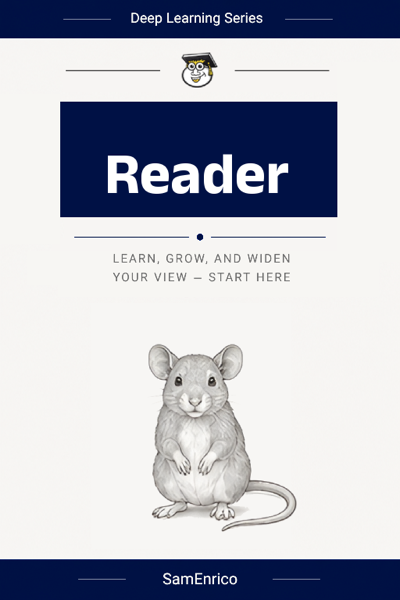
Non-FictionInformativeEducational
Reader
A Coursebook on Reader
by Cole Caleb
A Coursebook on Reader
Formats
About this book
Free sample
Chapter 1: The Unread Revolution...–- Every morning, millions of people open books, scan screens, and scroll through texts. They move their eyes across lines of ink or pixels. They sound out words. They turn pages or tap for the next sentence. And then something strange happens: most of them finish reading without ever having truly read at all.They have decoded.
They have not understood.This is the great unspoken crisis of literacy in the twenty-first century. Schools teach children to sound out words. Standardized tests measure how fast students can identify letters and read aloud. Parents proudly watch their five-year-olds stumble through Cat in the Hat. And everyone assumes that because the words were spoken correctly, comprehension followed automatically.
It did not.The act of reading is not the act of decoding. Decoding is mechanical. Decoding is what a computer does when it scans a QR code. Decoding transforms symbols into sounds or into digital data. But reading—real reading, the kind that changes minds, moves hearts, and builds civilizations—is something else entirely.
Reading is the creation of meaning in the space between a text and a living, breathing, historically situated human being.This chapter dismantles the most persistent and damaging myth in all of literacy education: the myth that reading is decoding. In its place, we will build a new foundation. Reading is a transaction. Reading is an event. Reading is something you do, not something you passively receive.
And until you understand this distinction, every strategy, every skill, every assessment, and every intervention you will encounter in this book remains useless.The Great Misconception: How We Came to Confuse Decoding with Reading The confusion between decoding and reading did not appear by accident. It has deep historical roots in behaviorist psychology, in the efficiency movements of early twentieth-century education, and in a profoundly convenient misunderstanding of what the human brain actually does when it encounters written language.In the 1910s and 1920s, psychologists like Edward Thorndike argued that reading was essentially a series of habits. A child learned to associate a visual symbol (the letter "A") with a…
This is the end of the free sample. Get the eBook to keep going. Buy now
Contents
- Chapter 1
- Chapter 2
- Chapter 3
- Chapter 4
- Chapter 5
- Chapter 6
- Chapter 7
- Chapter 8
- Chapter 9
- Chapter 10
- Chapter 11
- Chapter 12
Details
- Author
- Cole Caleb
- Publisher
- SamEnrico
- Language
- English
- Genre
- Non-Fiction, Informative, Educational
- Released
- 2026-05-09
- Pages (approx.)
- 154
- Available as
- eBook, Audiobook

Read better in the ZLOADR app
Your eBooks on your phone or tablet. Sign in with your SamEnrico account and start reading.
More by Cole Caleb
 Parent Exercise Self Care GuideCole Caleb$11.99
 Immigrant Logistics And TruckingCole Caleb$11.99
 Uber Comfort and Premier StrategyCole Caleb$11.99
 YouTube Binge Watching RecoveryCole Caleb$11.99
 HGH and Dental Bone LossCole Caleb$11.99
 The Healers of the Nile: Ancient Egypt's Medical RevolutionariesCole Caleb$11.99
 Asana Portfolio Management GuideCole Caleb$12.99
 Customer Experience CX GuideCole Caleb$12.99
 Understanding Melanoma, MalignantCole Caleb$17.99
 Ultimate Handbook Guide to Xinzheng : (China) Travel GuideCole Caleb$11.99
You may also like
 Hong Kong Handover 1997Dunn Johnnie$11.99
 Zumba For Postnatal Recovery CourseNeal Christian$11.99
 Zumba for BeginnersLadner Nikia$11.99
 YouTube Comment Mining GuideHumes Pandora$12.99
 Worry Box MeditationCarlin Rudy$11.99
 Workplace Stress MeditationNguyen Lynn$11.99
 Workplace Stress and Sleep RepairHawley Ivory$11.99
 Workplace Perfectionism CureDelaney Jeffry$11.99
 Workplace Injustice Anger GuideWallen Isabelle$11.99
 Work Addiction and Burnout LinkGreenwood Ester$11.99
 Women in Yoga and WellnessBeattie Galina$11.99
 Women in Stand Up ComedyChun Evangeline$11.99