
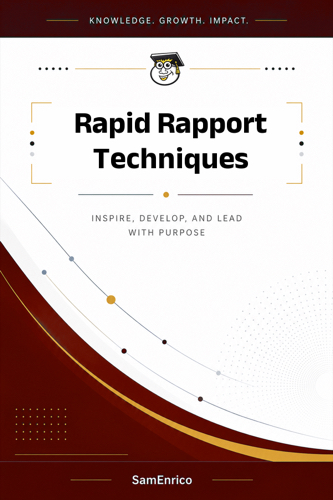
Rapid Rapport Techniques
Establish trust and likeability in first conversat
by Boren Chance
Establish trust and likeability in first conversations quickly.
Formats
About this book
Free sample
Chapter 1: The First 90 Seconds--You have ninety seconds. Maybe fewer.From the moment you enter someone's field of vision—or they enter yours—a silent, ancient process begins inside their brain. Their amygdala, a small almond-shaped cluster of neurons deep in the temporal lobe, is running a threat-detection algorithm that has been refined over three hundred million years of evolution. It does not care about your intentions, your résumé, or how much you practiced that opening line in the mirror. It cares about one thing and one thing only: Friend or foe?This judgment happens before a single word is spoken.
Before a handshake. Before a smile is fully formed. And once it locks in, it is extraordinarily difficult to reverse.This is not a metaphor. This is neuroscience.The Primacy Effect, first documented by the Polish-born psychologist Solomon Asch in the 1940s and repeatedly validated across decades of research, shows that the first information we receive about a person disproportionately shapes everything we subsequently learn about them. If the first ninety seconds of an interaction signal "threat" or "untrustworthy" or "awkward," every subsequent smile, every intelligent comment, every gesture of goodwill will be filtered through that initial negative frame.
The brain looks for evidence to confirm its first impression, not to contradict it.But here is what most people never realize: the judgment is not really about you. It is about safety.The Three Pillars of Instant Judgment When another person's amygdala evaluates you, it scans for three specific signals. These are not conscious decisions. They are automatic, pre-cognitive, and happening whether you want them to or not. Understanding these three pillars is the difference between accidentally triggering a threat response and deliberately broadcasting safety.Pillar One: Safety The most primitive question the brain asks is: Will this person hurt me?
This does not only mean physical harm. Social harm—embarrassment, rejection, humiliation, status loss—triggers the same neural pathways as physical pain. Research using functional MRI (f MRI) has shown that social rejection activates the same brain regions (the anterior cingulate cortex and the insula) as physical pain. Your body…
This is the end of the free sample. Get the eBook to keep going. Buy now
Contents
- Chapter 1
- Chapter 2
- Chapter 3
- Chapter 4
- Chapter 5
- Chapter 6
- Chapter 7
- Chapter 8
- Chapter 9
- Chapter 10
- Chapter 11
- Chapter 12
Details
- Author
- Boren Chance
- Publisher
- SamEnrico
- Language
- English
- Genre
- Non-Fiction, Self-Help, Interpersonal Skills
- Released
- 2026-06-07
- Pages (approx.)
- 136
- Available as
- eBook, Audiobook

Read better in the ZLOADR app
Your eBooks on your phone or tablet. Sign in with your SamEnrico account and start reading.
More by Boren Chance
 Bergman Light in DarknessBoren Chance$11.99
 Gardening Season PriorityBoren Chance$11.99
 CSGO Skin Gambling RecoveryBoren Chance$11.99
 Upwork Client Interview PreparationBoren Chance$11.99
 Masada: The Last Stand of the ZealotsBoren Chance$11.99
 Project Management Glossary GuideBoren Chance$12.99
 Workforce Skills Long Term GuideBoren Chance$12.99
 Understanding MeningomyeloceleBoren Chance$17.99
 How to Become a Tube RepairerBoren Chance$11.99
 Robotics Team MentorBoren Chance$11.99
You may also like
 Empathy Building GuideBertrand Milagro$11.99
 Toxic Coworker Stress ManagementSwisher Lacey$11.99
 Nonviolent Communication WorkbookCombs Wen$11.99
 Opioid Dependency Boundaries And Recovery CourseAndersen Charla$11.99
 Assertive Communication HandbookParham Emely$11.99
 Workplace Passive Aggression ResponseThatcher Williemae$11.99
 The Social Distraction ShieldGrover Christiana$11.99
 The Assertiveness Scripting HandbookLuke Eugene$11.99
 Liking Persuasion TechniquesYoungblood Mica$11.99
 Difficult Coworker Anger ControlHartman Emilia$11.99
 Self Talk For Difficult PeopleConnell Collette$11.99
 Interpersonal Effectiveness DBTConnolly Trista$11.99