
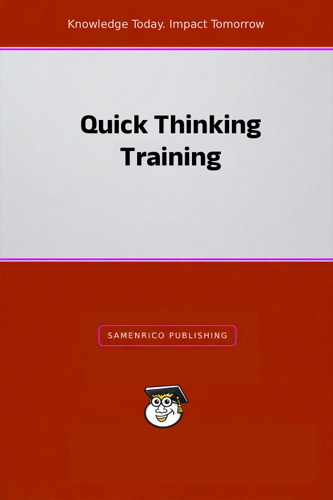
Non-FictionSelf-HelpQuick Thinking
Quick Thinking Training eBook
Respond faster in conversations without freezing o
Respond faster in conversations without freezing or overthinking.
Formats
Free sample
Chapter 1: The Silver Tongue Lie--–- It happens to everyone. The会议室 goes quiet. Every eye turns toward you. Your boss asks, “So, what do you think?” And then—nothing. Your mind, which just moments ago was full of opinions and data and clever observations, is suddenly a white screen.
No thoughts. No words. Just the growing thud of your own heartbeat and the horrifying awareness that three seconds have passed and you still haven’t spoken. Someone jumps in to save you. Or worse, no one does.
The moment passes, the conversation moves on, and you are left sitting there, face warm, replaying what you should have said.If you have ever experienced this—and you almost certainly have—you have also drawn the wrong conclusion about what it means. You told yourself: I’m just not quick on my feet. I’m not a natural speaker. Some people are born with it, and I wasn’t. You filed that experience away as evidence of a permanent character flaw, like being born left-handed or unable to carry a tune.That conclusion is wrong.
And it is the single most expensive mistake you will ever make in your professional and social life.This chapter dismantles the myth that quick thinking is a personality trait—a gift possessed only by the charismatic, the extroverted, or the naturally witty. In its place, we will build a new understanding: quick thinking is a trainable skill of cognitive agility. By the end of this chapter, you will understand exactly why your brain freezes under pressure, why some people seem immune, and—most importantly—how you can train the same ability regardless of your starting point.The Expensive Cost of the Freeze Before we fix the problem, we have to fully acknowledge its cost. The freeze response is not merely embarrassing. It is expensive in ways that compound over years.Consider the following scenarios, drawn from real clients and research participants across dozens of industries:The promotion that went elsewhere.
A senior analyst at a financial services firm was asked during a leadership panel, “What is your vision for transforming our client onboarding process?” She had a vision. She had spent months thinking about it. But in the two seconds between the question and her answer, her mind blanked. She stammered something generic about “efficiency” and “collaboration.” The person who got the promotion gave a specific, confident, three-sentence answer. The analyst’s career trajectory stalled for eighteen months.The deal that slipped away.
A sales director was in the final round of negotiations with a major prospect. The prospect asked an unexpected question about a competitor’s feature. The director froze, then over-explained, then said “um” seven times in forty-five seconds. The prospect later told his team, “They didn’t seem confident in their own product.” The deal went to a competitor.The relationship that never deepened. At a dinner party, someone asked a quiet engineer, “What do you do for fun outside of work?” He knew the answer—he was a competitive rock climber—but the question caught him off guard.
He said, “Oh, nothing much,” and the conversation died. A potential friendship, networking contact, or even romantic connection never materialized.These are not failures of knowledge or preparation. They are failures of access—the inability to retrieve what you already know under the specific condition of social pressure. And the cumulative cost of these small freezes is enormous. Over a career, the person who can answer unexpected questions confidently will be promoted faster, paid more, trusted more readily, and invited into more rooms than the person who freezes, regardless of their actual expertise.The good news—and the entire premise of this book—is that access is trainable.The Cognitive Load Trap To understand why you freeze, we need to understand how your brain works under pressure.
The key concept is cognitive load.Cognitive load is the total amount of mental effort being used in your working memory at any given moment. Think of working memory as a small whiteboard in your mind. At any time, you can hold approximately four to seven discrete pieces of information on that whiteboard. That is it. When the whiteboard is full, adding one more thing means something else falls off.Under normal, low-stress conditions, your working memory operates efficiently.
You can listen to a question, retrieve relevant information from long-term memory, formulate a response, and deliver it—all while maintaining awareness of your body language, the listener’s reactions, and the clock. This feels easy because your cognitive load is low, perhaps three out of ten.Under pressure, everything changes.When you perceive a high-stakes situation—a boss asking a question, a crowd looking at you, a hostile interruption—your brain’s threat-detection system (the amygdala) activates before your conscious mind even registers the event. The amygdala does not distinguish between a physical threat (a predator) and a social threat (judgment, rejection, embarrassment). To your ancient brain, they are the same: danger.The amygdala triggers a cascade of stress hormones, most notably cortisol. Cortisol has many effects, but the most relevant for our purposes is this: cortisol reduces the firing rate of neurons in the prefrontal cortex, the part of your brain responsible for logic, planning, language, and impulse control.
Your prefrontal cortex is your “smart brain.” When cortisol levels rise, your smart brain literally operates more slowly. Connections that were easy a moment ago become difficult. Words that were on the tip of your tongue disappear.This is the cognitive load trap. Under pressure, two things happen simultaneously:Your working memory capacity shrinks by 30 to 40 percent. The whiteboard gets smaller.The effort required to perform the same task (listening, retrieving, formulating, speaking) increases because your prefrontal cortex is operating at reduced efficiency.The result is catastrophic for fluency.
Tasks that were automatic become deliberate. Deliberate tasks become impossible. The person who asked you a simple question is waiting for an answer, and your brain is running on half its usual processing power while also trying to manage panic. Of course you freeze. Biology demands it.But here is the crucial insight: cognitive load is not fixed.
You can reduce it in two ways. First, you can lower the stress response itself (which we will cover extensively in Chapters 6 and 7). Second, you can reduce the mental effort required to respond by using pre-learned structures. The second path is the subject of this chapter and the foundation of the entire ARC Method.The Improvisation Paradox There is a concept from the world of jazz that will change how you think about spontaneity. Jazz musicians are celebrated for their improvisation—for creating brilliant, original solos in real time.
It looks like pure freedom, pure instinct, pure genius.But here is what the audience does not see: every great jazz musician has spent thousands of hours practicing scales. Not just learning them, but internalizing them to the point where the scales are automatic, unconscious, and instantaneous. When a jazz pianist improvises, they are not creating notes from nothing. They are combining and recombining pre-learned patterns—scales, arpeggios, chord progressions—in novel ways. The structure (the scale) frees them to be creative.…
This is the end of the free sample. Get the eBook to keep going. Buy now
About this book
Details
- Author
- Perryman Grover
- Publisher
- SamEnrico
- Language
- English
- Genre
- Non-Fiction, Self-Help, Quick Thinking
- Released
- 2026-06-10
- Pages (approx.)
- 149
- Available as
- eBook, Audiobook

Read better in the ZLOADR app
Your eBooks on your phone or tablet. Sign in with your SamEnrico account and start reading.
More by Perryman Grover
 Financial Stress UndocumentedPerryman Grover$11.99
 Favoritism Anger At Work HandbookPerryman Grover$11.99
 Karamo Queer Eye TalkPerryman Grover$11.99
 The Friendship Letdown RecoveryPerryman Grover$11.99
 Whispers of the Willow Tree: A Love Reborn in TimePerryman Grover$11.99
 Hairstyling Salon ManagerPerryman Grover$11.99
 How to Start a Ornamental Fish Farming, Freshwater Business (Beginners Guide)Perryman Grover$11.99
 Nevada LLC for Non ResidentsPerryman Grover$12.99
 Datadog PLG GuidePerryman Grover$12.99
 Understanding Radiculomegaly of Canine Teeth Congenital CataractPerryman Grover$17.99
You may also like
 Hong Kong Handover 1997Dunn Johnnie$11.99
 Zumba For Postnatal Recovery CourseNeal Christian$11.99
 Zumba for BeginnersLadner Nikia$11.99
 YouTube Comment Mining GuideHumes Pandora$12.99
 Worry Box MeditationCarlin Rudy$11.99
 Workplace Stress MeditationNguyen Lynn$11.99
 Workplace Stress and Sleep RepairHawley Ivory$11.99
 Workplace Perfectionism CureDelaney Jeffry$11.99
 Workplace Injustice Anger GuideWallen Isabelle$11.99
 Work Addiction and Burnout LinkGreenwood Ester$11.99
 Women in Yoga and WellnessBeattie Galina$11.99
 Women in Stand Up ComedyChun Evangeline$11.99