
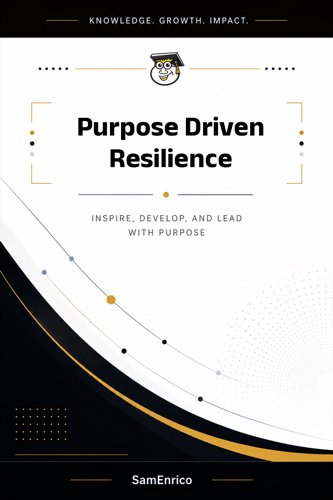
Purpose Driven Resilience eBook
Use meaning and mission to fuel perseverance throu
Use meaning and mission to fuel perseverance through difficulties.
Formats
Free sample
Chapter 1: The Brittle Hero--–- Marcus had done everything right. He woke at 5:00 AM, took the cold shower that every motivational speaker promised would rewire his brain, and meditated for exactly twelve minutes. He had read every book on resilience, attended the corporate workshops, and mastered the art of the "stiff upper lip." When his startup missed its quarterly targets, he told his team, "We'll work harder." When his marriage began to fray, he told himself, "I just need to be tougher." When his father was diagnosed with cancer, he flew across the country every weekend while maintaining a full work schedule, because quitting was not in his vocabulary.Six months later, Marcus sat in a therapist's office unable to explain why he had spent forty-five minutes crying in his parked car before driving home. He hadn't lost his job. His father was still alive.
His wife hadn't left him. By every objective measure, he was winning. And yet, he was shattered.The therapist asked him a question that would unravel everything Marcus believed about strength: "What if you're not breaking because you're weak? What if you're breaking because you've been taught the wrong definition of resilience?"This chapter opens with a provocative truth that challenges the very foundation of modern self-help: the toughest people sometimes break first not despite their toughness, but because of it. Traditional resilience training—"toughen up," "grin and bear it," "don't show weakness," "push through the pain"—does not create durability.
It creates brittleness. Like tempered glass, a person who only knows how to resist force without flexing, adapting, or reorienting will shatter catastrophically under the right pressure. And the pressure always comes.The Resilience Industrial Complex Before we can rebuild resilience, we must first dismantle the myths that have broken so many well-intentioned people. There is an $11 billion global industry built on selling toughness. Corporate resilience workshops, grit training programs, "no-excuses" leadership seminars—they all share a common formula: convince you that you are the problem, that you simply need to try harder, be stronger, and outlast the pain.The data tells a different story.
A 2022 meta-analysis of workplace resilience programs involving over 47,000 participants found that programs focused exclusively on individual toughness—"personal fortitude," "mental strength," "grit training"—actually increased burnout rates by 18% within six months. Participants became more exhausted, more cynical, and more likely to leave their jobs than those who received no training at all. Why? Because being told to "be tougher" when you are already drowning does not teach you to swim. It teaches you that drowning is a moral failure.The Core Problem: Most resilience advice confuses coping with thriving.
Coping keeps you alive in the storm—you hunker down, conserve energy, and wait for the weather to pass. Thriving means sailing intentionally toward a destination, using the storm's energy to propel you forward rather than merely enduring it. Coping is survival. Thriving is advancement. And you cannot thrive with a broken compass.Marcus had mastered coping.
He could endure anything. But endurance without direction is just slow suffocation. He had no compass—no mission vivid enough to pull him through the mud. He was running on willpower alone, and willpower, as we will see throughout this book, is a finite resource. Purpose is not.The Compass vs.
The Rudder Let me introduce a metaphor that will frame everything that follows. Imagine you are captaining a ship through a violent storm. Your ship has two critical components: a rudder and a compass.The rudder is your energy, your willpower, your discipline, your grit. It steers the ship. When you are well-rested, motivated, and clear-headed, the rudder responds beautifully.
You can cut through waves, avoid obstacles, and make progress.The compass is your mission, your meaning, your purpose. It tells you which direction is north. It does not require energy to function. It simply points.Most resilience advice focuses exclusively on the rudder. It tells you to strengthen your willpower, build better habits, wake up earlier, cold-shower harder, and push through fatigue.
This is like telling a lost sailor to grip the wheel tighter while having no idea which way is land. When the rudder breaks—when exhaustion, grief, or failure depletes your energy—the compass is all you have left. And if you have no compass, you drift.Marcus had an exceptionally strong rudder. He could out-work anyone. But his compass was a tangle of competing signals: career success, family duty, social approval, financial security, and the vague notion that he should be "happy." These signals pointed in different directions.
When the storm hit, he gripped the rudder harder and tried to steer in every direction at once. The result was not progress. It was spinning.The Compass vs. Rudder Principle: Your resilience is not determined by how hard you can steer. It is determined by how clearly you can see north when the rudder breaks.
Purpose is the fuel that makes the rudder irrelevant—because when you know where you're going, even floating in the right direction is progress.The Lone Wolf Myth One of the most damaging myths about resilience is the image of the lone wolf—the solitary hero who needs no one, who bears their burdens in silence, who emerges from the wilderness stronger and alone. This myth sells books and movie tickets. It also destroys lives.The research on human resilience is unequivocal: social connection is the single strongest predictor of who survives catastrophe and who does not. The Harvard Study of Adult Development, which followed 724 men for over eighty years, found that the quality of a person's relationships was a better predictor of their health, happiness, and longevity than their cholesterol levels, their exercise habits, or even their genetics. Loneliness, the study found, was as toxic as smoking fifteen cigarettes a day.But here is the counter-intuitive twist that most resilience books miss: community alone is not enough.
Purpose-connected communities—groups united by a shared mission, a common why—produce dramatically better outcomes than generic social networks. A 2019 study of firefighters, a profession with extraordinary resilience demands, found that firefighters who reported both strong social bonds and a clear sense of mission had 73% lower rates of PTSD than those with strong bonds alone. The mission acted as a container for the suffering, transforming random trauma into meaningful sacrifice.Marcus had friends. He had a loving wife. But he had no purpose-connected community.
He was surrounded by people who cared about him but who did not share a vivid, specific mission. When he suffered, he suffered alone—not because no one offered help, but because he had no framework for turning his suffering into something that served a larger goal. He was not a lone wolf by choice. He was a lone wolf by accident of an empty compass.The Community Principle: You do not need more people in your life. You need the right people—those who share your mission or who can witness your struggle without trying to fix it.
We will build your Resilience Network in Chapter 11. For now, simply recognize that the lone wolf is a fiction. Real resilience is a team sport played on a mission field.Two Kinds of…
This is the end of the free sample. Get the eBook to keep going. Buy now
About this book
Details
- Author
- Peltier Neely
- Publisher
- SamEnrico
- Language
- English
- Genre
- Non-Fiction, Self-Help, Purpose
- Released
- 2026-06-06
- Pages (approx.)
- 124
- Available as
- eBook, Audiobook

Read better in the ZLOADR app
Your eBooks on your phone or tablet. Sign in with your SamEnrico account and start reading.
More by Peltier Neely
 Upwork Connects Budgeting SystemPeltier Neely$11.99
 No Credit No Problem SuccessPeltier Neely$11.99
 The Trance JournalPeltier Neely$11.99
 Processing Nightmares After AssaultPeltier Neely$11.99
 Unidentified Remains Family DNA SubmissionPeltier Neely$11.99
 Breast Master GuidePeltier Neely$11.99
 Stage Lighting for SpeakersPeltier Neely$11.99
 The Fur Trade Kings: Canada's Path to NationhoodPeltier Neely$11.99
 The Shanghai Shadow: The Kidnapping That Haunted the Bund (1927)Peltier Neely$11.99
 How to Produce Nutrition Drinks and ShakesPeltier Neely$11.99
 How to Produce Art SetsPeltier Neely$11.99
 Ending Retained Earnings FormulaPeltier Neely$12.99
You may also like
 Hong Kong Handover 1997Dunn Johnnie$11.99
 Zumba For Postnatal Recovery CourseNeal Christian$11.99
 Zumba for BeginnersLadner Nikia$11.99
 YouTube Comment Mining GuideHumes Pandora$12.99
 Worry Box MeditationCarlin Rudy$11.99
 Workplace Stress MeditationNguyen Lynn$11.99
 Workplace Stress and Sleep RepairHawley Ivory$11.99
 Workplace Perfectionism CureDelaney Jeffry$11.99
 Workplace Injustice Anger GuideWallen Isabelle$11.99
 Work Addiction and Burnout LinkGreenwood Ester$11.99
 Women in Yoga and WellnessBeattie Galina$11.99
 Women in Stand Up ComedyChun Evangeline$11.99