
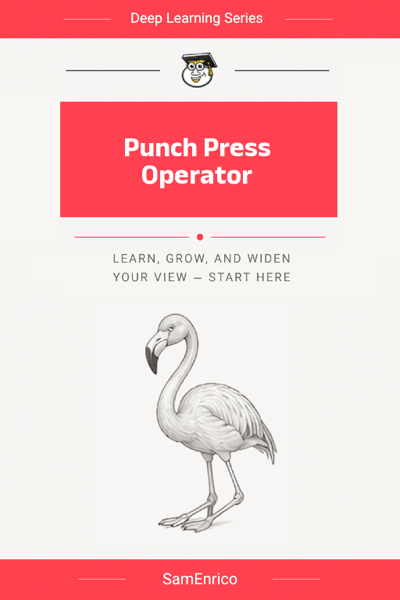
Non-FictionInformativeEducational
Punch Press Operator eBook
A Coursebook on Punch Press Operator
A Coursebook on Punch Press Operator
Formats
Free sample
Chapter 1: The Machine Remembers...--–- It was 2:47 on a Tuesday afternoon when the press tried to kill him. Not because the machine was evil or haunted or poorly designed. The press was simply being a press. It was doing exactly what it was built to do: store energy, release it, store it again, release it again, twelve times every minute, shift after shift, year after year. But on that Tuesday, the man operating it made a decision that lasted less than one second.
He reached past the light curtain. He thought he could beat the cycle. He could not.The paramedics arrived seven minutes later. They found him sitting on a stool with his right hand wrapped in a shop rag that was already soaked through. His face was pale, not from blood loss but from shock.
He kept repeating the same sentence: “It didn’t even hurt. Why doesn’t it hurt?” The foreman, a woman who had been running presses since the Reagan administration, looked at the rag and knew immediately that he would never again hold a wrench with that hand. The light curtain had been working perfectly. He had disabled it with a zip tie. Fifteen years of safe operation, erased by one moment of impatience.That story is not in any accident report because it happened last month.
The names have been changed because the lawsuit is still pending. The press, a 200-ton mechanical with a part-revolution clutch, has already been cleaned, repaired, and returned to service with a new operator standing in front of it. The machine remembers nothing. But you will remember this chapter if you do one thing: commit to being the operator who never becomes the story.This is not a textbook. Textbooks are safe, dry, and forgettable.
This is a coursebook, which means it is designed to be used, marked up, and referred back to until the pages soften from handling. The difference matters because what you are about to learn will determine whether you go home with all your fingers at the end of every shift. There is no multiple-choice test at the end of this book that can certify you as “safe.” Safety is not a certificate. Safety is a daily choice, sometimes an hourly choice, sometimes a choice you have to make between one stroke and the next.Before we talk about die clearance or shut height or the difference between a progressive die and a transfer die, we need to talk about why this job exists, what it demands of you, and whether you are the right person to stand in front of a machine that can flatten a steel bar into a shiny coin without noticing.The Quiet Violence of Metal Forming Metal stamping is a form of controlled violence. That might sound dramatic, but spend five minutes watching a 400-ton press cycle at sixty strokes per minute and you will understand.
The ram comes down with enough force to turn a one-inch-thick aluminum plate into a pancake. The sound is not a click or a thud. It is a concussive impact that you feel in your chest. The floor vibrates. Small chips of metal fly into the air and land on your arms like hot rain.
The finished part drops into a bin with a clatter that never quite becomes background noise, no matter how many years you stand there.And yet, within that violence is precision measured in thousandths of an inch. The same press that can crush a soda can into a disk can also punch a hole that varies no more than five ten-thousandths of an inch from part to part. The same ram that descends with fifty tons of force stops at bottom dead center within a few degrees of rotation, every single time. The machine is a paradox: brutally powerful yet exquisitely precise. The operator’s job is to respect both halves of that paradox.Most people outside manufacturing imagine that punch press operators are unskilled laborers who pull a lever all day.
That misconception is persistent and expensive. It costs industry billions of dollars in turnover, rework, and accidents. It costs operators their careers when they are promoted into roles for which they are not prepared. And it costs students like you the opportunity to see this trade for what it actually is: a profession that rewards mechanical intuition, steady attention, and the kind of calm problem-solving that cannot be automated away.Consider what a skilled operator actually knows. You know how to read a blueprint that looks like a plate of spaghetti to anyone else.
You know that a flatness callout of 0.005 inches means something different on a three-inch part than on a twelve-inch part. You know that the tonnage calculation formula is perimeter times thickness times shear strength divided by two thousand, and you know that underestimating tonnage by ten percent can stall the press and overestimating by ten percent can crack the frame. You know that dies have personalities: this one likes to be clamped on the left side first, that one will shift if you tighten the rear bolts before the front. You know that the sound of a press with a dying bearing is different from the sound of a press with a misaligned feed, and you know which one requires an immediate stop and which one can wait until the end of the shift.That is not unskilled labor. That is expertise.
And expertise is what this book is designed to build.Who This Book Is For (And Who Should Put It Down)Let me be direct about who should read this book. You should read it if you are new to stamping and want a complete education that safety manuals and quick-start guides do not provide. You should read it if you have been running presses for a while but learned by watching the person before you, and you suspect there are gaps in your knowledge. You should read it if you are a trainer, supervisor, or safety manager looking for a structured curriculum to use with new hires. You should read it if you are considering a career in manufacturing and want to understand one of its most essential roles before you invest time and money in training.You should put this book down and walk away if you are looking for shortcuts.
There are no shortcuts in stamping. Every bypassed safety device, every skipped inspection, every “it’s probably fine” is a bet against the laws of physics. The house always wins. You should also put it down if you are not willing to do the math. The math in this book is not calculus or trigonometry.
It is basic arithmetic: addition, subtraction, multiplication, division, fractions, decimals. But you have to do it, and you have to do it correctly, because a measurement error of 0.010 inches can scrap a thousand parts before anyone notices. If numbers make your brain shut down, stamping is not for you.Finally, you should put this book down if you are not willing to take responsibility for your own safety. No employer can watch you every second. No light curtain can protect you…
This is the end of the free sample. Get the eBook to keep going. Buy now
About this book
Details
- Author
- Todd Sylvester
- Publisher
- SamEnrico
- Language
- English
- Genre
- Non-Fiction, Informative, Educational
- Released
- 2026-05-11
- Pages (approx.)
- 105
- Available as
- eBook, Audiobook

Read better in the ZLOADR app
Your eBooks on your phone or tablet. Sign in with your SamEnrico account and start reading.
More by Todd Sylvester
 Israeli Immigrant Tech SuccessTodd Sylvester$11.99
 Parent Friendship Support GuideTodd Sylvester$11.99
 ABCDE for College Admissions GuideTodd Sylvester$11.99
 The HGH Exercise TimingTodd Sylvester$11.99
 AI Cooperative Learning PlannerTodd Sylvester$11.99
 The Battle of Fallen Timbers: The Last Stand of the Northwest ConfederacyTodd Sylvester$11.99
 Ultimate Handbook Guide to Xuanwei : (China) Travel GuideTodd Sylvester$11.99
 Asana Trello Notion Tool Comparison GuideTodd Sylvester$12.99
 Project Management Agile GuideTodd Sylvester$12.99
 Understanding Megalocytic Interstitial NephritisTodd Sylvester$17.99
You may also like
 Hong Kong Handover 1997Dunn Johnnie$11.99
 Zumba For Postnatal Recovery CourseNeal Christian$11.99
 Zumba for BeginnersLadner Nikia$11.99
 YouTube Comment Mining GuideHumes Pandora$12.99
 Worry Box MeditationCarlin Rudy$11.99
 Workplace Stress MeditationNguyen Lynn$11.99
 Workplace Stress and Sleep RepairHawley Ivory$11.99
 Workplace Perfectionism CureDelaney Jeffry$11.99
 Workplace Injustice Anger GuideWallen Isabelle$11.99
 Work Addiction and Burnout LinkGreenwood Ester$11.99
 Women in Yoga and WellnessBeattie Galina$11.99
 Women in Stand Up ComedyChun Evangeline$11.99