
Non-FictionHealth & WellnessSupplement Science
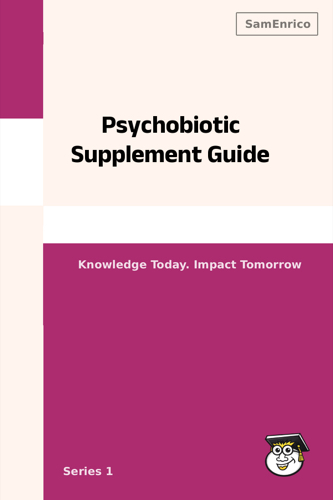
Psychobiotic Supplement Guide eBook
Recommends specific probiotic strains and dosages
by Nevarez Yuki
Recommends specific probiotic strains and dosages for depression, anxiety, and stress reduction.
Formats
Free sample
Chapter 1: The Second Brain--Most people believe their mind resides exclusively between their ears. They imagine thoughts bubbling up from some mysterious neural cauldron inside the skull, emotions sparking in the amygdala, memories stored in the hippocampus like files in a cabinet. The brain, in this view, is the commander. The rest of the body is merely along for the ride.This is wrong.Not slightly inaccurate. Not missing a few nuances.
Fundamentally, structurally, embarrassingly wrong.The truth is stranger and more empowering than any neuroscience textbook from twenty years ago would have you believe. Your mood, your anxiety levels, your ability to handle stress, even your cravings and your sleep quality—these are not solely products of your brain. They are, to a startling degree, products of your gut. Specifically, they are products of the hundred trillion microorganisms living inside your digestive tract, a hidden ecosystem so vast and so influential that scientists have given it a name: the gut microbiome.This chapter will fundamentally change how you understand your own body. By the time you finish reading, you will never think about your gut as merely a digestive tube again.
You will see it for what it is: a neurological powerhouse, a neurotransmitter factory, and the most underappreciated organ in the story of mental health.The Five Hundred Million Neuron Discovery Let us begin with a fact that should stop you cold. Your gut contains over five hundred million neurons. That is more than the number of neurons in the spinal cord. It is roughly equivalent to the number of neurons in a cat's entire brain. Scientists call this the enteric nervous system (ENS), but you might know it by its more evocative nickname: the second brain.The second brain does not write poetry or solve calculus problems.
It does not hold your childhood memories or recognize your mother's face. But it does something arguably just as important for your daily well-being: it runs the entire show of digestion, absorption, and motility, all while maintaining constant, intimate conversation with the brain inside your skull.Here is where most people get confused. They assume the brain in the head tells the gut what to do. After all, that is the intuitive model: the commander gives orders, the soldier follows. But the anatomy tells a different story.
The vagus nerve, a thick cable of neural tissue running from the brainstem all the way down to the abdomen, is the primary communication line between the two brains. And here is the shocking detail that changes everything: approximately eighty to ninety percent of the nerve fibers in the vagus nerve carry signals from the gut to the brain. Only ten to twenty percent carry signals from the brain to the gut.Read that again. The gut talks to the brain ten times more than the brain talks to the gut.Your microbiome is not a passive recipient of commands from above. It is an active broadcaster, constantly sending signals that shape your mood, your stress response, and even your cognitive function.
When your gut is healthy and diverse, those signals promote calm, resilience, and mental clarity. When your gut is inflamed, imbalanced, or overrun by pathogenic bacteria, those signals promote anxiety, depression, and brain fog.This is not metaphor. This is physiology.The Microbial Neurotransmitter Factories To understand how the gut influences the brain, you need to understand neurotransmitters. These are chemical messengers that carry signals between neurons. When you feel anxious, that is GABA levels dropping.
When you feel motivated, that is dopamine rising. When you feel content and socially connected, that is serotonin doing its job.Conventional psychiatry treats neurotransmitters as brain problems. If you are depressed, the theory goes, your brain is not making enough serotonin, so take an SSRI to keep more serotonin in the synapses. This model has helped millions of people, and this book is not here to dismiss it. But the model is incomplete because it ignores where most of those neurotransmitters actually come from.Consider serotonin.
The textbook version says serotonin is a brain chemical. The true version says that approximately ninety percent of the body's serotonin is synthesized not in the brain but in the gut. Specifically, enterochromaffin cells lining the intestinal wall produce massive quantities of serotonin in response to signals from the gut microbiome. Certain bacterial species, including Candida, Streptococcus, and Enterococcus, directly manufacture serotonin or stimulate its production. Your gut microbes are, quite literally, making the molecule that regulates your mood, sleep, appetite, and social behavior.Consider GABA (gamma-aminobutyric acid), the brain's primary inhibitory neurotransmitter.
GABA is the brake pedal of the nervous system. When GABA is high, you feel calm, relaxed, and able to let things go. When GABA is low, you feel anxious, tense, and prone to rumination. Lactobacillus and Bifidobacterium species—the same friendly bacteria found in fermented foods and high-quality probiotics—convert glutamate into GABA through a process called decarboxylation. They are manufacturing your calmness in real time.Consider dopamine and norepinephrine.
These are the alertness and motivation molecules. When dopamine is balanced, you feel focused, driven, and capable of pursuing goals. When it is dysregulated, you feel apathetic, anhedonic (unable to feel pleasure), or compulsively driven. Escherichia coli, Bacillus, and Saccharomyces species produce these catecholamines directly. Your gut bacteria are influencing your drive to achieve, your ability to focus, and your experience of reward.The implications are staggering.
When you take a psychobiotic—a probiotic strain specifically chosen for its brain effects—you are not just supporting digestion. You are supplementing your brain's neurotransmitter supply from the bottom up. You are giving your gut microbes the tools they need to manufacture the very molecules that determine how you feel.The Inflammation Highway: How Leaky Gut Becomes Leaky Brain Neurotransmitters are only half the story. The other half is inflammation.The gut lining is a remarkable structure. It is a single layer of epithelial cells bound together by tight junction proteins.
In a healthy gut, this barrier is selective: it allows nutrients, water, and electrolytes to pass through while blocking bacteria, toxins, and undigested food particles. This is called intestinal permeability, and when it is working correctly, you barely notice it. When it stops working correctly, you have a condition popularly known as leaky gut.Leaky gut happens when the tight junctions loosen. This can be caused by chronic stress, poor diet (especially processed foods, sugar, and emulsifiers), alcohol, certain medications (NSAIDs and antibiotics), and infections. When the junctions loosen, bacterial fragments called lipopolysaccharides (LPS) slip through the gut wall and into the bloodstream.Your immune system treats LPS like an invading army.
It launches a massive inflammatory response, flooding the bloodstream with pro-inflammatory cytokines: interleukin-6 (IL-6), tumor necrosis factor-alpha (TNF-α), and C-reactive protein (CRP). These cytokines are designed to fight infection, but when they are chronically elevated due to a leaky gut, they cause collateral damage throughout the body, including the brain.Here is where it gets truly fascinating and frightening. Cytokines are small enough to cross the blood-brain barrier, the protective shield that normally keeps pathogens and toxins out of the brain. Once inside, they trigger what scientists call sickness behavior. This is not depression in…
This is the end of the free sample. Get the eBook to keep going. Buy now
About this book
Details
- Author
- Nevarez Yuki
- Publisher
- SamEnrico
- Language
- English
- Genre
- Non-Fiction, Health & Wellness, Supplement Science
- Released
- 2026-06-07
- Pages (approx.)
- 134
- Available as
- eBook, Audiobook

Read better in the ZLOADR app
Your eBooks on your phone or tablet. Sign in with your SamEnrico account and start reading.
More by Nevarez Yuki
 Clinical Research Coordinator Protocol Stress WorkbookNevarez Yuki$11.99
 Disappointment in Spiritual PathNevarez Yuki$11.99
 Self Abandonment Recovery PrimerNevarez Yuki$11.99
 Breaking the Roulette Addiction CycleNevarez Yuki$11.99
 The Unbreakable Streak: The Legend of Joe DiMaggio’s 56Nevarez Yuki$11.99
 Cashier Team MemberNevarez Yuki$11.99
 How to Become a Coating-machine Operator INevarez Yuki$11.99
 Understanding Laterality Defects DominantNevarez Yuki$17.99
 Social Listening Sentiment EngineNevarez Yuki$12.99
 Freight Forwarder ConsolidationNevarez Yuki$12.99
You may also like
 Hong Kong Handover 1997Dunn Johnnie$11.99
 Zumba For Postnatal Recovery CourseNeal Christian$11.99
 Zumba for BeginnersLadner Nikia$11.99
 YouTube Comment Mining GuideHumes Pandora$12.99
 Worry Box MeditationCarlin Rudy$11.99
 Workplace Stress MeditationNguyen Lynn$11.99
 Workplace Stress and Sleep RepairHawley Ivory$11.99
 Workplace Perfectionism CureDelaney Jeffry$11.99
 Workplace Injustice Anger GuideWallen Isabelle$11.99
 Work Addiction and Burnout LinkGreenwood Ester$11.99
 Women in Yoga and WellnessBeattie Galina$11.99
 Women in Stand Up ComedyChun Evangeline$11.99