
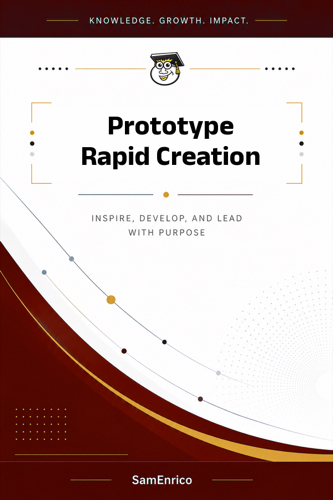
Prototype Rapid Creation eBook
Build quick low fidelity models to test ideas.
Build quick low fidelity models to test ideas.
Formats
Free sample
Chapter 1: The $10 Million Typo--The email arrived at 9:47 AM on a Tuesday. Marcus, the founder of a sixteen-person startup called Loomly, opened it while walking to the kitchen. The subject line read: "Dashboard Usage Data – Q3." He expected good news. They had spent eight months and four hundred and eighty thousand dollars building a new analytics dashboard based on a single customer’s enthusiastic comment during a sales call.The data showed the opposite of good news.Zero. Zero users had clicked on the dashboard in the past ninety days.
Not a single customer had opened it. Four hundred and eighty thousand dollars. Eight months of engineering time. Three developers pulled off other projects. And the result was a feature that might as well have never existed.Marcus’s head of engineering, a quiet woman named Priya who had opposed the dashboard from the beginning, stood in the doorway of the kitchen holding a paper napkin.
On the napkin, she had drawn a rough sketch of what the dashboard could have looked like. It took her forty-five seconds to draw. She had shown it to five customers at a coffee shop the week before the project started. Four of them said, “I don’t understand what this does.” The fifth said, “I would never use this.”Marcus had ignored the napkin. He had said, “That’s just a sketch.
Customers don’t react to sketches. We need to build it to know if they’ll use it.”He was wrong. And the napkin was right.This chapter is about why that story happens thousands of times every day across every industry, and why the solution is not better engineering, more market research, or faster development cycles. The solution is ugly, stupid, embarrassing, low-fidelity prototypes built in minutes instead of months. This chapter dismantles the single most expensive myth in product development: that good prototypes must be polished.
It introduces the Cost of Change Curve, a concept that will reframe how you think about every decision in the rest of this book. And it closes by redefining success in a way that will make you uncomfortable—because that discomfort is where growth lives.The Myth of Polished Perfection Every product team believes, at some level, that a prototype must look real to be valuable. This belief is so deeply embedded in corporate culture that it rarely gets questioned. A marketing executive wants a “clickable mockup.” A founder wants a “minimum viable product that feels like the real thing.” A designer opens Figma and spends six hours on a single screen because “the client needs to see the vision.”Here is the truth that the best-selling books on prototyping—from The Lean Startup to Sprint to Design of Everyday Things—all converge upon: High-fidelity prototypes are dangerous.Why? Because they attract the wrong kind of feedback.
When you show someone a polished, high-fidelity prototype—full color, custom illustrations, smooth animations—they will comment on the color. They will comment on the font. They will say things like “the button should be more rounded” or “the blue is too dark.” These are opinions about aesthetics, not insights about functionality.When you show someone a cardboard box with a hole cut in it, they will comment on whether their hand fits through the hole. They will try to press the button that isn’t there and then complain that nothing happened. They will reveal, through their actions, where your design actually fails.This is not a small difference.
It is the difference between building something people want and building something that looks nice on a screen but fails in the real world.Consider the case of IBM’s design transformation in the early 2010s. The company had spent decades building enterprise software that won awards for visual design but lost customers because nobody could figure out how to use it. When the new design leadership arrived, they banned high-fidelity prototypes for the first three weeks of every project. Teams were required to build prototypes out of paper, sticky notes, and index cards. Executives were invited to user tests where they watched customers struggle with paper screens.The result was not chaos.
The result was clarity. Teams discovered within days—not months—which features were actually useful and which were just decorations. The paper prototypes were thrown away after each test, but the learnings survived. IBM’s enterprise software became usable for the first time in a decade.The Cost of Change Curve To understand why low-fidelity prototyping works, you need to understand the single most important economic concept in product development: the Cost of Change Curve.Imagine a simple design flaw. Let’s say a button is placed in the wrong location on a screen.
A user expects it on the left, but you put it on the right. Users keep clicking the wrong area, getting frustrated, and abandoning the task.Now imagine three different moments when you could fix that flaw.Moment One: You fix it on a paper prototype. You draw the button in the wrong place. A user clicks the empty space. You move your Sharpie, redraw the button on the left, and test again.
Total time: thirty seconds. Total cost: the depreciation on a piece of paper and a marker. Let’s call it one cent.Moment Two: You fix it in a coded prototype or early production build. The button is already programmed to be on the right. Changing it requires opening your code editor, finding the correct file, modifying the CSS or layout code, recompiling, redeploying to a test environment, and re-testing.
The engineer who makes the change costs fifty to one hundred and fifty dollars per hour. The change takes one to four hours. Total cost: fifty to six hundred dollars.Moment Three: You fix it after launch. The button is in production. Five thousand users have already been confused.
Customer support tickets are flooding in. Changing the button now requires a full regression test, a deployment pipeline, possibly an app store review if it’s a mobile app, and a communications plan to notify users of the change. Total cost: thousands of dollars, plus lost customer trust, plus the hidden cost of the support tickets you already answered.The Cost of Change Curve is exponential. The later you fix a problem, the more expensive it becomes. And here is the cruel irony: the problems you find later are the exact same problems you could have found earlier, if you had only looked with the right tool.A paper prototype costs pennies to change.
Production code costs fortunes. That is not an exaggeration. That is the fundamental economics of product development, confirmed by every major study from the National Institute of Standards and Technology to the Consortium for IT Software Quality.Why High-Fidelity Prototypes Are a Trap If low-fidelity prototypes are so effective, why does almost every team reach for high-fidelity tools first? The answer is psychological, not logical.Fear of looking unprofessional. No product manager wants to walk into a stakeholder meeting holding a piece of paper with a crooked line drawn on it.
They want a clickable Figma prototype that makes the team look sophisticated. This fear is understandable but destructive. The stakeholder…
This is the end of the free sample. Get the eBook to keep going. Buy now
About this book
Details
- Author
- Buckingham Shayne
- Publisher
- SamEnrico
- Language
- English
- Genre
- Non-Fiction, Self-Help, Prototyping
- Released
- 2026-06-11
- Pages (approx.)
- 152
- Available as
- eBook, Audiobook

Read better in the ZLOADR app
Your eBooks on your phone or tablet. Sign in with your SamEnrico account and start reading.
More by Buckingham Shayne
 Law Firm Layoff GuideBuckingham Shayne$11.99
 The Crucial Conversation WorkbookBuckingham Shayne$11.99
 Customer Need Mapping PlanBuckingham Shayne$11.99
 Joy for ExtrovertsBuckingham Shayne$11.99
 Handling Q and A SessionsBuckingham Shayne$11.99
 Building Creative ResilienceBuckingham Shayne$11.99
 Adoptive Parent Anger GuideBuckingham Shayne$11.99
 Blood and Shield: The Zulu Sun Rises at IsandlwanaBuckingham Shayne$11.99
 The Legend of 'El Chino' Hernández: How a Mexican Comedian Conquered Latin America's StagesBuckingham Shayne$11.99
 Armadillos: Unique Placental MammalsBuckingham Shayne$11.99
 Post Pop Up Strategy GuideBuckingham Shayne$12.99
 Free Business Phone Number WorkbookBuckingham Shayne$12.99
You may also like
 Collaborative Prototyping Sessions CourseKellogg Luci$11.99
 Play Doh Prototyping GuidePringle Shantelle$11.99
 The Non Artist Prototyping GuidePatten Adela$11.99
 Collaborative Prototyping GuideFinch Caitlyn$11.99
 Idea Prototyping GuideOverton Barabara$11.99
 Prototyping for Non MakersEllison Eden$11.99
 Rapid Prototyping GuideSaxton Sharita$11.99
 Collaborative Prototyping LabToney Willow$11.99
 Prototyping for Problem SolversBeebe Chet$11.99