
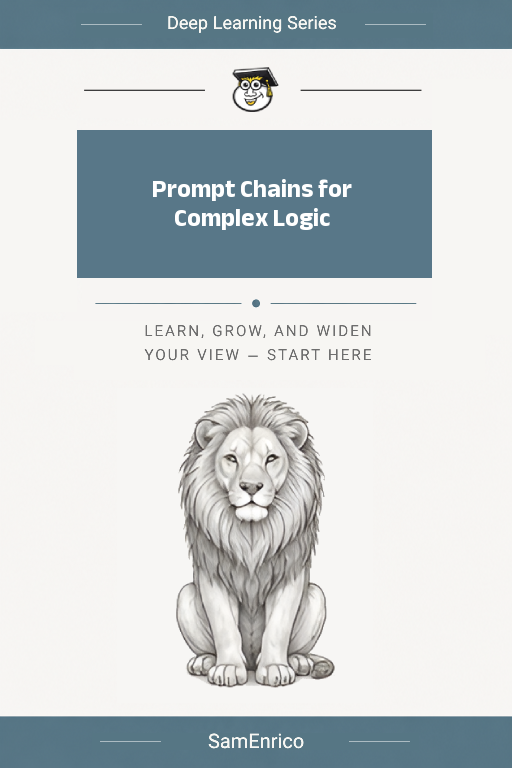
Non-FictionAI OperatorSoftware Craft
Prompt Chains for Complex Logic eBook
Break complex programming tasks into prompt sequen
by Coons Elicia
Break complex programming tasks into prompt sequences. Build features step by step with AI guidance.
Formats
Free sample
Chapter 1: The 5,000-Lie Monster--–- Sarah had been an engineer for eleven years. She’d shipped features at two unicorns, debugged memory leaks in production at 3 AM, and once explained a left join to a product manager without losing her temper. But on a gray Tuesday afternoon, sitting in front of an Anthropic chat window, she did something that made her feel like a complete amateur.She wrote the perfect prompt.It wasn’t her first try. Over the course of ninety minutes, she’d refined it like a poem:text Copy Download You are a senior backend architect. Build me a complete microservices-based
order management system with the following components: user authentication (JWT-based), inventory management (real-time reservation), payment processing (Stripe integration), shipping label generation (Ship Station API), and order history (read replicas). Use Python Fast API for all services. Include Dockerfiles, docker-compose for local development, and a README explaining how to run it. Handle edge cases: out-of-stock, payment failure, and duplicate orders.She hit Enter.The AI thought for several seconds—that familiar typing animation that tricks your brain into thinking a tiny intelligence is working hard just for you—and then it began to stream.And stream.And stream.Three minutes later, the screen held over 5,000 lines of code across fourteen files. Sarah leaned back, smiling. This was the future. This was why people said software engineering was about to change forever.Then she tried to run it.The First Crack The first error appeared within thirty seconds. In the auth service, a variable called user_id was being passed to the inventory service, but the inventory service expected customer Id. Sarah fixed it manually. Then the payment service couldn’t find the Order Total class because the order service had defined it as order_total. She fixed that too.Then she tried to reserve inventory before payment. The code ran—sort of—but it reserved items even when the payment later failed, leaving ghost inventory that couldn’t be released. She traced the logic and found that the AI had written the payment webhook handler first, then the inventory reservation, but had never connected them with any kind of rollback.By hour four, Sarah had identified seventeen distinct bugs. By hour six, she had abandoned the AI-generated code entirely and was rewriting it from scratch using the structure she would have written anyway.She had spent six hours to save zero hours.She had been vibing. And the vibe had lied.The Big Bang Myth What Sarah experienced is so common among AI-assisted developers that it has a name: the Big Bang Prompt. The belief that a single, detailed, well-crafted prompt can generate a complete, working, production-ready system.It’s seductive. The AI is smart. It can write code in seconds that would take you hours. Why wouldn’t you just ask for everything at once?Because the AI is also profoundly, dangerously limited in ways the chat interfaces hide from you.Let me show you what Sarah couldn’t see while the tokens were streaming.Three Silent Killers Killer One: The Finite Context Window Every LLM has a maximum context window—the total number of tokens it can process in a single call. When you paste a massive prompt and ask for 5,000 lines of code, you’re filling that window to the brim.As of this writing, GPT-4 has a context window of 128,000 tokens. Claude 3 Opus has 200,000. That sounds enormous. But here’s what those numbers actually mean:A single line of code averages 15-20 tokens.200,000 tokens is roughly 10,000-13,000 lines of code.That’s enough for a small-to-medium application.So what’s the problem?The problem is attention decay. Studies of transformer-based LLMs consistently show that the model’s ability to recall and use information degrades significantly as you approach the context limit. One widely cited analysis found that GPT-4’s accuracy on information in the first 10% of the context window was nearly perfect, but accuracy on information in the final 10% dropped by roughly 40%.Think about what that means for your big bang prompt.You write: “The user authentication service should use JWT tokens with a 15-minute expiration and refresh tokens stored in Redis.”By the time the AI reaches the payment service section of its response, it has partially forgotten that instruction. Maybe it implements JWTs but forgets the refresh tokens. Maybe it uses the wrong expiration. Maybe it hardcodes a secret instead of reading from environment variables.The AI isn’t being lazy. It’s not stupid. It’s working with a degraded memory of your instructions because you asked it to hold too much at once.Killer Two: The Hallucination Cascade A single hallucination is bad. A cascade of hallucinations is catastrophic.Here’s what a cascade looks like. The AI hallucinates that a function called validate_payment_method exists. Later, it hallucinates that this function returns an object with a .status field. Later still, it hallucinates a conditional branch based on .status == 'approved'. Each new hallucination is built on the ruins of previous ones.The cascade has a mathematical property that makes it especially dangerous: each new hallucination increases the probability of the next one. Research on chain-of-thought reasoning errors found that once an LLM introduces an incorrect assumption, the likelihood of subsequent errors multiplies by approximately 1.8x.That means if your big bang prompt contains one hallucination—say, an invented API endpoint—the chance of a second hallucination is nearly double. A third hallucination is nearly triple the baseline.By the time you’ve generated 5,000 lines, you’re not debugging code. You’re excavating a collapsed building.Killer Three: No Persistent State This is the killer that most developers misunderstand.Between generating two separate code blocks, the AI remembers nothing. Absolutely nothing.When you ask it to write the auth service and then later ask it to write the inventory service that calls the auth service, the AI has no memory of the variable names, function signatures, or return types it used in the auth service. It writes the inventory service in a vacuum.This is why Sarah saw user_id and customer Id. The AI invented the first name in one generation and a different name in another. It wasn’t inconsistency—it was amnesia.The chat interface creates an illusion of memory by showing you the conversation history, but that history is part of your input to each new prompt. The AI doesn’t remember. You have to remind it, every single time, of everything it needs to know.And when your prompt is 5,000 lines long, you’re not reminding it of anything. You’re overwhelming it.The Data That Should Scare You Let me share three numbers that changed how I think about AI-assisted development.Number one: A systematic evaluation of LLM performance across varying context lengths found that accuracy on tasks requiring information from the middle of the context window dropped by an average of 27% compared to tasks using information from the beginning. For tasks requiring information from the end of the context window (where the AI just wrote something and immediately needs to reference it), the drop was even steeper—approaching 50% in some models.Number two: In a controlled study of 100 developers using AI to build full-stack features, the “big bang prompt” approach had a first-time success rate of just 12%. Success was defined as code that ran without critical bugs. The remaining 88% required at least 90 minutes of manual debugging—longer, on average, than just writing the feature from scratch.Number three: The average big bang…
This is the end of the free sample. Get the eBook to keep going. Buy now
About this book
Details
- Author
- Coons Elicia
- Publisher
- SamEnrico
- Language
- English
- Genre
- Non-Fiction, AI Operator, Software Craft
- Released
- 2026-05-30
- Pages (approx.)
- 116
- Available as
- eBook, Audiobook

Read better in the ZLOADR app
Your eBooks on your phone or tablet. Sign in with your SamEnrico account and start reading.
More by Coons Elicia
 MAT And Pregnancy OutcomesCoons Elicia$11.99
 Listening Across CulturesCoons Elicia$11.99
 The Franklin D. Roosevelt GuideCoons Elicia$11.99
 Black Friday Avoidance PlanCoons Elicia$11.99
 Cortés and the Conquest of the Aztec Empire: A Clash of CivilizationsCoons Elicia$11.99
 Learn to Play the SackbutCoons Elicia$11.99
 Dietary AideCoons Elicia$11.99
 How to Start a Fish Dish (prepared) Production Business (Beginners Guide)Coons Elicia$11.99
You may also like
 Hong Kong Handover 1997Dunn Johnnie$11.99
 Zumba For Postnatal Recovery CourseNeal Christian$11.99
 Zumba for BeginnersLadner Nikia$11.99
 YouTube Comment Mining GuideHumes Pandora$12.99
 Worry Box MeditationCarlin Rudy$11.99
 Workplace Stress MeditationNguyen Lynn$11.99
 Workplace Stress and Sleep RepairHawley Ivory$11.99
 Workplace Perfectionism CureDelaney Jeffry$11.99
 Workplace Injustice Anger GuideWallen Isabelle$11.99
 Work Addiction and Burnout LinkGreenwood Ester$11.99
 Women in Yoga and WellnessBeattie Galina$11.99
 Women in Stand Up ComedyChun Evangeline$11.99