
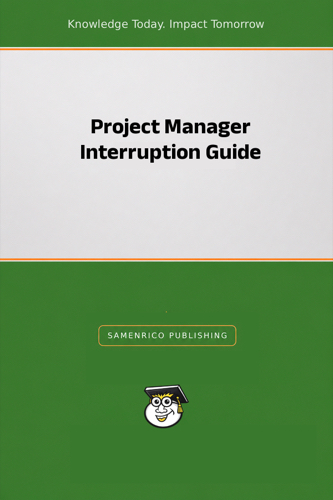
Project Manager Interruption Guide eBook
Handle stakeholder questions without losing produc
Handle stakeholder questions without losing productivity using this practical PM focus handbook.
Formats
Free sample
Chapter 1: The 23-Minute Tax--–- Sarah had been staring at the same Gantt chart for forty-seven minutes. Not because it was complicated—she had built hundreds of them over her twelve years as a project manager—but because she had been interrupted eleven times since she opened the file. Each time, she told herself it would only take a second. Each time, she was wrong.The first interruption came at 9:14 AM, just as she was identifying a critical path dependency between the server migration and the UAT schedule. Her product owner, Marcus, appeared at her desk with a question about a ticket in the backlog.
"Real quick," he said. Sarah answered in forty-five seconds. Marcus left. Sarah looked back at her screen. The dependency she had been tracing was gone from her mind.
It took her nearly twenty minutes to find her place again.By 11:30 AM, she had been interrupted by the QA lead, a stakeholder from marketing, her own boss, and two Slack messages that she made the mistake of answering immediately. At 2:00 PM, she gave up on deep work entirely and spent the afternoon in meetings. At 5:00 PM, she looked at the Gantt chart. It was unchanged from the morning. She had been at her desk for eight hours and had accomplished approximately ninety minutes of actual focused work.Sarah is not lazy.
She is not disorganized. She is not bad at her job. Sarah is a victim of the 23-Minute Tax.The Mathematics of Fragmentation Let us begin with a deceptively simple question: How long does an interruption actually cost you?If you ask most project managers this question, they will give you the duration of the interruption itself. "Oh, about two minutes," they will say. Or "maybe five, if the stakeholder is chatty." This answer is not just wrong—it is catastrophically wrong.
It is the difference between thinking you are losing twenty minutes a day and realizing you are losing over two hours.The error is understandable. When a stakeholder appears at your desk and asks a question, you stop what you are doing. You answer the question. The stakeholder leaves. You return to your work.
The clock says that the entire exchange took ninety seconds. So you assume you lost ninety seconds.But you did not. You lost far more.In 2009, the cognitive psychologist Sophie Leroy published a landmark study introducing the concept she called "attention residue." Her research revealed something counterintuitive: when you switch from Task A to Task B, your brain does not cleanly let go of Task A. Instead, a portion of your cognitive processing remains stuck on the original task, like a shadow that follows you into the new one. This residue degrades your performance on Task B.
More importantly, it prevents you from fully re-engaging with Task A when you return. You are not really back. Part of you is still thinking about the interruption.Leroy found that the average time required for attention residue to dissipate after an interruption is approximately twenty-three minutes. Not two minutes. Not five.
Twenty-three minutes.Let us return to Sarah's morning. The product owner's question took forty-five seconds. But the cost was not forty-five seconds. It was forty-five seconds plus twenty-three minutes of attention residue. Her brain, even after Marcus left, was still partially occupied with the conversation, the ticket, the question, the answer.
She was not truly focused again until nearly 9:40 AM. Then the QA lead interrupted at 9:42 AM. The clock reset.By this accounting, Sarah's eleven interruptions did not cost her eleven short conversations. They cost her eleven recovery periods. At twenty-three minutes each, that is over four hours of lost productivity—more than half of her workday.This is the 23-Minute Tax.
And you are paying it every single day.The Attention Residue Deep Dive Before we can solve a problem, we must understand its mechanism. Why does attention residue happen? Why can we not simply "snap back" into focus after a quick question?The answer lies in the fundamental architecture of human cognition. Your brain is not a computer processor capable of rapid context switching without penalty. It is a biological organ designed for sustained, uninterrupted attention to a single task.
The neural networks that support deep concentration—what psychologist Mihaly Csikszentmihalyi famously called "flow"—take time to activate. They also take time to deactivate and reactivate.Consider what happens when you are deeply focused on a complex project management task: say, recalculating the critical path after a vendor delay. Your working memory is holding multiple variables simultaneously: task durations, dependencies, resource availability, risk probabilities, stakeholder constraints. Your long-term memory is retrieving relevant past experiences. Your executive function is sequencing decisions.
This is a symphony of cognitive activity.When an interruption occurs, your brain does not simply "pause" this symphony. It tries to keep the music playing while also attending to the stakeholder. This dual-processing is impossible to sustain, so your brain makes a trade-off: it maintains a partial representation of the original task while shifting most of its resources to the interruption. The partial representation is attention residue. It is incomplete, fragmented, and unreliable, but it is there.When the stakeholder leaves, your brain now faces an even harder task: it must suppress the interruption's representation while reactivating the original task's full representation.
This is not instantaneous. In Leroy's studies, participants took an average of twenty-three minutes to reach the same level of cognitive performance they had before the interruption. For highly complex tasks—like those project managers perform daily—the recovery time is often longer.A 2014 study by Gloria Mark at the University of California, Irvine, reinforced these findings. Mark placed digital trackers on knowledge workers and measured their focus patterns. She found that the average worker was interrupted every eleven minutes.
More troubling, she found that it took an average of twenty-five minutes to return to the original task after each interruption. The 23-Minute Tax was not an outlier. It was the norm.Collaboration versus Intrusion: A Critical Distinction At this point, a skeptical reader might object: "Are you saying I should never speak to anyone? That collaboration is bad?" Absolutely not. That is a dangerous misinterpretation—and one that has gotten many well-intentioned project managers labeled as bottlenecks or antisocial.The solution is not to eliminate all interruptions.
The solution is to distinguish between two fundamentally different types of interaction: collaboration and intrusion.Collaboration is planned, mutual, and agenda-driven. It advances the project. It happens on a schedule that respects both parties' need for focus. Examples include a scheduled weekly status meeting with stakeholders, a thirty-minute design review on the calendar, a daily stand-up with your development team, or a negotiated fifteen-minute conversation about a risk mitigation strategy. In collaboration, both participants know that the interaction is happening.
Both have prepared. Both have allocated time.Intrusion is unplanned, unilateral, and low-value. It serves the asker's curiosity or anxiety but does not meaningfully advance the project. Examples include a stakeholder walking to your desk to ask "Are we on track?" when they could check the dashboard, a Slack message that says "Quick question" with no context, an email forwarded with the single word "Thoughts?", or a drive-by…
This is the end of the free sample. Get the eBook to keep going. Buy now
About this book
Details
- Author
- Keenan Adelia
- Publisher
- SamEnrico
- Language
- English
- Genre
- Non-Fiction, Self-Help, Project Management
- Released
- 2026-06-06
- Pages (approx.)
- 142
- Available as
- eBook, Audiobook

Read better in the ZLOADR app
Your eBooks on your phone or tablet. Sign in with your SamEnrico account and start reading.
More by Keenan Adelia
 Food Addiction Recovery Acupuncture GuideKeenan Adelia$11.99
 Lecture Note Taking ChunkingKeenan Adelia$11.99
 Anger in In-Law RelationshipsKeenan Adelia$11.99
 Beginner Group Fitness ClassKeenan Adelia$11.99
 The Last Whisper of the DodoKeenan Adelia$11.99
 Orbiting Dreams: The Forgotten Pioneers of Space HabitationKeenan Adelia$11.99
 Fitness InstructorKeenan Adelia$11.99
 Understanding Encephalocele FrontalKeenan Adelia$17.99
 Bookkeeping Scope CreepKeenan Adelia$12.99
 Oversized Cargo TransportKeenan Adelia$12.99
 How to Start a Prefabricated Buildings Made of Wood (commission Agent) Business (Beginners Guide)Keenan Adelia$11.99
You may also like
 Remote Project CommunicationMorse Kirby$11.99
 Todoist Advanced ProjectsBox Wendi$11.99
 Self Esteem for Project LeadersSilverman Johnny$11.99
 Pomodoro Goal Breakdown MethodHatley Ruthanne$11.99
 Active Listening For ScrumMackay Chin$11.99
 Weekly Project ReviewBustamante Soon$11.99
 Project Weekly Review GuideBraswell Janell$11.99
 EQ For Project ManagersEng Aretha$11.99
 Workaholism in Project ManagementMalcolm Misti$11.99
 Stakeholder Mapping GuideHutchinson Angle$11.99
 Project Manager Stress GuideDozier Asia$11.99
 Project Management CreativityHathaway Colene$11.99