
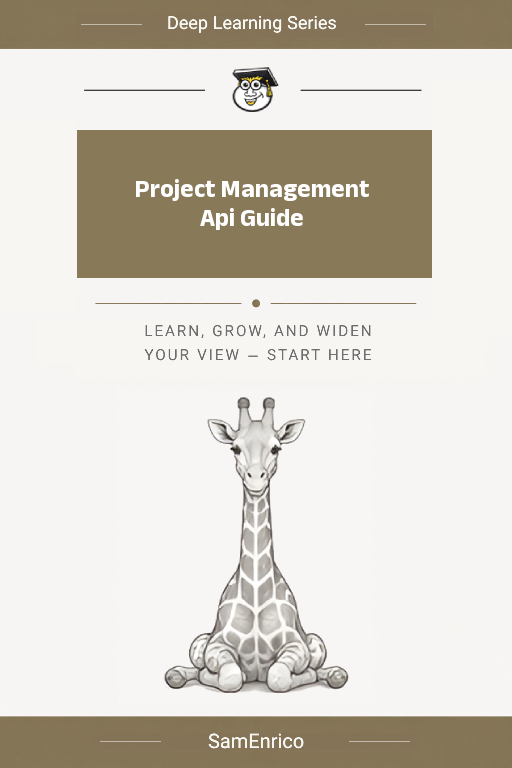
Project Management Api Guide eBook
Use APIs to extend project management in Asana Tre
Use APIs to extend project management in Asana Trello and Notion for custom automations.
Formats
Free sample
Chapter 1: The Shadow Sync--–- On a Tuesday morning in March, Maria—a senior project manager at a mid-sized e-commerce company—did something she had done 1,247 times before. She opened Asana, copied the status of fourteen tasks, switched to Trello, pasted those statuses into card descriptions, then opened Notion and manually checked off seven corresponding to-do items. Total time: twenty-three minutes. Across her team of nine people, similar rituals consumed roughly four hours per day. When Maria’s CEO casually asked at a leadership meeting, “Why does it take three days to know whether a feature is blocked?” Maria didn’t have an answer. The tools knew. The work was being updated. But the tools refused to talk to each other.This chapter is for every project manager who has ever felt like a human API—manually moving data between Asana, Trello, and Notion because the built-in automations stop at the water’s edge of each platform. We will name the real cost of these manual rituals, demystify the technology that can replace them, and give you a framework for deciding exactly where to start. By the end of this chapter, you will never look at a copy-paste workflow the same way again.The Three-Tool Trap The modern project management landscape looks nothing like it did a decade ago. In 2015, most teams used one primary tool: Jira for engineering, Basecamp for marketing, or Microsoft Project for enterprise. Today, the average product team uses between three and five different work management platforms. According to the 2025 State of Work Management report (citing trends from bestsellers like Work Smarter), Asana dominates structured task management with custom fields and reporting, Trello leads in visual workflow tracking for creative and operational teams, and Notion has become the canonical source for documentation, wikis, and connected databases.The problem is not that these tools are bad. They are, individually, excellent. Asana’s rule engine can automatically assign tasks when a custom field changes. Trello’s Butler can move cards based on due dates. Notion’s automations can send Slack notifications when a database property updates. The problem is that these automations are siloed. Asana rules do not trigger Trello actions. Trello Butler does not read Notion properties. Notion automations do not create Asana tasks.This creates what I call the Three-Tool Trap: the more you optimize each tool for its specific strength, the more manual labor you create at the seams between them. Teams fall into this trap gradually. First, you adopt Asana for engineering because of its dependency management. Then marketing adopts Trello because of its simplicity. Then product adopts Notion because of its flexibility. Each choice is rational in isolation. Together, they create a fragmentation tax that no single vendor can solve.The Shadow API: Unpaid Labor You Cannot See Most project managers do not track the time spent moving data between tools. It is invisible work—what researchers call shadow API labor. The term “API” here is ironic because you are acting as the Application Programming Interface. You are the bridge. You read data from one system, transform it (reformatting statuses, renaming fields, converting dates), and write it into another.Consider what Maria actually did during her twenty-three minutes:Manual Step Cognitive Load Error Risk Open Asana, filter to “My Tasks”Low Low Read status of each task (In Progress, Review, Blocked)Medium Medium (misreading)Switch to Trello, find matching card by title High (matching by memory)High (wrong card)Type or paste status into card description Low Medium (typo)Switch to Notion, find matching database row High (different naming)High (wrong row)Check or uncheck “Complete” box Low Low Close all three tabs Low N/AThe high-cognitive-load steps are where errors multiply. Maria once updated the wrong Trello card because two features had similar names. The bug went unnoticed for three days, causing a missed deadline and a tense post-mortem. The error was not caused by laziness or incompetence. It was caused by a workflow that demanded human memory to act as a foreign key across three databases.Shadow API labor has three hidden costs:Direct time waste: The minutes spent copying data add up. A team of ten spending fifteen minutes per day on sync loses sixty-five hours per month—nearly two full workweeks.Context switching penalties: Every time you leave Asana for Trello, you lose focus. Research suggests it takes an average of nine minutes to fully re-engage after a context switch. If you sync data five times per day, you lose forty-five minutes of deep work beyond the sync time itself.Data degradation: Manual syncing introduces errors. Errors create distrust. Distrust leads to redundant checks (“I’ll just ask in Slack to confirm”). Redundant checks create more manual work. The spiral accelerates.Why Built-in Automations Cannot Save You“But wait,” you might say, “can’t I just use Zapier or Make.com for this?” Yes and no. Chapter 7 of this book is dedicated entirely to no-code middleware. But before we get there, you need to understand why native automations—the rules built into Asana, Trello, and Notion—are insufficient for cross-platform workflows.Asana Rules work only within Asana. They can move tasks between sections, assign due dates, or add followers. They cannot see Trello cards or Notion pages. The closest Asana comes is its “Integration” tab, which connects to third-party tools via—you guessed it—APIs. But those integrations require separate configuration and rarely cover the exact custom fields your team uses.Trello Butler is remarkably powerful for a visual automation builder. It can watch for card moves, label changes, or due date arrivals. But Butler’s actions are limited to Trello’s own objects: cards, lists, boards, and members. It cannot query a Notion database. It cannot read an Asana custom field.Notion Automations are the newest and most limited. As of 2025, Notion’s native automation builder can trigger on database property changes and send Slack messages or update other properties. It cannot create Trello cards. It cannot update Asana tasks. Notion’s philosophy is “document as a database,” not “orchestration engine.”The result is a triangle of isolation. Each tool has grown its automation capabilities, but only within its own walls. The industry has no incentive to change—every vendor wants you to live entirely inside their ecosystem. Asana would prefer you stop using Trello. Trello (owned by Atlassian) would prefer you switch to Jira. Notion would prefer you use their new “Projects” feature instead of a dedicated PM tool.You need a neutral bridge. That bridge is the API.REST and Webhooks: The Two Languages of Integration If this is your first time encountering the term “API” outside of a developer context, take a breath. You do not need to become a programmer to use APIs effectively. You need to understand two simple metaphors.REST: Pulling Data on Your Schedule REST (Representational State Transfer) is the most common API pattern. Think of it as a restaurant menu. You (the client) look at the menu (the API documentation), place an order (send an HTTP request), and the kitchen (the server) brings you food (returns data). You decide when to order. You decide how often. You decide what to ask for.In project management terms, a REST API call might look like this: “Hey Asana, give me all tasks in Project X that have a status of ‘In Progress’ and were updated in the last hour.” Asana’s API responds with a structured list of those tasks. You…
This is the end of the free sample. Get the eBook to keep going. Buy now
About this book
Details
- Author
- Calderon Jerri
- Publisher
- SamEnrico
- Language
- English
- Genre
- Non-Fiction, Professional's Cheat Sheet, API
- Released
- 2026-05-30
- Pages (approx.)
- 141
- Available as
- eBook, Audiobook

Read better in the ZLOADR app
Your eBooks on your phone or tablet. Sign in with your SamEnrico account and start reading.
More by Calderon Jerri
 Meal Planning Priority GuideCalderon Jerri$11.99
 Networking Event ScriptsCalderon Jerri$11.99
 Hair Loss Due to MedicationCalderon Jerri$11.99
 Upwork Freelancer Niche SelectionCalderon Jerri$11.99
 Madden Microtransaction GuideCalderon Jerri$11.99
 The Navigators of the Indian Ocean: Africa's Unsung Maritime MastersCalderon Jerri$11.99
 Understanding Mental RetardationCalderon Jerri$17.99
 UN Language Requirements and ExamsCalderon Jerri$12.99
 Safflower HarvestingCalderon Jerri$11.99
 How to Become a SplicerCalderon Jerri$11.99