
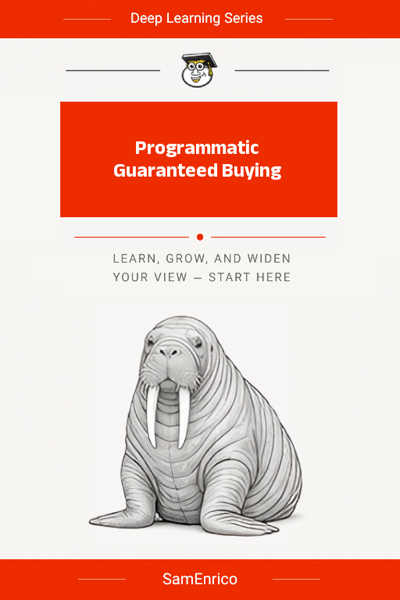
Non-FictionInformativeEducational
Programmatic Guaranteed Buying eBook
A Coursebook on Programmatic Guaranteed Buying
A Coursebook on Programmatic Guaranteed Buying
Formats
Free sample
Chapter 1: The Auction Illusion...--–- It was 3:47 PM on a Tuesday when Sarah, a senior media buyer at a global agency, watched 47,000vanishintowhatshewouldlaterdescribeas"thedigitalfog."Herclient,amajorautomotivebrand,hadapproveda47,000 vanish into what she would later describe as "the digital fog." Her client, a major automotive brand, had approved a 47,000vanishintowhatshewouldlaterdescribeas"thedigitalfog."Herclient,amajorautomotivebrand,hadapproveda2 million budget for a product launch. She had done everything right—or so she thought. She had set up a Private Marketplace (PMP) deal with premium publishers, layered on brand safety controls, and activated real-time bidding (RTB) to find the most efficient prices. The campaign went live. For two weeks, the dashboards looked beautiful.
The DSP reported 98% brand safety, a $4.50 CPM, and over 4 million impressions delivered. The client was pleased. Then came the third-party verification report.The truth landed like a wrecking ball. Only 62% of the impressions were viewable. Twelve percent came from sites that weren't even on the approved list—a quirk of how the PMP deal had been configured.
Worse, nearly 8% of the traffic was later classified as invalid, generated by data centers masquerading as real people. Sarah had bought certainty, or so she had believed. What she had actually bought was the illusion of control wrapped in the convenience of automation.This scenario plays out thousands of times every single day across the advertising industry. And the root cause is almost always the same: a fundamental misunderstanding of how the digital auction actually works, combined with a blind faith in the open exchange's ability to deliver on brand promises. Programmatic Guaranteed (PG) was built specifically to solve Sarah's problem, yet most buyers never use it correctly—or worse, never use it at all.
This chapter exposes the cracks in the real-time bidding foundation and reveals why PG is not just another deal type, but a fundamentally different way of buying digital media.The Great Promise of Real-Time Bidding To understand why Programmatic Guaranteed exists, we must first understand what RTB was supposed to fix. In the early 2000s, digital advertising was a manual, slow, and surprisingly human-powered affair. Insertion Orders (IOs) were faxed or emailed as PDFs. A buyer would call a publisher's sales representative, negotiate a flat CPM for a fixed number of impressions on a specific site, and then wait—sometimes days—for the campaign to be trafficked. If the campaign under-delivered, someone had to notice, call the publisher, and ask for a makegood.
If it over-delivered, invoices had to be adjusted manually, often weeks after the fact.Then came the real-time bidding revolution around 2009. Suddenly, the process was inverted: instead of humans negotiating every single transaction, an automated auction would decide, in milliseconds, which ad would appear on which webpage, and at what price. The promise was intoxicating. Efficiency would skyrocket. Waste would evaporate.
A media buyer could launch a campaign, set a maximum bid, and let the market determine the fairest price for every single impression, individually. The open exchange became the default for most programmatic buying, and the industry celebrated what seemed like a perfect market in action.But there was a catch—a massive, underappreciated catch that most buyers learned only through painful experience. The open exchange optimizes for only one thing: price. It does not optimize for brand safety, viewability, audience accuracy, or delivery predictability. In fact, the very mechanisms that make the auction efficient also make it inherently unstable for anything resembling a guaranteed media buy.Consider what happens when you place a bid on the open exchange.
You are competing against hundreds of other buyers, each with different objectives, different risk tolerances, and different valuations of the same impression. A brand running a corporate reputation campaign might value an impression on the New York Times homepage at 25CPM.Adirectresponseadvertisersellingdietpillsmightvaluetheexactsameimpressionatonly25 CPM. A direct response advertiser selling diet pills might value the exact same impression at only 25CPM.Adirectresponseadvertisersellingdietpillsmightvaluetheexactsameimpressionatonly1.50 CPM because their margin math works differently. The auction clears at the second-highest bid plus one cent. That is textbook economics.
But what happens when the mix of bidders changes from millisecond to millisecond? What happens when a brand safety vendor blocks a domain at 2:00 PM, but your DSP's blocklist hasn't updated until 3:00 PM? What happens when a competitor decides to cap their frequency at three impressions per user per day, causing their bidding to drop off unpredictably?The answer is chaos. Not the kind of chaos that crashes campaigns, but the more insidious kind that slowly erodes performance while dashboards report everything is fine. The open exchange gives you efficiency at the cost of certainty.
For direct response campaigns where the only thing that matters is the final cost per acquisition, that trade-off might be acceptable. For brand campaigns where reach, frequency, and context matter enormously, it is a disaster waiting to happen.The Three Guarantees You Didn't Know You Needed This brings us to the central problem that Programmatic Guaranteed was designed to solve. If the open exchange cannot offer certainty, and traditional direct IO buying cannot offer efficiency, then the industry needed a third path—one that combined the automation of programmatic with the contractual guarantees of direct sales. That third path is Programmatic Guaranteed, but only if we understand what "guaranteed" actually means.Throughout this book, we will use three distinct and precise definitions of the word "guaranteed." Do not skim past this section. Most failures in PG buying trace back to confusing these three concepts or assuming they are automatically bundled together.Volume-Guaranteed means that a specific, contractually binding number of impressions must be delivered.
If the IO says 1 million impressions, the publisher is obligated to deliver 1 million impressions. If they deliver 950,000, they owe a makegood. This is the most common and most straightforward form of guarantee. However, volume guarantees are meaningless if the impressions are not where they are supposed to be or are never seen by real people, which leads us to the second type.Price-Guaranteed means that the CPM is fixed and cannot be bid down or auction-optimized. In the open exchange, the price you pay for an impression fluctuates based on who else is bidding.
In a PG deal, the price is set in advance. If the IO says 8CPM,thebuyerpays8 CPM, the buyer pays 8CPM,thebuyerpays8 CPM for every impression delivered, regardless of what other bidders might have paid. This sounds simple, but it has profound implications for how campaigns are optimized (which we will cover extensively in Chapter 9). Price certainty allows for predictable budgeting, but it also means you cannot benefit from a soft auction.Delivery-Guaranteed is the most subtle and most frequently misunderstood form of guarantee. It means that the campaign will pace evenly according to a predetermined schedule.
If a campaign has 30 days to deliver 3 million impressions, delivery-guaranteed means the impressions will be spread roughly evenly across those 30 days—not 2.5 million in the first week and 500,000 in the remaining three weeks. Delivery pacing matters enormously for brand campaigns that need sustained presence, for frequency management, and for creative rotation. A publisher that front-loads delivery might exhaust your frequency caps early, causing the second half of the campaign to under-deliver because your audience has already seen the ad too many times.These three…
This is the end of the free sample. Get the eBook to keep going. Buy now
About this book
Details
- Author
- Quezada Lesley
- Publisher
- SamEnrico
- Language
- English
- Genre
- Non-Fiction, Informative, Educational
- Released
- 2026-05-09
- Pages (approx.)
- 160
- Available as
- eBook, Audiobook

Read better in the ZLOADR app
Your eBooks on your phone or tablet. Sign in with your SamEnrico account and start reading.
More by Quezada Lesley
 The Spiral Staircase DescentQuezada Lesley$11.99
 Deep Trance Phenomena GuideQuezada Lesley$11.99
 Rare Disease InvestmentQuezada Lesley$11.99
 OCD and TicsQuezada Lesley$11.99
 The Panel Discussion ParticipantQuezada Lesley$11.99
 The 911 Dispatcher Stress PlanQuezada Lesley$11.99
 The IBS Physical Activity GuideQuezada Lesley$11.99
 Lindsay JohnQuezada Lesley$11.99
 Anger And Power DynamicsQuezada Lesley$11.99
 The Last Dance of the Red Baron: How a Legend Fell from the SkyQuezada Lesley$11.99
 Scandal in the Sistine: Michelangelo’s Forbidden PassionQuezada Lesley$11.99
 Wayfinders of the Celestial Tides: The Legend of Maui’s HookQuezada Lesley$11.99
You may also like
 Hong Kong Handover 1997Dunn Johnnie$11.99
 Zumba For Postnatal Recovery CourseNeal Christian$11.99
 Zumba for BeginnersLadner Nikia$11.99
 YouTube Comment Mining GuideHumes Pandora$12.99
 Worry Box MeditationCarlin Rudy$11.99
 Workplace Stress MeditationNguyen Lynn$11.99
 Workplace Stress and Sleep RepairHawley Ivory$11.99
 Workplace Perfectionism CureDelaney Jeffry$11.99
 Workplace Injustice Anger GuideWallen Isabelle$11.99
 Work Addiction and Burnout LinkGreenwood Ester$11.99
 Women in Yoga and WellnessBeattie Galina$11.99
 Women in Stand Up ComedyChun Evangeline$11.99