
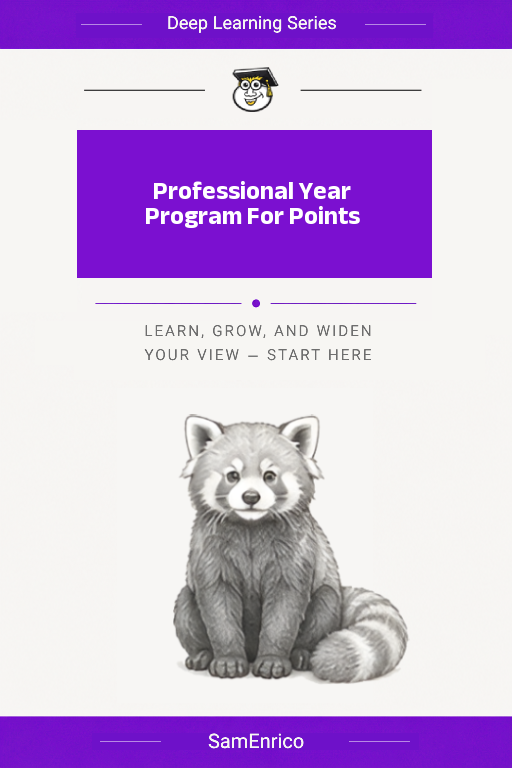
Professional Year Program For Points eBook
Complete 44 week internship in accounting, IT or e
by Blank Dolly
Complete 44 week internship in accounting, IT or engineering to get 5 PR points.
Formats
Free sample
Chapter 1: The 5-Point Trap--Most international graduates discover the Professional Year Program exactly the way Priya did. Priya was a 24-year-old IT graduate from Hyderabad who had just received her 485 visa. She had 18 months to find a job, pass a skills assessment, and submit an Expression of Interest for permanent residency. She had 70 points – not terrible, not great. Her migration agent told her about the PY: a 44-week program that would give her 5 extra points.
"You don't really need it," the agent said, "but it's a nice safety net." Priya didn't enroll. Eighteen months later, with 85 points and no invitation, she wished she had.This chapter exists because of Priya – and the thousands of graduates like her who discover the hard way that 5 points are not "nice to have." In Australia's migration system, 5 points are the difference between an invitation in three months and an invitation in three years. They are the difference between a 189 visa (independent, unrestricted) and a 491 visa (regional, temporary, with strings attached). And in some cases, they are the difference between permanent residency and a plane ticket home.But here is the trap: most graduates misunderstand the PY entirely. They see it as a "points program" – a box to tick, a fee to pay, a certificate to file away.
That thinking is dangerous. The PY is not a points program. It is a 44-week career accelerator that happens to deliver 5 points as a byproduct. Graduates who treat it as a box-ticking exercise waste 12,000–12,000–12,000–15,000 and end up no closer to PR than when they started. Graduates who treat it as what it actually is – a structured pathway to Australian employment, skills assessment waivers, and professional networks – often find themselves with PR offers before the 44 weeks are finished.This chapter will show you the real value of the 5 points, the brutal mathematics of invitation rounds, and why the PY is either a waste of money or the smartest investment you will ever make – depending entirely on how you approach it.The Math of Desperation: How Invitation Rounds Actually Work Let us start with a truth that migration agents rarely explain: Australia's Skill Select system does not invite the most qualified candidates first.
It invites the candidates with the highest points first, then works downward. If 1,000 invitations are issued in a round, the system takes the 1,000 highest-scoring EOIs (Expressions of Interest) in that occupation group, regardless of when those EOIs were submitted.This creates a phenomenon known as "points creep." In 2020, an IT graduate with 75 points could expect an invitation within two rounds. By 2023, the minimum for IT in New South Wales had risen to 85 points. By 2025, some occupations in Sydney required 90 points. The goalposts keep moving because more graduates are earning more points – through English tests, NAATI accreditation, and yes, the PY.Here is a simplified example based on real Department of Home Affairs data (anonymized and aggregated):Points Score (without PY)Estimated Wait Time (IT, NSW)With PY (+5 points)New Wait Time70No invitation (below threshold)7512-18 months7518-24 months806-9 months806-9 months851-3 months851-3 months90Next round90+Next round95Next round (no change)The table reveals a critical insight: the PY's 5 points are most valuable for candidates with 70-85 points.
Below 70, 5 points won't save you – you need a larger strategy (English testing, regional migration, or a different occupation). Above 90, you don't need the PY at all; you are already competitive. The sweet spot is the middle range, where 5 points move you from "unlikely" to "competitive" or from "long wait" to "short wait."But there is a second, less obvious benefit: the PY also changes which visa subclasses you qualify for. Consider the 189 visa (independent skilled migration) versus the 491 visa (regional skilled migration). The 189 typically requires 5-10 more points than the 491 for the same occupation.
A candidate with 80 points might miss the 189 cutoff but comfortably clear the 491 threshold. Adding 5 PY points to that same candidate creates optionality – they can now apply for both, doubling their chances of an invitation.The Return on Investment Calculation: Is $15,000 Worth 5 Points?Let us talk about money. The PY costs between 12,000and12,000 and 12,000and15,000 depending on the provider, the city, and any "promotional discounts" you negotiate. That is a significant sum for most international graduates, who are already paying rent, living expenses, and possibly supporting family back home.But the relevant comparison is not "15,000versus15,000 versus 15,000versus0." It is "$15,000 versus the cost of not getting PR." Consider the following scenario:A graduate on a 485 visa earns approximately $60,000 per year (casual or contract work, below market rate for permanent employees). If their visa expires without a PR invitation, they must either:Leave Australia (zero income, plus relocation costs of $5,000-10,000)Apply for a bridging visa (cost: $1,500-3,000 in legal fees, plus restricted work rights)Switch to a student visa (cost: $15,000-25,000 tuition, plus limited work hours)Find employer sponsorship (cost: $0 but extremely rare without existing employment)Each of these alternatives costs money, time, and certainty.
A bridging visa, for example, typically takes 6-12 months to process. During that time, you may have limited work rights (or none). Your career stalls. Your savings drain. Your mental health suffers.Now calculate the ROI of the PY:Scenario Without PYWith PYInvitation wait time18 months6 months Income during wait (assume $60k/year)$90,000 (18 months)$30,000 (6 months)PY tuition$0$15,000Legal fees for visa extensions$5,000$0Net financial position$85,000$15,000This is a simplified calculation, but the direction is clear.
The graduate with the PY is $70,000 better off over the same 18-month period – not because the PY gave them a job, but because it reduced their waiting time for PR, which allowed them to work full-time without interruption.Of course, this calculation assumes the PY works – that you complete the program, receive your points, and receive an invitation within a reasonable timeframe. That is why the rest of this book exists. A poorly executed PY (wrong provider, poor attendance, bad internship placement) is a $15,000 hole in your budget with nothing to show for it.The Three Visas: 189, 190, and 491 – Which One Cares About PY Points?Not all visas treat PY points equally. Understanding the differences will help you decide whether the PY is worth your time.The 189 Visa (Skilled Independent): This is the gold standard – permanent residency with no state nomination and no regional restrictions. You can live anywhere in Australia and work for any employer.
The 189 is also the most competitive visa, with invitation points typically 5-10 points higher than the 190 or 491. The PY's 5 points are most valuable here because they move you up the ranking in a crowded field.The 190 Visa (Skilled Nominated): This visa requires nomination by a state or territory government. In exchange, you agree to live and work in that state for the first two years. Points thresholds are typically lower than the 189 – 75-80 points may be sufficient where 85-90 are required for the 189. The PY's 5 points are still valuable, but less critical.
Some states also prioritize candidates with PY completion, effectively giving you a second boost beyond the points.The 491 Visa (Skilled Work Regional): This is a provisional visa (5 years) with a pathway to PR after 3 years of living and working in a regional area. Points thresholds are the lowest of the three – sometimes…
This is the end of the free sample. Get the eBook to keep going. Buy now
About this book
Details
- Author
- Blank Dolly
- Publisher
- SamEnrico
- Language
- English
- Genre
- Non-Fiction, Student's Shortcut
- Released
- 2026-05-30
- Pages (approx.)
- 155
- Available as
- eBook, Audiobook

Read better in the ZLOADR app
Your eBooks on your phone or tablet. Sign in with your SamEnrico account and start reading.
More by Blank Dolly
 Recall Classification Appeal ProcessBlank Dolly$11.99
 AI Presentation CertificationBlank Dolly$11.99
 Arm Levitation Self Trance MethodBlank Dolly$11.99
 The Beginner's Nature SoundscapeBlank Dolly$11.99
 Plus Size Self Esteem GuideBlank Dolly$11.99
 Lithuanian Laser Technology LeadershipBlank Dolly$11.99
 Green Beret SOG OperatorBlank Dolly$11.99
 Wendy Davis FilibusterBlank Dolly$11.99
 Strength Training for PostpartumBlank Dolly$11.99
 The Shadow War of the Golden Freemen: Poland’s Secret Cold War Against the SovietsBlank Dolly$11.99
 The Last Stand of the 1992 Dream TeamBlank Dolly$11.99
 The Alchemist's Apothecary: Secrets of the Medici's Golden ElixirBlank Dolly$11.99
You may also like
 LSE Online Program LengthAgee Letisha$11.99
 Harvard Extension School for Working AdultsRoush Yer$11.99
 LSE Online Reading ListAshford Ludivina$11.99
 LSE Online Language RequirementsWhitten Daphine$11.99
 LSE Online Class SizeHughey Garret$11.99
 LSE Online Alumni MentorshipWild Lyla$11.99
 London School of Economics Alumni NetworkDutton Chantal$11.99
 Harvard Extension School Student SupportCantrell Christene$11.99
 Harvard Extension School Library AccessSantana Adah$11.99
 Harvard Extension School Degree CompletionBray Wyatt$11.99
 Harvard Extension School Course AuditingAbbott Craig$11.99
 Harvard Extension School Extension DiplomaNew Joane$11.99