
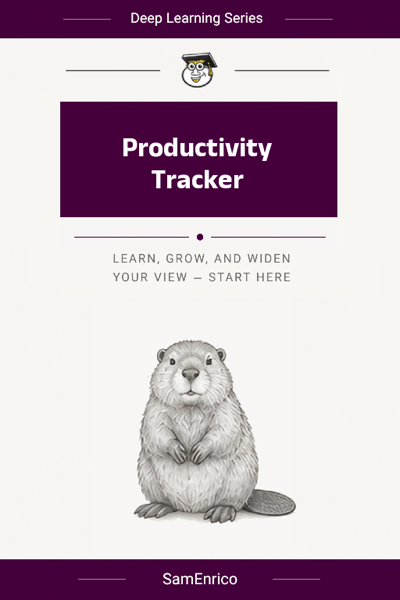
Non-FictionInformativeEducational
Productivity Tracker
A Coursebook on Productivity Tracker
by Keaton Wen
A Coursebook on Productivity Tracker
Formats
About this book
Free sample
Chapter 1: The Fog Lied...--You believe you work fifty hours a week. You tell your boss, your partner, and yourself that you are putting in the time. You feel exhausted at the end of most days, and exhaustion, you have learned, is the currency of legitimacy. If you are tired, you must have worked hard. If you worked hard, you must have been productive.
This is the lie that keeps millions of people trapped in a cycle of busyness without impact, motion without progress, and exhaustion without reward.The data tells a different story.Over the past decade, researchers have asked thousands of professionals to track their time with precision. Not estimates. Not memory. Actual real-time logging of how they spend their waking hours. The results are consistent across industries, seniority levels, and personality types.
The average knowledge worker spends approximately twenty-two hours per week on what researchers call "high-impact work" — tasks that directly advance key goals, generate revenue, solve meaningful problems, or create lasting value. The remaining twenty-eight to thirty hours are consumed by what can only be described as productivity theater: email, meetings, context switching, digital distraction, and the performance of busyness.You are not lazy. You are lost in the Fog.The Productivity Paradox Defined The Productivity Paradox is a cruel cognitive trap. It states that the harder you try to "be productive" without a measurement system, the more likely you are to waste time on low-impact activities. This happens for three reasons.First, your brain is wired to seek immediate closure.
Checking an email provides a small dopamine hit because the task is complete. Deleting a file, organizing a folder, answering a simple question — these actions feel productive because they generate a sense of progress. But they are what we call "shallow work": tasks that require little cognitive effort, produce minimal lasting value, and can usually be done by someone else or automated entirely.Second, your brain is terrible at estimating time. This is called the Planning Fallacy, identified by Nobel laureate Daniel Kahneman and his collaborator Amos Tversky. When you imagine doing a task, your…
This is the end of the free sample. Get the eBook to keep going. Buy now
Contents
- Chapter 1
- Chapter 2
- Chapter 3
- Chapter 4
- Chapter 5
- Chapter 6
- Chapter 7
- Chapter 8
- Chapter 9
- Chapter 10
- Chapter 11
- Chapter 12
Details
- Author
- Keaton Wen
- Publisher
- SamEnrico
- Language
- English
- Genre
- Non-Fiction, Informative, Educational
- Released
- 2026-05-11
- Pages (approx.)
- 136
- Available as
- eBook, Audiobook

Read better in the ZLOADR app
Your eBooks on your phone or tablet. Sign in with your SamEnrico account and start reading.
More by Keaton Wen
 Scott Peterson Victim Impact PanelKeaton Wen$11.99
 Book Buying Addiction GuideKeaton Wen$11.99
 Self Talk for Medical ProceduresKeaton Wen$11.99
 GoDaddy Domain Outage GuideKeaton Wen$11.99
 The Multi Member LLC GuideKeaton Wen$11.99
 The Whitechapel Shadow: Jack the Ripper’s Unseen VictimsKeaton Wen$11.99
 UAE Golden Visa PRKeaton Wen$12.99
 Age Restricted Terms GuideKeaton Wen$12.99
 Understanding Vitreoretinochoroidopathy DominantKeaton Wen$17.99
 How to Start a Derv Business (Beginners Guide)Keaton Wen$11.99
You may also like
 Hong Kong Handover 1997Dunn Johnnie$11.99
 Zumba For Postnatal Recovery CourseNeal Christian$11.99
 Zumba for BeginnersLadner Nikia$11.99
 YouTube Comment Mining GuideHumes Pandora$12.99
 Worry Box MeditationCarlin Rudy$11.99
 Workplace Stress MeditationNguyen Lynn$11.99
 Workplace Stress and Sleep RepairHawley Ivory$11.99
 Workplace Perfectionism CureDelaney Jeffry$11.99
 Workplace Injustice Anger GuideWallen Isabelle$11.99
 Work Addiction and Burnout LinkGreenwood Ester$11.99
 Women in Yoga and WellnessBeattie Galina$11.99
 Women in Stand Up ComedyChun Evangeline$11.99