
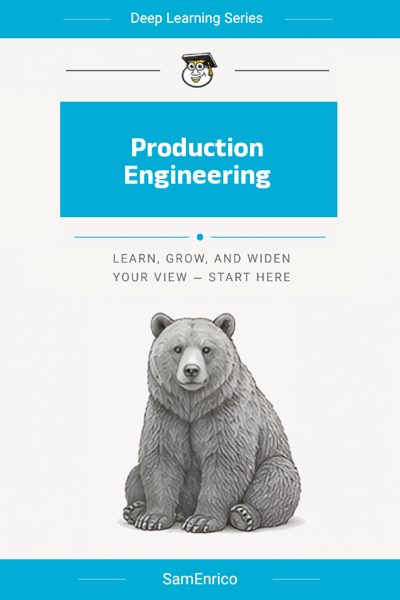
Production Engineering eBook
A Coursebook on Production Engineering
by Penn Elodia
A Coursebook on Production Engineering
Formats
Free sample
Chapter 1: The Making of Everything...--Look at the object closest to your right hand right now. A coffee mug? A smartphone? A key? A pen?
Now ask yourself a question that almost nobody ever asks: How did this get here?Not where you bought it. Not who gave it to you. But what chain of events—what sequence of fire, force, friction, and human ingenuity—transformed raw earth into the object you are now holding?The mug began as clay, dug from a riverbank, shaped on a wheel, fired in a kiln at 1,200 degrees Celsius until the silica fused into glass-hard ceramic. The smartphone began as silica too—but purified to 99.9999% purity, crystallized into a silicon wafer, etched with billion-transistor circuits using light so precise it would stretch across a football field and miss the goalposts by the width of a virus. The key began as iron ore, smelted at 1,500 degrees, alloyed with carbon, rolled into strip, stamped, broached, and deburred.
The pen began as petroleum, cracked into polymer pellets, injection-molded into a barrel, assembled with a brass mechanism machined to tolerances thinner than a human hair.Everything you see, touch, and use—everything in your room, your car, your workplace, your city—passed through the hands of production engineers. Not necessarily their physical hands, but their minds. Someone designed the process. Someone selected the machine. Someone calculated the tolerance, the cycle time, the cost per unit, the break-even quantity.
Someone decided whether to cast this part or forge it, whether to weld that joint or braze it, whether to inspect every piece or sample statistically.That someone could be you.This book is about becoming that someone. It is about learning to see the world not as a collection of finished products but as a collection of manufacturing decisions. It is about acquiring the knowledge to make those decisions well—economically, technically, ethically, and sustainably.What Is Production Engineering, Really?Production engineering is the discipline of transforming raw materials into finished products at scale. Not just making one—anyone with a hammer and determination can make one. But making ten thousand, or a hundred thousand, or ten million, each one identical to the last, each one meeting specifications, each one costing less than the one before.The production engineer asks: What is the cheapest way to make this part without compromising function?
What is the fastest way without sacrificing quality? What is the most reliable way without wasting material?These questions have answers. They are not matters of opinion. They are matters of physics, economics, and mathematics. The answers can be calculated, tested, and optimized.Consider a simple steel bolt.
It seems trivial—a threaded rod with a head. But a production engineer sees layers of decisions:What steel? Low-carbon (cheap, easy to form), medium-carbon (stronger, requires heat treatment), or alloy steel (expensive, high performance)?How to form the head? Forged from heated bar (strong, grain flow follows head shape) or machined from hex stock (simpler setup, weaker)?How to cut the threads? Rolling (displaces material, stronger threads) or cutting (removes material, weaker, faster for small batches)?How many?
Job shop of 100 units (machine from bar, cut threads). Batch of 10,000 (forge heads, roll threads). Mass production of 1,000,000 (cold-heading machine, 200 parts per minute, fully automated).The wrong decision at any step multiplies cost, reduces quality, or misses delivery dates. The right decision—the engineered decision—creates value.Production engineering sits at the intersection of several disciplines. From mechanical engineering, it borrows the understanding of forces, stresses, and material behavior.
From industrial engineering, it borrows the tools of optimization, scheduling, and cost analysis. From materials science, it borrows the knowledge of microstructure, phase transformations, and failure mechanisms. From economics, it borrows the concepts of fixed and variable costs, break-even analysis, and return on investment.But production engineering is not merely the sum of these parts. It has its own body of knowledge, its own methods, its own heuristics and rules of thumb. It is the discipline that asks not only "Can we make it?" but "Should we make it this way?" It is the discipline that transforms the possible into the profitable.The Five Families of Manufacturing Every manufacturing process—every single one—belongs to one of five families.
Learn these families, and you have a framework for understanding any production method you will ever encounter.Family One: Casting In casting, material is heated until it becomes liquid, then poured into a mold that contains a hollow cavity of the desired shape. The liquid fills the cavity, solidifies, and then the mold is removed—broken away if it is sand, opened if it is metal. What remains is a part that is, within certain tolerances, the shape of the cavity.Casting is ancient. The oldest known cast object is a copper frog from Mesopotamia, dated to approximately 3200 BCE. But casting is also modern: turbine blades for jet engines are cast single crystals, meaning the entire blade is one continuous crystal of nickel-based superalloy with no grain boundaries to weaken it at high temperature.
The same family, separated by five thousand years.Casting excels at producing complex internal geometries that would be impossible or prohibitively expensive to machine. An engine block, for example, has coolant passages, oil galleries, and cylinder bores all cast into a single piece. To machine those passages from solid metal would require operations that do not exist. Casting also handles large parts well: ship propellers weighing over one hundred tons are cast in sand molds the size of small houses.But casting has limitations. The surface finish is rough by machining standards—sand cast surfaces typically measure 6 to 25 micrometers roughness, compared to 0.4 micrometers for ground surfaces.
Dimensional accuracy is modest: a sand casting might be accurate to ±1 millimeter over a meter, while a machined part holds ±0.025 millimeters. And castings can contain internal defects: porosity from trapped gas, shrinkage cavities from inadequate feeding, inclusions from eroded mold material.Family Two: Forming In forming, material is shaped by plastic deformation—pushes, pulls, squeezes, and bends that exceed the material's yield strength but do not fracture it. The material flows, like clay in a potter's hands, but with far greater forces.Forming is divided into bulk deformation and sheet metal operations. Bulk deformation changes the entire cross-section of the workpiece: rolling squeezes thickness between rolls, forging hammers metal into dies, extrusion pushes billet through a die orifice, drawing pulls wire through a die. Sheet metal operations work on thin flat stock: shearing cuts, bending folds, drawing forms cups and boxes, stamping embosses features.The defining characteristic of forming is that it moves material rather than removing it.
Where machining produces chips—wasted material, wasted energy, wasted time—forming preserves nearly all the original material. A forged connecting rod, for example, wastes less than twenty percent of its starting billet; a machined rod from bar stock wastes eighty percent.Forming also improves mechanical properties through grain flow alignment. Metals are not homogeneous; they consist of grains, each a small crystal, and between the grains are boundaries that affect strength and toughness. When metal is cast, the grains grow in random directions. When metal is forged, the grains deform and align themselves along the direction of…
This is the end of the free sample. Get the eBook to keep going. Buy now
About this book
Details
- Author
- Penn Elodia
- Publisher
- SamEnrico
- Language
- English
- Genre
- Non-Fiction, Informative, Educational
- Released
- 2026-05-11
- Pages (approx.)
- 153
- Available as
- eBook, Audiobook

Read better in the ZLOADR app
Your eBooks on your phone or tablet. Sign in with your SamEnrico account and start reading.
More by Penn Elodia
 The Funnel for FreelancersPenn Elodia$11.99
 Restful Alertness State GuidePenn Elodia$11.99
 The Mayor Who Lost the OlympicsPenn Elodia$11.99
 Third Party Vendor Data Leak ScriptsPenn Elodia$11.99
 Bob Goalby Rules Controversy MemoirPenn Elodia$11.99
 The Empire of Pixels: How Steve Jobs Built a Digital DynastyPenn Elodia$11.99
 The Great Moon Hoax: When the Sun Newspaper Fooled the WorldPenn Elodia$11.99
 Production Smoothing MethodsPenn Elodia$12.99
 Business Plan Appendix GuidePenn Elodia$12.99
 Understanding Cleft Lip Palate Deafness Sacral LipomaPenn Elodia$17.99
 A Beginners Guide to Artistic gymnastics (Volume 1)Penn Elodia$11.99