
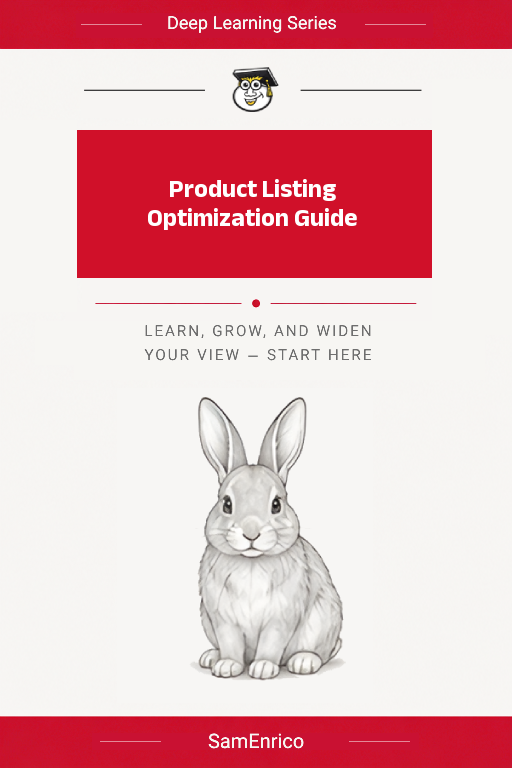
Non-FictionBusiness BriefListing Optimization
Product Listing Optimization Guide eBook
Optimize titles and images for Jumia search versus
Optimize titles and images for Jumia search versus Amazon A9 algorithm and Alibaba keyword bidding. Different SEO strategies for each marketplace.
Formats
Free sample
Chapter 1: The Blender Lie--–- In 2019, a seller we’ll call Elena launched the exact same product—a 39.99personalblender—on Amazon,Jumia,and Alibaba.Sheusedthesametitle,thesamefiveimages,andthesamebulletpointsacrossallthreeplatforms.“Whyreinventthewheel?”shetoldherassistant.Within90days,shehadlost39.99 personal blender—on Amazon, Jumia, and Alibaba. She used the same title, the same five images, and the same bullet points across all three platforms. “Why reinvent the wheel?” she told her assistant. Within 90 days, she had lost 39.99personalblender—on Amazon,Jumia,and Alibaba.Sheusedthesametitle,thesamefiveimages,andthesamebulletpointsacrossallthreeplatforms.“Whyreinventthewheel?”shetoldherassistant.Within90days,shehadlost4,700 on Amazon (high ad spend, low conversion), sold exactly two units on Jumia (both returned), and received zero RFQs on Alibaba despite 1,200 impressions. The blender itself worked perfectly.
The listings were the problem.Elena’s mistake is the most expensive fallacy in e-commerce: a good listing works everywhere. It does not. Amazon’s algorithm rewards a different set of behaviors than Jumia’s trust-based ranking system, and neither of them operates anything like Alibaba’s keyword auction marketplace. The same title that ranks on page one for “personal blender” on Amazon will confuse a Jumia shopper who needs to see a warranty badge before paying cash on delivery. That same title will be ignored entirely by an Alibaba procurement officer searching for “stainless steel 300W blender MOQ 500 units.”This chapter dismantles the Blender Lie.
You will learn why platform-specific optimization is not optional—it is the difference between profit and losses. You will understand the three fundamentally different algorithms you are about to face. And you will walk away with a single framework that will guide every decision in this book: the Traffic-to-Conversion Roadmap.But first, we need to talk about why Elena failed, and why you won’t.The Three Algorithms: A 30-Second Breakdown Before we dive into tactics, you need to know what you are up against. Each marketplace operates on a different logic engine. Think of them as three different countries with three different legal systems.
What is legal in one is a crime in another.Amazon (A9 – the current algorithm; Amazon does not use official version numbers publicly) is a conversion-velocity engine. It asks one question above all others: Does this product sell consistently? If you sell a unit every hour, Amazon will rank you higher than a product that sells ten units in one hour then nothing for a day. Consistency is the signal of customer satisfaction. Amazon’s business model depends on Prime subscriptions and repeat buyers.
Therefore, its algorithm favors listings that convert browsers into buyers quickly and repeatedly. Keyword density mattered five years ago. Today, sales velocity matters more.Jumia is a trust-and-catalog-completeness system. It operates in markets where cash on delivery accounts for 60-80% of transactions. Buyers do not trust the system yet.
They trust evidence. Jumia’s algorithm first asks: Is every possible field filled out? A complete listing with zero sales can outrank a partial listing with fifty sales. Only after completeness does Jumia ask about clicks and conversions. This is the opposite of Amazon.
On Jumia, you earn the right to compete by proving you are a real seller with a real product.Alibaba is a keyword-auction marketplace with an organic quality overlay. You bid on keywords (Pay for Performance, or P4P) to appear in sponsored slots. But you also rank organically based on a 1-5 star product quality score. That score depends on image count, response time, trade assurance usage, and on-time delivery. A 5-star product pays dramatically less per click than a 2-star product for the same keyword.
Alibaba buyers are not browsing. They are hunting. They know exactly what specifications they need. Your listing must speak the language of engineers and procurement officers.Elena used the same title for all three. That title was optimized for exactly zero of these algorithms.The Intent Gap: Why Your Buyer Is Not Your Buyer Here is the single most important concept in this book.
Read it twice.The same person behaves differently on different platforms because their intent is different.On Amazon, that person is a consumer with a credit card, often browsing after work or during a lunch break. They want inspiration, social proof, and fast shipping. They will spend two minutes on a listing if the images are beautiful.On Jumia, that same person is a cautious shopper using a smartphone on a limited data plan. They have been burned by fake products or undelivered orders before. They want proof.
They will spend ten seconds scanning for a warranty badge, a local payment method logo, and a photo of the actual box.On Alibaba, that person is a procurement officer or small business owner with a spreadsheet open in another tab. They know exactly what they need: material, voltage, size, MOQ (Minimum Order Quantity), and certification. They will spend thirty seconds scanning for specifications. If they do not find them, they click away and never return.This is the Intent Gap. You cannot close it with better keywords alone.
You cannot close it with prettier images alone. You must rebuild your listing from scratch for each platform, starting with a different question.For Amazon: What will make them click and buy in under sixty seconds?For Jumia: What will make them believe this is real and will arrive?For Alibaba: What will prove I can fulfill a bulk order reliably?Elena asked none of these questions. She asked only: Does this look professional? Professional is not the same as effective.The Traffic-to-Conversion Roadmap This book is organized around a single framework. Every chapter, every tactic, every template feeds into it.
Memorize this sequence.Stage 1: Discovery. Can buyers find your listing? This is about keywords, titles, and backend search terms. If you are invisible, nothing else matters.Stage 2: Click. Once found, do buyers click on your listing?
This is about your main image, price, and title’s first few words. Click-Through Rate (CTR) is the first filter.Stage 3: Conversion. Once clicked, do buyers purchase? This is about your secondary images, bullet points, description, and social proof. Conversion Rate (CVR) is the money metric.Stage 4: Retention.
After purchase, do buyers return or leave good reviews? This is about accurate descriptions, realistic images, and customer service. Returns kill your ranking on every platform.Stage 5: Velocity. Over time, do you sell consistently? This is about inventory management, advertising, and review generation.
Velocity is the compounding engine.Most sellers jump straight to Stage 3. They obsess over bullet points and descriptions while their main image is invisible on page 4. Or they bid aggressively on keywords (Stage 1) but their listing converts at 1% (Stage 3 failure), wasting ad spend.The Traffic-to-Conversion Roadmap forces you to diagnose where your listing is breaking. Low clicks? Fix Stage 2.
Low sales? Fix Stage 3. High returns? Fix Stage 4. Each chapter in this book is tagged with the stage it serves.
You will know exactly where to turn.The 5-Minute Fix: Your First Action Before you read another chapter, do this. It will take less than five minutes.Open your best-selling product on Amazon. Look at the title. Now ask: Does this title work on Jumia? Probably not.
Jumia titles need local payment badges, warranty language, and simpler words.Open that same product on Jumia. Look at the main…
This is the end of the free sample. Get the eBook to keep going. Buy now
About this book
Details
- Author
- Willoughby Twana
- Publisher
- SamEnrico
- Language
- English
- Genre
- Non-Fiction, Business Brief, Listing Optimization
- Released
- 2026-06-01
- Pages (approx.)
- 153
- Available as
- eBook, Audiobook

Read better in the ZLOADR app
Your eBooks on your phone or tablet. Sign in with your SamEnrico account and start reading.
More by Willoughby Twana
 The Theater Stage Manager StressWilloughby Twana$11.99
 Pelvic Floor Journal WorkbookWilloughby Twana$11.99
 Micronutrients For Hormone Balance GuideWilloughby Twana$11.99
 The Wishing Well ReleaseWilloughby Twana$11.99
 Pet Loss Insurance ClaimsWilloughby Twana$11.99
 Improv til I DieWilloughby Twana$11.99
 The IBS Massage ProtocolWilloughby Twana$11.99
 Tenant Screening Process GuideWilloughby Twana$11.99
 The Calculators of Timbuktu: Masters of the Mathematical UniverseWilloughby Twana$11.99
 The Silent Diplomat: How Michelle Obama Redefined Global InfluenceWilloughby Twana$11.99
 The Alchemists of the Industrial Age: From Lavoisier to NobelWilloughby Twana$11.99
 The Strategist's Guide to Brand LanguageWilloughby Twana$11.99
You may also like
 Hong Kong Handover 1997Dunn Johnnie$11.99
 Zumba For Postnatal Recovery CourseNeal Christian$11.99
 Zumba for BeginnersLadner Nikia$11.99
 YouTube Comment Mining GuideHumes Pandora$12.99
 Worry Box MeditationCarlin Rudy$11.99
 Workplace Stress MeditationNguyen Lynn$11.99
 Workplace Stress and Sleep RepairHawley Ivory$11.99
 Workplace Perfectionism CureDelaney Jeffry$11.99
 Workplace Injustice Anger GuideWallen Isabelle$11.99
 Work Addiction and Burnout LinkGreenwood Ester$11.99
 Women in Yoga and WellnessBeattie Galina$11.99
 Women in Stand Up ComedyChun Evangeline$11.99