
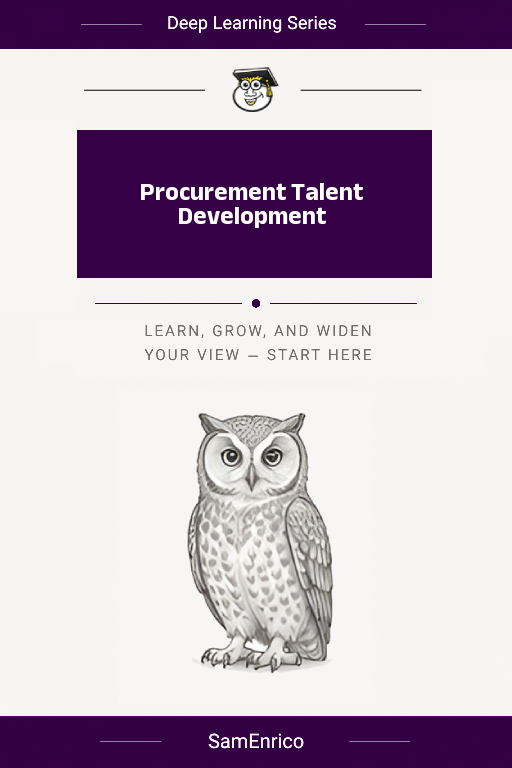
Non-FictionOperational Efficiency ManualTalent
Procurement Talent Development eBook
Build procurement team skills in analytics, negoti
Build procurement team skills in analytics, negotiation, and supplier relationship management.
Formats
Free sample
Chapter 1: Trust, But Verify...--The email arrived at 4:47 PM on a Friday, which is when bad news always seems to arrive.“Per our conversation,” the supplier’s account manager wrote, “we are implementing a 17% price increase on all delivered volumes, effective in 30 days. We appreciate your partnership and look forward to your understanding.”No prior conversation. No warning. No negotiation.The procurement director who received that email, let us call her Sarah, had worked with this supplier for eleven years. They had celebrated contract renewals together.
The supplier had once rushed a critical shipment overnight when Sarah’s factory line was about to shut down. She had trusted them. She had stopped running competitive bids three renewals ago because, in her words, “they have never let us down.”That trust had just cost her company an estimated $2.3 million in unexpected costs over the next twelve months. And because she had no recent market data, no alternative supplier qualified, and no leverage, she had no choice but to pay it.Sarah is not the villain of this story. She is the victim of a broken model—a model that has dominated procurement for decades.
The model that says: build relationships, trust your partners, and do not waste time on data that confirms what you already know.That model is a lie.The Great Procurement Lie Here is a truth that will make some procurement professionals uncomfortable: your suppliers have been playing a different game than you have. While you were building relationships and trusting handshake agreements, they were building data models, tracking your purchase patterns, and calculating exactly how much they could raise prices before you would bother to shop around.This is not malice. It is not dishonesty. It is simply the logical outcome of two different operating systems.Most procurement teams operate on intuition-driven decision making. They rely on historical relationships, personal trust, and what worked last time.
When asked why they chose a supplier, the answer is often “we have always used them” or “they are our partner.”Most sophisticated sales organizations operate on data-driven decision making. They know your average order size, your seasonal peaks, your price sensitivity, and your switching costs. They know, often better than you do, exactly how much leverage they have in any negotiation.The result is an asymmetry that costs companies billions of dollars annually. According to a study by the Hackett Group, organizations with mature procurement analytics capabilities achieve cost savings 18-27% higher than those without. That is not a minor difference.
That is the gap between a procurement team that adds value and one that simply processes transactions.This book exists to close that gap. But before we can build the new model, we must first understand why the old model fails, and why the solution is not choosing between data and relationships, but integrating them into something more powerful.The Three False Gods of Traditional Procurement Every profession has its sacred cows—beliefs that go unchallenged because they have always been true, or at least have always been assumed to be true. Procurement is no exception. Let us slaughter three of them right now.False God #1: “We Have a Good Relationship”The most dangerous sentence in procurement is also the most common: “We have a good relationship with that supplier.”What does that actually mean? Usually, it means the supplier has been reliable in the past, the buyer enjoys working with their account manager, and no major disputes have occurred.
These are all positive signals. But they are not data. They are not predictive of future performance. And they are certainly not a reason to skip competitive bidding or stop monitoring market prices.Consider the airline industry. For decades, procurement teams at major airlines had “good relationships” with their legacy aircraft manufacturers.
Then a new entrant would offer a plane that burned 20% less fuel, and those good relationships suddenly looked very expensive.The problem is not relationships. The problem is relationships that are unexamined. A relationship without data is like a car without brakes—it feels fine until you need to stop quickly.False God #2: “We Know Our Spend”Ask most procurement leaders to describe their company’s spending, and they will point to a spreadsheet. That spreadsheet, upon closer inspection, is almost always wrong.Supplier names are inconsistently entered: “IBM,” “I.B.M.,” “International Business Machines,” and “IBM Corp.” appear as four separate vendors. Invoices are miscoded to the wrong cost centers.
Maverick spending hides in plain sight as miscellaneous expenses. And that is before we even discuss the spending that happens on procurement cards or expense reports, which often never enters the official system at all.Research from Ardent Partners suggests that the average organization has visibility into only 60-70% of its total addressable spend. That means 30-40% of what your company buys—hundreds of millions of dollars in many cases—is invisible to the procurement function. You cannot manage what you cannot see.False God #3: “Price Is All That Matters”This is the oldest lie in procurement, and it persists because it is convenient. Price is easy to measure.
Price is easy to compare. Price is easy to put in a spreadsheet and declare a victory.But price is not cost. Cost is price plus logistics, warehousing, quality control, sustainability compliance, switching expenses, training, maintenance, downtime risk, and reputational exposure. A supplier who offers a 10% lower price but delivers late 15% of the time is not cheaper. A supplier who offers a 5% discount but requires a three-year lock-in contract is not cheaper when technology evolves in eighteen months.The Japanese automotive industry learned this lesson in the 1980s.
They stopped buying the lowest-priced components and started buying from suppliers who could deliver just-in-time with zero defects. The price was higher. The total cost was dramatically lower.The Data-Informed Relationship: A New Operating System So where does this leave us? If intuition is unreliable, relationships are insufficient without verification, and price is a liar, what is the alternative?The alternative is the data-informed relationship. It is the recognition that data and relationships are not opposites.
They are two sides of the same coin. Data without relationship is cold, brittle, and easily ignored. Relationship without data is blind, risky, and easily exploited. The magic is in the integration.A data-informed relationship works like this:You maintain the human connection—the regular check-ins, the site visits, the problem-solving conversations. But you overlay that connection with a layer of objective data.
You know their on-time delivery percentage for the last twelve months. You know their quality rejection rate. You know how their pricing compares to the market index. You know their competitors’ capabilities.When the supplier asks for a price increase, you do not just trust that it is justified. You ask to see their cost breakdown.
You compare their request to commodity indices. You run a mini-bid with two alternative suppliers just to test the market. And then, because you have maintained the relationship, you can have an honest conversation: “I want to keep this partnership. But the data says your proposed increase is 8% above market. Help me understand what I am missing.”That conversation is possible only with both…
This is the end of the free sample. Get the eBook to keep going. Buy now
About this book
Details
- Author
- Aguiar Nevada
- Publisher
- SamEnrico
- Language
- English
- Genre
- Non-Fiction, Operational Efficiency Manual, Talent
- Released
- 2026-06-01
- Pages (approx.)
- 154
- Available as
- eBook, Audiobook

Read better in the ZLOADR app
Your eBooks on your phone or tablet. Sign in with your SamEnrico account and start reading.
More by Aguiar Nevada
 The Tech Professional NetAguiar Nevada$11.99
 Hypnotic Energy ManagementAguiar Nevada$11.99
 Sciatica Mindfulness GuideAguiar Nevada$11.99
 Food Diary MethodAguiar Nevada$11.99
 Self Esteem and Partner's ExistenceAguiar Nevada$11.99
 The Silk Throne Conspiracy: How a Forgotten Empress Outmaneuvered the CourtAguiar Nevada$11.99
 The Lost Mines of the Andes: Prehistoric Gold and the Birth of MetallurgyAguiar Nevada$11.99
 Writing Executive Summaries for Operations ReviewsAguiar Nevada$12.99
 Understanding Faces SyndromeAguiar Nevada$17.99
 Other Mahogany HarvestingAguiar Nevada$11.99
 How to Become a Mold PolisherAguiar Nevada$11.99
You may also like
 Hong Kong Handover 1997Dunn Johnnie$11.99
 Zumba For Postnatal Recovery CourseNeal Christian$11.99
 Zumba for BeginnersLadner Nikia$11.99
 YouTube Comment Mining GuideHumes Pandora$12.99
 Worry Box MeditationCarlin Rudy$11.99
 Workplace Stress MeditationNguyen Lynn$11.99
 Workplace Stress and Sleep RepairHawley Ivory$11.99
 Workplace Perfectionism CureDelaney Jeffry$11.99
 Workplace Injustice Anger GuideWallen Isabelle$11.99
 Work Addiction and Burnout LinkGreenwood Ester$11.99
 Women in Yoga and WellnessBeattie Galina$11.99
 Women in Stand Up ComedyChun Evangeline$11.99