
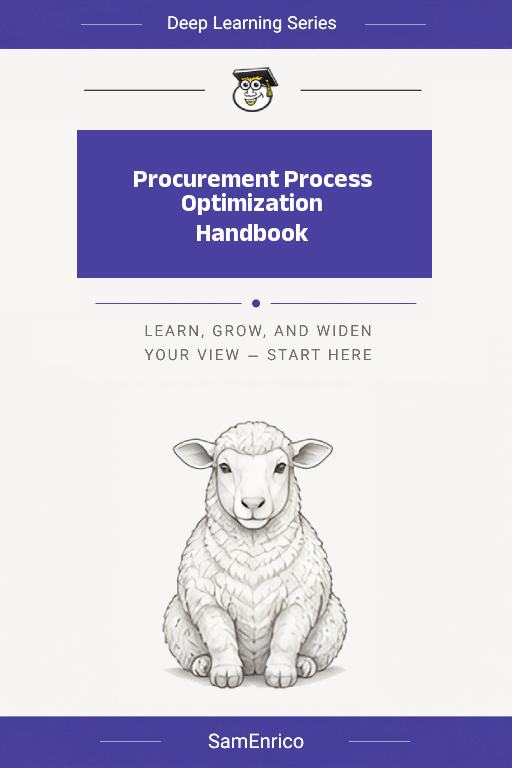
Non-FictionOperational Efficiency ManualProcess Improvement
Procurement Process Optimization Handbook eBook
Delivers actionable methods for eliminating bottle
Delivers actionable methods for eliminating bottlenecks in requisition, purchase order, and accounts payable workflows.
Formats
Free sample
Chapter 1: The Invisible Friction--–- Every morning, Maria Vasquez walks into her office at 7:45 AM, coffee in hand, ready to fight fires. As the Procurement Director for a $400 million manufacturing company, she has mastered the art of the emergency–the rush order, the lost shipment, the supplier who suddenly can't deliver. What she hasn't mastered is why her team processes only twelve POs on a good day when they should handle forty. She doesn't know where the time goes. She only knows that her CFO is demanding answers, her internal customers are complaining about delays, and her best buyer just quit to join a company with "better systems."Maria's story is not unique.
It is the story of thousands of procurement leaders who work harder every year yet feel less effective. The problem is not their effort. The problem is that they cannot see what is slowing them down. They are fighting invisible friction.This chapter introduces the single most important concept in procurement optimization: you cannot fix what you cannot measure. Before you buy software, restructure your team, or renegotiate with suppliers, you must diagnose where your time is actually going.
Most organizations skip this step. They implement new ERPs, automate random processes, or hire consultants to "fix procurement" without ever identifying the specific bottlenecks that are eating their budgets. That is like trying to cure a disease without running a single diagnostic test.We will change that here. By the end of this chapter, you will have a repeatable, five-step methodology to map your current Procure-to-Pay process, identify your primary bottleneck, and quantify its annual cost in dollars. You will understand the three metrics that separate world-class procurement from chaos.
And you will have a real-world case study of a company that saved $1.2 million by fixing one missing field on a requisition form.Let us begin with a simple question: Where does your procurement time actually go?The Myth of the Busy Procurement Team Walk into almost any procurement department, and you will see frantic activity. Emails flying. Spreadsheets open. People on the phone with suppliers, with AP, with internal customers. Everyone looks busy.
But busy is not productive.The difference between "busy" and "productive" is the difference between motion and progress. Motion is responding to the same emergency for the fifth time. Progress is eliminating the root cause so the emergency never happens again. Most procurement teams are trapped in motion because they have never mapped their value stream.A value stream is simply the sequence of steps from a customer request (a requisition) to the delivery of value (a paid supplier). In procurement, that stream looks like this:Requisition created → Approval routing → PO issuance → Supplier receipt → Goods receipt → Invoice receipt → 3-way match → Payment approval → Payment execution Between each of these steps lie handoffs.
Handoffs are where time disappears. A requisition sits in a manager's inbox for three days. A PO waits for a missing budget code. An invoice waits for a receipt that was never entered. These waiting periods are invisible on a standard to-do list but devastating on a timeline.Here is the hard truth: most procurement teams cannot tell you their average PO cycle time.
They cannot tell you their invoice exception rate. They cannot tell you what percentage of spend is maverick. They are flying blind, and they are paying for it.The Three Metrics That Matter If you remember nothing else from this book, remember these three metrics. They are the vital signs of your procurement process. Measure them weekly.
Post them on a dashboard. And never stop trying to improve them.Metric One: PO Cycle Time Definition: The time from requisition creation to PO issuance, measured in hours or days.Why it matters: Every hour a PO sits unissued is an hour your internal customer is waiting, an hour your supplier is not producing, and an hour your production line is potentially idle. Long PO cycles also drive maverick spend because frustrated internal customers will bypass the system to get what they need quickly.Industry benchmarks: World-class organizations achieve PO cycle times of 2–4 hours for low-risk, low-value purchases and 24–48 hours for complex, high-value purchases. Average organizations take 5–10 days. Struggling organizations take 2–4 weeks.How to measure: Timestamp the moment a requisition is submitted.
Timestamp the moment the PO is issued. Subtract. Average over a rolling 30-day period. Break down by commodity code and value band to see where your worst delays are hiding.Metric Two: Invoice Exception Rate Definition: The percentage of invoices that require manual intervention (cannot be auto-matched to a PO and receipt).Why it matters: Every exception costs you labor (AP clerk time), delay (late payment penalties or lost early-payment discounts), and supplier goodwill. Suppliers who constantly chase payments add a hidden premium to your prices.Industry benchmarks: World-class organizations achieve exception rates below 10%.
Average organizations run 20–40%. Struggling organizations exceed 50%. Yes, some organizations have more exceptions than clean invoices.How to measure: Take the number of invoices processed in a month. Subtract the number that matched automatically on first pass. Divide the remainder by the total.
Multiply by 100.Metric Three: Maverick Spend Percentage Definition: Spend occurring outside approved procurement channels (no PO, non-contract supplier, or off-catalog pricing).Why it matters: Maverick spend is the ultimate symptom of a broken process. It means your internal customers have given up on your system. They are buying from their preferred suppliers, at unknown prices, with no contract protection. Maverick spend typically costs 10–20% more than controlled spend.Industry benchmarks: World-class organizations keep maverick spend below 5% for direct materials and below 15% for indirect/services. Average organizations run 30–50%.
Struggling organizations exceed 60%.How to measure: Compare total spend against spend that flowed through approved POs with approved suppliers at approved prices. The gap is maverick.A note on targets: You will see aggressive targets like "under 5%" in some chapters. Those are aspirational for highly controlled direct materials. For most organizations, 10–15% for indirect and services is world-class realistic. Set your targets category by category, not as a single number.The Bottleneck Audit: A Five-Step Diagnostic Now we move from theory to action.
The Bottleneck Audit is the core diagnostic tool of this book. It takes one week to complete and requires no software, no consultants, and no budget. It requires only a whiteboard, a stopwatch, and the courage to see the truth.Step One: Map the Current P2P Process as a Value Stream Gather your team in a room. Do not invite managers only. Invite the people who actually do the work: the buyers, the AP clerks, the requisitioners from internal departments.
Give them sticky notes and markers.Ask them to map every step from "I need something" to "the supplier is paid." Do not use the official process map from your ERP documentation. Use the real process–the one with email loops, manual workarounds, and "special" approvals.Here is what you will likely find:Requisition created (3 minutes)Sent to manager for approval (waits 2 days)Manager approves (1 minute)Sent to procurement (waits 4 hours)Procurement checks budget (5 minutes)Procurement creates PO (10 minutes)PO sent to supplier (1 minute)Supplier acknowledges (waits 1 day)Goods received (waits 5 days)Receipt entered (5 minutes)Invoice arrives (waits 3 days)AP matches invoice (15 minutes)Exception flagged (waits 2 days)Buyer…
This is the end of the free sample. Get the eBook to keep going. Buy now
About this book
Details
- Author
- Causey Janiece
- Publisher
- SamEnrico
- Language
- English
- Genre
- Non-Fiction, Operational Efficiency Manual, Process Improvement
- Released
- 2026-06-01
- Pages (approx.)
- 147
- Available as
- eBook, Audiobook

Read better in the ZLOADR app
Your eBooks on your phone or tablet. Sign in with your SamEnrico account and start reading.
More by Causey Janiece
 The Emotional Vocabulary BuilderCausey Janiece$11.99
 Breath Awareness In SilenceCausey Janiece$11.99
 French Resistance Execution PilesCausey Janiece$11.99
 The Emotional Intelligence Self Assessment GuideCausey Janiece$11.99
 Aging Body Self Esteem WorkbookCausey Janiece$11.99
 The Last Phalanx: Belisarius at Callinicum - A Byzantine Masterstroke That Could Have Changed the WorldCausey Janiece$11.99
 Data Presentation For Technical AudiencesCausey Janiece$12.99
 Understanding Macular DegenerationCausey Janiece$17.99
 Line DancingCausey Janiece$11.99
 A Beginners Guide to Downhill mountain biking (Volume 1)Causey Janiece$11.99
You may also like
 Hong Kong Handover 1997Dunn Johnnie$11.99
 Zumba For Postnatal Recovery CourseNeal Christian$11.99
 Zumba for BeginnersLadner Nikia$11.99
 YouTube Comment Mining GuideHumes Pandora$12.99
 Worry Box MeditationCarlin Rudy$11.99
 Workplace Stress MeditationNguyen Lynn$11.99
 Workplace Stress and Sleep RepairHawley Ivory$11.99
 Workplace Perfectionism CureDelaney Jeffry$11.99
 Workplace Injustice Anger GuideWallen Isabelle$11.99
 Work Addiction and Burnout LinkGreenwood Ester$11.99
 Women in Yoga and WellnessBeattie Galina$11.99
 Women in Stand Up ComedyChun Evangeline$11.99