
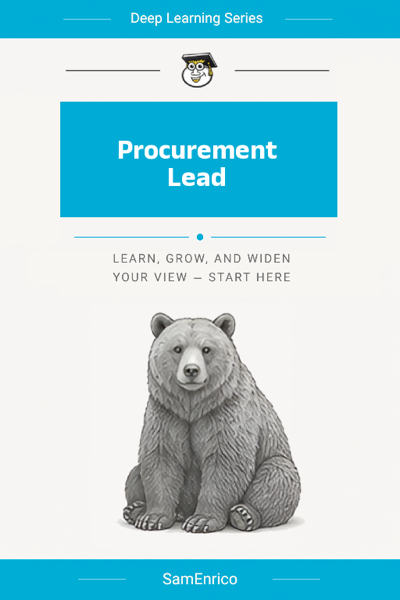
Procurement Lead eBook
A Coursebook on Procurement Lead
by Cobbs Juli
A Coursebook on Procurement Lead
Formats
Free sample
Chapter 1: The Value Trap--–- The first time I watched a Procurement Lead get fired, it wasn’t because she failed to save money. It was because she saved too much. Her name was Claire, and she had done everything her job description asked for. In eighteen months, she had reduced direct materials spend by 14 percent, renegotiated three supplier contracts for a combined $4.2 million in savings, and consolidated the company’s logistics providers from seven to three. Her annual performance review, signed by the CFO, called her “a model of procurement efficiency.” Six weeks later, she was packing her office while security watched.The plant manager had discovered that one of Claire’s “savings” — switching to a lower-cost raw material supplier — had reduced product shelf life from eighteen months to eleven.
The company’s largest retailer had just rejected an entire shipment because the product failed freshness testing at twelve months. The 4.2millioninsavingsdidn’tmatter.The4.2 million in savings didn’t matter. The 4.2millioninsavingsdidn’tmatter.The12 million in spoilage, lost revenue, and damaged customer relationship did. When the CEO asked Claire how this had happened, she said, “I was just doing my job.”That was the moment I understood something that no one had ever taught me. The traditional job description of a Procurement Lead — cut costs, measure savings, report compliance — is not a path to success.
It is a trap. And most procurement professionals walk into it on their first day.This chapter dismantles the single most dangerous assumption in procurement: that your primary value is reducing what the company spends. If you are reading this book, you have likely already sensed that something is wrong with this picture. You have negotiated a hard-won price reduction only to watch the factory reject the materials. You have hit your savings target only to be told you missed the “real” goal.
Or you have watched a colleague — like Claire — be celebrated one quarter and escorted out the next.The problem is not your effort. The problem is the metric. And the only way to survive and thrive as a Procurement Lead is to escape what I call the Value Trap: the belief that a lower purchase price equals better procurement.The Birth of a Broken Metric To understand why the Value Trap is so seductive, you have to understand where the cost-cutting mandate came from. In the 1980s and 1990s, procurement was largely a clerical function. Buyers processed purchase orders, checked inventory levels, and made sure the factory didn’t run out of nuts and bolts.
The idea that procurement could be “strategic” didn’t exist. Then came the shareholder value revolution. Jack Welch at GE popularized the idea that every function should be measured by its direct contribution to profit. Procurement’s contribution was obvious: every dollar saved on materials dropped directly to the bottom line.Thus was born the sacred metric of Purchase Price Variance (PPV) — the difference between what you paid and what you expected to pay. Negative PPV (paying less than expected) was good.
Positive PPV (paying more) was bad. Procurement departments were reorganized around this single number. Bonuses were tied to it. Careers were made and broken by it.Here is what no one tells you about PPV: it is a perfectly rational metric for a purchasing clerk and a dangerously misleading metric for a Procurement Lead. Why?
Because PPV ignores everything that happens after the invoice is paid. It ignores quality. It ignores delivery reliability. It ignores the hidden costs of supplier switching. It ignores the value of supplier innovation.
And it absolutely ignores risk.Claire’s story is a textbook example. She achieved negative PPV by switching to a cheaper raw material supplier. The material cost less. That was true. But the material was less stable.
That was also true. Her bonus was calculated on the first truth. Her career ended on the second.The Value Quartet: Four Lenses, One Leader If price reduction is a trap, what should you measure instead? Over the past decade, the best procurement organizations have converged on a framework that I call the Value Quartet. It has four dimensions, each as important as the others, and the job of the Procurement Lead is to optimize all four simultaneously, even when they conflict.Dimension One: Cost Yes, cost still matters.
Anyone who tells you otherwise has never answered to a CFO. But cost is not purchase price. Cost is Total Cost of Ownership (TCO) , a concept we will explore in depth in this chapter. TCO includes the purchase price, plus all the costs that come after: maintenance, training, energy consumption, downtime, disposal, and even opportunity costs. A cheaper product that breaks twice as often is not cheaper.
A lower-priced service that requires four hours of internal oversight per week is not lower-priced. The Procurement Lead’s job is to minimize TCO, not the invoice total.Dimension Two: Quality Quality is not a separate concern from cost — it is a component of cost. Poor quality shows up in warranty claims, customer returns, rework labor, and brand damage. A supplier that costs 5 percent less but has twice the defect rate is almost certainly more expensive on a TCO basis. But quality is also a strategic lever.
Higher quality materials can enable premium pricing from your own customers. Consistent quality reduces variability in your manufacturing process, which increases throughput. The Procurement Lead must define quality in operational terms (defects per million, spec compliance, consistency) and track it as rigorously as price.Dimension Three: Innovation This is the dimension that separates good procurement from great procurement. Your suppliers have knowledge that you do not. They see multiple customers.
They know what materials, processes, or designs are emerging. The question is whether you have structured your relationship to capture that knowledge. An innovative supplier might suggest a material substitution that reduces weight, a design change that simplifies assembly, or a process improvement that cuts lead time. Sometimes these innovations reduce cost. Sometimes they improve performance.
Sometimes they open entirely new product categories. The Procurement Lead’s job is to create the conditions for supplier-led innovation — and then to measure its value.Dimension Four: Resilience The COVID-19 pandemic, the Suez Canal blockage, the war in Ukraine, the semiconductor shortage — each of these events exposed the fragility of supply chains optimized for cost and nothing else. Resilience is the ability to absorb disruption and continue operating. It has many components: supplier redundancy (having a second source), geographic diversity (not all suppliers in one region), inventory buffers (holding more stock than Just-in-Time would tolerate), and substitutability (designing products that can use alternative components). Resilience costs money.
It is the opposite of efficiency. But the Procurement Lead who saves 1milliononcostandexposesthecompanytoa1 million on cost and exposes the company to a 1milliononcostandexposesthecompanytoa50 million disruption risk has failed. The Value Quartet forces you to ask: what is the resilience cost of this sourcing decision, and is it worth paying?The Hidden Curriculum: Total Cost of Ownership in Practice Let me show you how TCO works in a real example. Suppose you are sourcing laptop computers for a salesforce of one thousand people. Vendor A offers a laptop for 1,000.Vendor Boffersalaptopfor1,000.
Vendor B offers a laptop for 1,000.Vendor Boffersalaptopfor1,200. Which is cheaper?You know the answer now: you cannot tell without calculating…
This is the end of the free sample. Get the eBook to keep going. Buy now
About this book
Details
- Author
- Cobbs Juli
- Publisher
- SamEnrico
- Language
- English
- Genre
- Non-Fiction, Informative, Educational
- Released
- 2026-05-11
- Pages (approx.)
- 139
- Available as
- eBook, Audiobook

Read better in the ZLOADR app
Your eBooks on your phone or tablet. Sign in with your SamEnrico account and start reading.
More by Cobbs Juli
 AI Syllabus GeneratorCobbs Juli$11.99
 Egyptian Immigrant EntrepreneursCobbs Juli$11.99
 Co Parenting Stress Management GuideCobbs Juli$11.99
 HGH and Injury RecoveryCobbs Juli$11.99
 The Eisenhower Matrix for LawyersCobbs Juli$11.99
 The Angel of Belisarius: Healing in the Shadow of the Great GeneralCobbs Juli$11.99
 Understanding Mediastinal Endodermal Sinus TumorsCobbs Juli$17.99
 Executive Time Blocking ResetCobbs Juli$12.99
 German Raise Real World CasesCobbs Juli$12.99
 How to Become a Knife GrinderCobbs Juli$11.99