
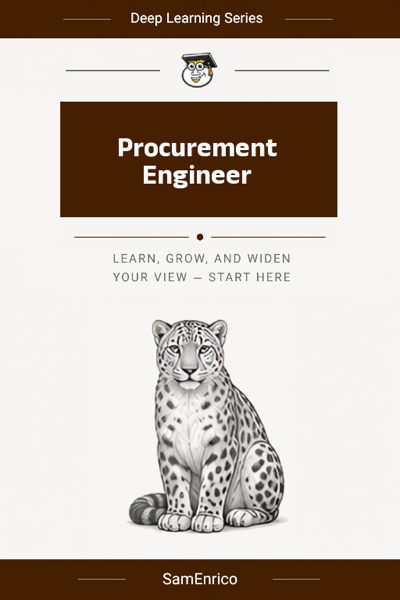
Non-FictionInformativeEducational
Procurement Engineer eBook
A Coursebook on Procurement Engineer
A Coursebook on Procurement Engineer
Formats
Free sample
Chapter 1: The $47 Million Mistake--–- On a Tuesday morning in March, a procurement engineer named Sarah watched a $2.3 million shipment of custom actuators arrive at her company’s receiving dock. She had spent six months negotiating the contract, three weeks chasing the supplier for updated drawings, and another ten days expediting the shipment through customs. The actuators were finally here.She walked to the dock with the quality inspector, a grizzled veteran named Frank who had seen everything. Frank pulled out his calipers and measured the first actuator’s mounting bracket. He measured it again.
He looked at Sarah with an expression she had learned to dread—the flat, tired look of someone about to deliver very bad news.“These are off by three millimeters,” Frank said.Sarah grabbed the drawing from her binder. The specification clearly stated a 150-millimeter center-to-center distance on the mounting holes. Frank’s calipers read 147 millimeters. She grabbed a second actuator. Same measurement.
She grabbed a third. Same.“They’re all wrong,” Frank said.Sarah’s stomach dropped. These actuators were designed to bolt onto a pre-drilled frame that had already been fabricated and installed at the customer’s site. The frame’s mounting holes were exactly 150 millimeters apart. A three-millimeter discrepancy meant the actuators would not fit.
At all. Not a single one.She called the supplier in Germany. The engineering manager was apologetic but firm. “Your drawing revision 2.1 showed 147 millimeters. We built to that drawing.”Sarah pulled up her email archive.
She had sent revision 2.2 to the supplier four months ago with a note: “Please update mounting hole spacing to 150mm to match customer frame.” The supplier’s project manager had responded: “Received. We will update our records.”But no one had updated the records. The supplier’s manufacturing team had continued using revision 2.1. And Sarah had never followed up to confirm the change had been implemented. She had assumed—that most dangerous of words in procurement—that a single email was sufficient.The cost of Sarah’s assumption: 2.3millionfortheactuators,plus2.3 million for the actuators, plus 2.3millionfortheactuators,plus400,000 in expedited freight for the replacement order, plus 750,000indelaypenaltiesfromthecustomer,plus750,000 in delay penalties from the customer, plus 750,000indelaypenaltiesfromthecustomer,plus1.2 million in lost goodwill and future business.
Total impact: nearly $4.7 million from a three-millimeter error that could have been prevented with a single phone call.Sarah did not get fired. But she should have. And the only reason she kept her job was that her boss, a wise procurement director named Elena, saw something in the disaster that Sarah could not see in the moment: the failure was not really Sarah’s fault. The failure was systemic. No one had ever taught Sarah how to be a procurement engineer.This book is what Elena wished she could have handed Sarah on her first day.The Hidden Role You Didn’t Know Existed If you are an engineer, you were trained to design things.
You learned how to calculate stresses, select materials, model tolerances, and simulate performance. You can read a blueprint, operate CAD software, and calculate a safety factor in your sleep. But no one ever taught you how to buy things. Not really.If you are a procurement professional, you were trained to negotiate prices, manage suppliers, process purchase orders, and track delivery dates. You know what an Incoterm is.
You know how to run an RFQ. You know how to read a balance sheet. But no one ever taught you how to read a technical drawing.The Procurement Engineer sits at the intersection of these two worlds. This person speaks both languages: the language of drawings and tolerances, and the language of contracts and costs. The Procurement Engineer is the technical expert who ensures that what gets bought will actually work, fit, and last.
And this person is the most underutilized asset in most engineering organizations.Consider the evidence. In a study of 247 major engineering projects across aerospace, automotive, construction, and energy sectors, researchers found that 62% of project delays and 58% of cost overruns traced directly to procurement failures—not design errors, not manufacturing defects, not acts of God. Wrong materials. Late deliveries. Incorrect specifications.
Supplier quality issues. Contract disputes. These are procurement failures, and they are almost always preventable.Yet most companies treat procurement as an administrative function. They staff it with junior buyers who process paperwork. They measure it by cost reduction alone.
They give it no seat at the design table. And then they wonder why their projects go off the rails.This book exists to fix that.Who This Book Is For (And Who It Is Not For)Let me be very clear about who should read this book and who should not.This book is for engineers who are moving into procurement roles or who find themselves responsible for buying engineered components as part of their project responsibilities. You already understand technical drawings, tolerances, materials, and manufacturing processes. You do not need me to explain what a micrometer is or why surface finish matters. What you need is the commercial, legal, financial, and logistical knowledge that no engineering school ever taught you.This book is also for procurement professionals who want to understand the technical side of the job.
You already know how to run a request for quote and negotiate a payment term. What you need is the engineering vocabulary and technical frameworks that allow you to evaluate suppliers on more than just price.This book is not for general readers with no background in engineering or procurement. It assumes you understand basic manufacturing concepts and have at least some exposure to project work. If you do not know the difference between a tolerance and a thread pitch, put this book down and come back after you have spent some time on a shop floor.This book is also not an academic textbook. It will not give you multiple-choice quizzes or learning objectives at the start of each chapter.
It will not define every term in a glossary before using it. It will teach you through stories, frameworks, and hard-won lessons from people who learned these things the expensive way—by making mistakes that cost real money.The Framework That Will Guide Everything Before we dive into the details, you need to understand the single framework that will guide every decision in this book. I call it the Value Triangle.Imagine a triangle with three corners: Cost, Quality, and Schedule. Every procurement decision you make will pull on these three forces. The fundamental law of procurement engineering is this: you cannot maximize all three corners simultaneously.
If you try, you will fail at all of them.Let me explain.If you focus exclusively on Cost, you will choose the lowest bidder. That supplier will likely deliver late (schedule slips) or deliver poor quality (rework, failures, downtime). You saved money on paper, but you lost it in reality. The cheap pump that breaks every six months is not cheap at all.If you focus exclusively on Quality, you will over-specify everything. You will require aerospace-grade tolerances for a bracket that holds a light fixture.
You will demand 100% inspection for parts that never fail. Your quality will be perfect, but your costs will be…
This is the end of the free sample. Get the eBook to keep going. Buy now
About this book
Details
- Author
- Latimer Carylon
- Publisher
- SamEnrico
- Language
- English
- Genre
- Non-Fiction, Informative, Educational
- Released
- 2026-05-23
- Pages (approx.)
- 130
- Available as
- eBook, Audiobook

Read better in the ZLOADR app
Your eBooks on your phone or tablet. Sign in with your SamEnrico account and start reading.
More by Latimer Carylon
 TCM Emotional HealthLatimer Carylon$11.99
 Minecraft Moderation HandbookLatimer Carylon$11.99
 Medical Professional EsteemLatimer Carylon$11.99
 HIIT for Endurance AthletesLatimer Carylon$11.99
 The Krays vs. The Twins: London's Gangland Cold War (1950s-1960s)Latimer Carylon$11.99
 How to Produce Changing Mats and TraysLatimer Carylon$11.99
 Legal Recourse for Unpaid InvoicesLatimer Carylon$12.99
 How to Start a Pipes Made of Clay Business (Beginners Guide)Latimer Carylon$11.99
You may also like
 Hong Kong Handover 1997Dunn Johnnie$11.99
 Zumba For Postnatal Recovery CourseNeal Christian$11.99
 Zumba for BeginnersLadner Nikia$11.99
 YouTube Comment Mining GuideHumes Pandora$12.99
 Worry Box MeditationCarlin Rudy$11.99
 Workplace Stress MeditationNguyen Lynn$11.99
 Workplace Stress and Sleep RepairHawley Ivory$11.99
 Workplace Perfectionism CureDelaney Jeffry$11.99
 Workplace Injustice Anger GuideWallen Isabelle$11.99
 Work Addiction and Burnout LinkGreenwood Ester$11.99
 Women in Yoga and WellnessBeattie Galina$11.99
 Women in Stand Up ComedyChun Evangeline$11.99