
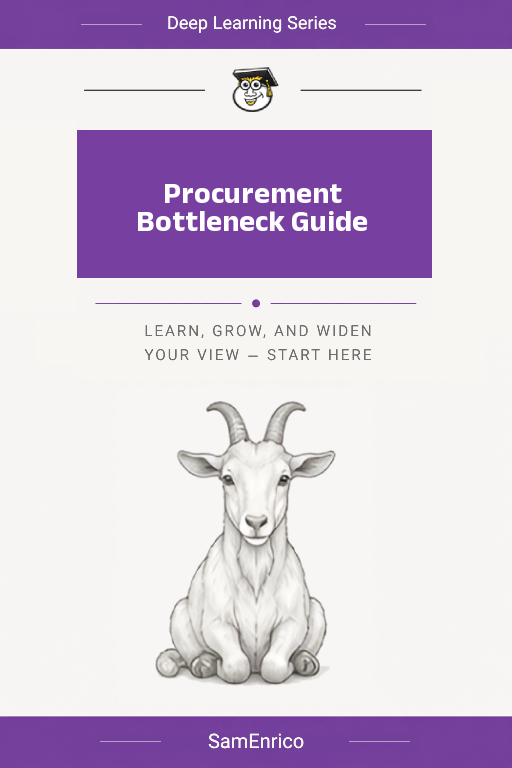
Non-FictionOperational Efficiency ManualBottleneck
Procurement Bottleneck Guide eBook
Identifies and removes constraints in requisition
by Baird Mitsue
Identifies and removes constraints in requisition approval, PO issuance, and invoice matching using Lean tools.
Formats
Free sample
Chapter 1: The Flow Fallacy--–- Most procurement professionals believe they have a cost problem. They spend their days negotiating discounts, chasing supplier rebates, and celebrating the two percent they shaved off a five-hundred-dollar office chair order. Meanwhile, somewhere in their organization, a production line sits idle because a ten-dollar part is waiting for a signature. No one celebrates the ten-dollar part. No one measures the cost of waiting.
And that is precisely why procurement is broken.This book is not about cost. It is about flow. More specifically, it is about the physics of how work moves—or fails to move—through the procure-to-pay cycle. The central argument is simple yet radical: most procurement bottlenecks are not cost bottlenecks. They are flow bottlenecks.
And flow bottlenecks are far more destructive because they do not just reduce savings; they stop operations entirely.Consider this. A factory loses ten thousand dollars per hour when a line is down. A hospital delays patient discharge because a specialized catheter is stuck in approval. A construction site sits idle while a critical fastener waits for a purchase order number. In every case, the culprit is not a high price.
It is a missing signature, a wrong account code, or a requisition that fell into an email black hole. These are flow failures. And traditional procurement training ignores them almost completely.The standard textbook presents the procure-to-pay process as a clean, linear sequence of seven steps: requisition, sourcing, purchase order issuance, goods receipt, invoice receipt, three-way matching, and payment. In theory, these steps flow smoothly from left to right. In practice, they fail at every handoff because the textbooks ignore three realities: human behavior, handoff delays, and queue accumulation.Human behavior means that requesters type vague descriptions like "computer stuff" into forms.
It means approvers let emails sit unread while they attend meetings. It means warehouse staff skip the goods receipt note because they are too busy unloading trucks. Handoff delays mean that every time a document moves from one person to another, time is lost. Queue accumulation means that work piles up at every step, and the more it piles, the slower each item moves.The result is a process that feels like a black hole. Requisitions go in.
POs come out—eventually. No one knows what happens inside. No one measures the time between steps. And no one has a systematic method for finding the single point where the entire system gets stuck.This book provides that method. It is called TLS—an integration of the Theory of Constraints, Lean, and Six Sigma.
The Theory of Constraints, developed by physicist Eli Goldratt, teaches that every system has exactly one constraint, or bottleneck, that limits its throughput. Find that constraint, exploit it, subordinate everything else to it, elevate it, and then repeat the cycle. Lean provides the tools to eliminate waste—the waiting, defects, overprocessing, and motion that clog the system. Six Sigma provides the statistical discipline to reduce variation and ensure that processes stay within tolerance.Together, these three methodologies form a powerful engine for transforming procurement from a source of frustration into a driver of operational velocity. But before we can apply any of these tools, we must first shift our mindset.
We must stop obsessing over the two percent savings on the office chair and start measuring the hours lost to a missing signature on the ten-dollar part.This chapter lays the foundation for that shift. It begins by distinguishing cost bottlenecks from flow bottlenecks—a distinction that seems obvious once stated but is routinely ignored in practice. It then introduces the key performance indicators that actually matter for flow: PO Cycle Time and Approval Lag. These metrics, not cost savings, will become your north star. Finally, it presents Goldratt's Five Focusing Steps as the structural backbone for the entire book.
Every subsequent chapter will apply one of these steps to a specific stage of the procure-to-pay cycle.By the end of this chapter, you will understand why your procurement process feels slow, why traditional fixes have failed, and how a single, counterintuitive idea—find the bottleneck—can reduce your cycle time by sixty percent or more.The Cost Bottleneck Versus the Flow Bottleneck Let us begin with a simple question. When you think of a procurement bottleneck, what comes to mind? For most people, the answer involves money. A supplier raised prices. A sole source vendor has no competition.
A category manager failed to negotiate a discount. These are cost bottlenecks. They limit your ability to reduce spending. They matter, certainly. But they are rarely the reason your operations stop.A flow bottleneck is different.
It limits your ability to move work from request to delivery. It has nothing to do with price and everything to do with time. A missing approval is a flow bottleneck. A requisition that requires three rounds of correction is a flow bottleneck. A goods receipt that never gets entered into the system is a flow bottleneck.
These bottlenecks do not just cost you potential savings. They cost you real, measurable operational downtime.Consider a manufacturing company we will call Allied Components. Allied spent months negotiating a five percent discount on a critical electronic component. The procurement team celebrated. The CFO applauded.
Then the component got stuck in approval because the requisition lacked a valid GL code. The production line waited three days. The cost of that three-day delay—in lost revenue, idle labor, and expedited shipping—was more than the annual savings from the discount. The procurement team had optimized the wrong thing.This story is not unusual. It happens every day in every industry.
The reason is simple: cost bottlenecks are easy to measure. You can calculate savings to two decimal places. You can report them in quarterly reviews. You can put them on a dashboard. Flow bottlenecks are harder.
They require you to measure time, which means tracking work across people, departments, and systems. Most organizations do not have the discipline for this. They measure what is easy, not what matters.But the physics of flow is unforgiving. In any process, the throughput—the rate at which work is completed—is determined by the slowest step. If that step takes five days, the whole process takes five days, regardless of how fast the other steps are.
Improving a step that is not the bottleneck accomplishes nothing. It is like repaving a road that leads to a one-lane bridge. The bridge determines the traffic flow, not the road.This is the central insight of the Theory of Constraints. And it applies directly to procurement. Your procure-to-pay cycle has exactly one constraint at any given time.
That constraint might be requisition data quality. It might be approval routing. It might be goods receipt capture. It might be three-way matching. But there is only one.
Your job is to find it, fix it, and then find the next one. Trying to fix everything at once is not just inefficient. It is impossible.Why the Seven Steps Fail The traditional seven-step model of procurement is taught in every introductory course. It looks clean on a Power Point slide. Requisition.
Sourcing. PO issuance. Goods receipt. Invoice receipt. Three-way match.…
This is the end of the free sample. Get the eBook to keep going. Buy now
About this book
Details
- Author
- Baird Mitsue
- Publisher
- SamEnrico
- Language
- English
- Genre
- Non-Fiction, Operational Efficiency Manual, Bottleneck
- Released
- 2026-05-30
- Pages (approx.)
- 145
- Available as
- eBook, Audiobook

Read better in the ZLOADR app
Your eBooks on your phone or tablet. Sign in with your SamEnrico account and start reading.
More by Baird Mitsue
 Bereavement After Long IllnessBaird Mitsue$11.99
 Beginner Mindfulness for AngerBaird Mitsue$11.99
 Complicated Grief After OverdoseBaird Mitsue$11.99
 The Emotional Validation in HealthcareBaird Mitsue$11.99
 Architect Creative GuideBaird Mitsue$11.99
 The Battle of the Lighthouse: The Dutch Defy the Mighty Spanish Armada (1597)Baird Mitsue$11.99
 How to Start a Accessories for Photographic Equipment Business (Beginners Guide)Baird Mitsue$11.99
 Chatbot Accounting AssistantBaird Mitsue$12.99
 Understanding Stimmler SyndromeBaird Mitsue$17.99
 Client Operations SpecialistBaird Mitsue$11.99Client Operations SpecialistBaird Mitsue$11.99Client Operations SpecialistBaird Mitsue$11.99
You may also like
 Hong Kong Handover 1997Dunn Johnnie$11.99
 Zumba For Postnatal Recovery CourseNeal Christian$11.99
 Zumba for BeginnersLadner Nikia$11.99
 YouTube Comment Mining GuideHumes Pandora$12.99
 Worry Box MeditationCarlin Rudy$11.99
 Workplace Stress MeditationNguyen Lynn$11.99
 Workplace Stress and Sleep RepairHawley Ivory$11.99
 Workplace Perfectionism CureDelaney Jeffry$11.99
 Workplace Injustice Anger GuideWallen Isabelle$11.99
 Work Addiction and Burnout LinkGreenwood Ester$11.99
 Women in Yoga and WellnessBeattie Galina$11.99
 Women in Stand Up ComedyChun Evangeline$11.99