
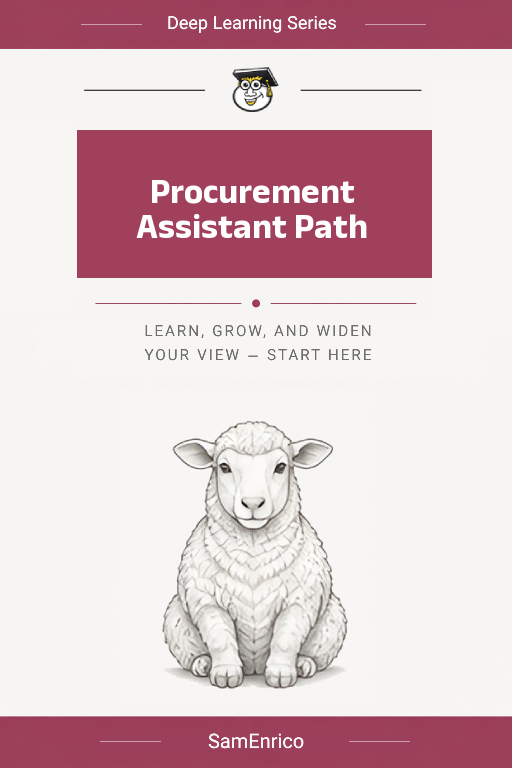
Procurement Assistant Path eBook
Negotiate with suppliers and manage purchase order
by Villa Noelia
Negotiate with suppliers and manage purchase orders for manufacturers.
Formats
Free sample
Chapter 1: The Factory's Front Door--–- The first time Maria saw a production line stop, it was because of a missing $0.47 washer. Not a complex circuit board, not a custom-engineered casting, not even a part with a lead time. A washer. A tiny ring of steel that cost less than a postage stamp. The line had been running smoothly for six hours, assembling hundreds of units per hour, when suddenly the hopper feeding the automatic screwdriver ran dry.
No washer meant no assembly. No assembly meant no product. No product meant the plant manager was standing at the line in sixty seconds, asking questions that nobody wanted to answer.The purchasing manager pulled Maria aside afterward. "That washer," she said, "is why we do what we do. The engineer who designed the product didn't think to tell us it was critical.
The production planner didn't flag it. The warehouse didn't notice they were running low. But you—you sit at the front door of this factory. Everything that comes in, every single item that keeps this place running, crosses your desk first. You are the gatekeeper.
And gatekeepers see problems before they happen."That conversation changed how Maria thought about her job. She wasn't processing paperwork. She was keeping machines running.This chapter is about becoming that gatekeeper. It is about understanding that the procurement assistant is not a clerical order-taker but a strategic role at the very heart of manufacturing. Every factory lives or dies by its supply of raw materials, components, and supplies.
The person who manages those purchases—who ensures the right thing arrives at the right time in the right quantity at the right price—is not support staff. They are essential staff.We will cover three foundational skills in this chapter: understanding why procurement matters to the factory floor, reading and interpreting the Bill of Materials that drives every manufacturing process, and performing requisition triage to catch errors before they become emergencies. By the end of this chapter, you will see every requisition differently. You will not just process it. You will interrogate it.
You will protect the factory from itself.Why Procurement Assistants Are the Unsung Heroes of Manufacturing Manufacturing is often thought of as a world of machines, conveyors, and robots. But those machines only run when they have material to process. The procurement function is the circulatory system of the factory. No blood, no movement. No materials, no production.Consider what happens when a single part is missing.
A production line stops. Workers stand idle, but they still get paid. That idle time is pure waste—often called "waiting time" in lean manufacturing, one of the seven deadly wastes. The machine that was supposed to be making product is now making nothing, but its depreciation, electricity, and maintenance contracts continue. Downstream operations that were expecting that product now have nothing to do, creating a ripple effect of idleness.
Expediting fees—overnight shipping, air freight, courier services—kick in to rush the missing part, often costing ten to twenty times the normal freight. And somewhere, a customer is waiting for their order, which is now late.A study by the Manufacturing Institute found that unplanned production stoppages cost manufacturers an average of $22,000 per minute in high-volume industries like automotive assembly. That is not a typo. Per minute. A thirty-minute stoppage costs more than a procurement assistant's annual salary.Now rewind that scenario.
What if the missing part had been caught before the line stopped? What if someone had noticed that the reorder point was approaching and placed the purchase order early? What if someone had questioned a requisition that seemed vague and discovered that the part number had been superseded? What if someone had called the supplier to confirm the delivery date before the factory assumed it was coming?That someone is you.The procurement assistant sits at the intersection of internal demand (what the factory needs) and external supply (what suppliers provide). No other role in the company has that same visibility.
Production planners see only the schedule. Engineers see only the design. Warehouse sees only what arrives. Accounts payable sees only the invoice. But procurement sees the entire chain from requisition to receipt.
That vantage point is powerful. It means you can see gaps before they become crises. You can see trends before they become problems. You can see opportunities before they become savings.This is the shift from tactical to strategic thinking. Tactical procurement is reactive: a requisition arrives, you create a purchase order, you send it to the supplier, you hope it arrives on time.
Strategic procurement is proactive: you understand the production schedule, you anticipate demand, you build relationships with suppliers who can flex with your needs, you identify risks before they materialize. The tactical assistant processes. The strategic assistant prevents.Every chapter in this book is designed to move you from tactical to strategic. But it starts here, with a simple reframing: you are not an order-taker. You are the gatekeeper.
And gatekeepers own the door.The Bill of Materials: Your Manufacturing Map If manufacturing has a secret language, it is the Bill of Materials. The BOM is the recipe for every product your factory makes. It lists every component, every raw material, every subassembly, every consumable that goes into the finished good. It tells you what is needed, how many, and often where to find it by part number.Learning to read a BOM is like learning to read a map. Without it, you are wandering blind.
With it, you know exactly where you are going and what you will need along the way.A typical BOM is structured as a hierarchy. At the top is the finished product—let us call it Product X. Beneath it are major subassemblies: perhaps a motor assembly, a control board assembly, and a chassis. Beneath each subassembly are the individual components that go into it: screws, brackets, wires, chips, bearings, lubricants. The BOM might go three, four, or even five levels deep depending on the complexity of the product.For the procurement assistant, the most important part of the BOM is not the hierarchy but the data fields that accompany each line.
A well-constructed BOM includes:Part number: The unique identifier for the component. Never rely on descriptions alone; part numbers are precise in ways that words are not.Description: A text description of the component. This is helpful but can be ambiguous—"screw" could mean a dozen different things.Quantity per assembly: How many of this component go into one unit of the parent assembly. If the quantity per assembly is 4 and you are building 100 units, you need 400 pieces.Unit of measure: Each, dozen, kilogram, meter, liter. Critical for accurate ordering.Procurement lead time: How long it takes from placing the order to receiving the goods.
Long-lead items (custom castings, imported electronics, specialized materials) require advance planning.Source type: Make (produced internally) vs. buy (purchased from supplier). Procurement assistants focus on the "buy" items.Preferred supplier: The default supplier for this component, if one exists.When you receive a requisition, the BOM is your reference document. Does the requisition match the BOM? If the requisition calls for 500 units of part…
This is the end of the free sample. Get the eBook to keep going. Buy now
About this book
Details
- Author
- Villa Noelia
- Publisher
- SamEnrico
- Language
- English
- Genre
- Non-Fiction, Non-Obvious Career, Procurement, Supplier Negotiation
- Released
- 2026-05-30
- Pages (approx.)
- 144
- Available as
- eBook, Audiobook

Read better in the ZLOADR app
Your eBooks on your phone or tablet. Sign in with your SamEnrico account and start reading.
More by Villa Noelia
 India FCPA Violation LogVilla Noelia$11.99
 Transcendental Meditation PostureVilla Noelia$11.99
 Therapy Without Borders Access GuideVilla Noelia$11.99
 Party Planning ShortcutVilla Noelia$11.99
 Imposter OCD Doubt LoopVilla Noelia$11.99
 Single Person LTC GuideVilla Noelia$11.99
 The Midnight Couriers: China's Forgotten Underground RailroadVilla Noelia$11.99
 Breath and Mental States ConnectionVilla Noelia$11.99
 Indigenous Grief Rituals ManualVilla Noelia$11.99
 Whispers of the Sky: The Vanishing City of the CloudsVilla Noelia$11.99
 Silent No More: The Unfinished Fight for the 19th AmendmentVilla Noelia$11.99
 Sixty Second Nervous System ResetVilla Noelia$12.99