
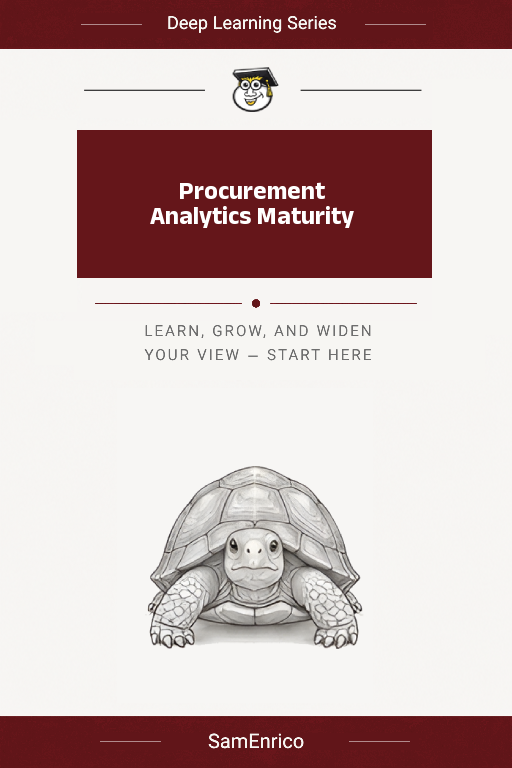
Non-FictionForecast & OutlookAnalytics Maturity
Procurement Analytics Maturity eBook
Project descriptive to predictive to prescriptive
Project descriptive to predictive to prescriptive analytics adoption across procurement functions.
Formats
Free sample
Chapter 1: The 4% Lie--–- In a windowless conference room on the forty-second floor of a glass tower in Chicago, a Chief Procurement Officer named David Westbrook was about to be fired. Not for fraud, not for corruption, not for any of the dramatic failings that make for good Hollywood scripts. He was going to be fired for something far more mundane and far more terrifying to every procurement professional reading this book: he could not answer three questions about his own spend.The CFO, a woman named Elena Vasquez who had risen through the ranks of corporate finance by asking exactly the right questions at exactly the right time, slid a single sheet of paper across the mahogany table. On it were three questions. No preamble.
No small talk. Just three questions that would end a twenty-three-year career.Question one: Which of your suppliers will be insolvent within the next six months?Westbrook had nine thousand active suppliers across forty-seven countries. He had quarterly business reviews with his top two hundred. He had supplier scorecards. He had a team of thirty-seven category managers who spent their days negotiating prices, visiting factories, and building relationships.
He did not have an answer to this question. He had spreadsheets with payment histories. He had Dun & Bradstreet reports that were updated annually. He had gut feelings about which suppliers felt “solid” and which ones made him nervous. But a data-driven prediction of supplier insolvency with any reasonable degree of confidence?
Nothing.Question two: What would happen to your gross margins if you lost your second-largest factory tomorrow?Westbrook’s second-largest factory was in northern Vietnam, run by a contract manufacturer that had never missed a shipment in eight years. The relationship was excellent. The plant manager sent him fruit baskets every Lunar New Year. But the question was not about the quality of the relationship. The question was about the mathematics of resilience.
Westbrook had never modeled the impact of losing that factory. He had never run a simulation that reallocated demand across his remaining suppliers. He had never quantified the lead time to qualify an alternative manufacturer. He had relationships, not models.Question three: Why did your maverick spend jump eighteen percent last quarter—and why didn’t you know until now?This was the question that made Westbrook’s stomach drop. Because he had known about the maverick spend increase.
His quarterly dashboard had shown a spike in off-contract purchasing in the indirect categories. He had seen the number. He had even highlighted it in his monthly review. But he could not explain why it had happened. Was it a single rogue business unit?
Was it a category where contracts had lapsed? Was it a supplier classification error in the ERP? He had descriptive analytics—he knew what happened. He had no diagnostic analytics—he had no idea why.Elena Vasquez did not fire him immediately. She gave him sixty days to answer the three questions.
She told him, with the cold politeness of a finance executive who has done this before, that his answers would determine his future. Westbrook walked out of that conference room knowing, with the certainty of a man who has just seen his own obituary, that he would fail.He did fail. Sixty days later, he was gone. Replaced by a forty-one-year-old from a logistics company who had never negotiated a major contract but who had built a predictive analytics function that could forecast shipping delays with ninety-three percent accuracy. The new CPO’s background was not procurement.
It was data science. And that, more than anything else, is the story of why you are holding this book.The Procurement Blind Spot Let me tell you a second story. This one is not about an individual failure. It is about a systemic failure so widespread that it has become invisible—like the air we breathe or the water that fish swim in.In 2025, a global research firm surveyed over four hundred procurement leaders across North America, Europe, and Asia. The results were published in a report titled “The Procurement Quantum Leap,” and they should have been a five-alarm fire for every CPO on the planet.
But they were not. Because the results confirmed what most procurement professionals already suspected but were too afraid to say out loud.Here is what the survey found: seventy-four percent of procurement leaders identified artificial intelligence and advanced analytics as their highest strategic priority. Seventy-four percent. That is not a fringe interest or a pilot project. That is a near-consensus that the old ways of doing procurement—the spreadsheets, the annual RFPs, the relationship-based negotiations—are no longer sufficient for the volatility of modern supply chains.But here is the other number from that same survey: only thirty-five percent of organizations had formal governance frameworks in place for AI-driven procurement.
Only thirty-five percent. Which means that nearly two-thirds of procurement leaders are prioritizing something they have not actually figured out how to govern, scale, or trust.This is the procurement blind spot. We know we need analytics. We know that the era of gut-feel procurement is ending. But we do not know how to cross the chasm from knowing to doing.
The result is what I call the insight-action gap.Defining the Insight-Action Gap The insight-action gap is the space between having data and using data to make better decisions. It is the distance between a dashboard that shows you what happened last quarter and a workflow that changes what happens next quarter. It is the difference between a predictive model that forecasts supplier risk and a procurement process that actually dual-sources critical components before the disruption hits.I have studied this gap across more than one hundred procurement organizations, from mid-market manufacturers to Fortune 50 retail giants. And I have found that the gap exists for a predictable set of reasons, none of which have anything to do with the quality of the data or the sophistication of the technology.First, most procurement analytics are backward-looking by design. Our ERP systems, our spend analysis tools, our supplier portals—they are all optimized to tell us what has already happened.
They were built for an era of relatively stable supply chains, predictable demand, and annual strategic planning. They were not built for a world where a container ship gets stuck in the Suez Canal and disrupts global supply chains for six months. They were not built for a pandemic that shuts down factories overnight. They were not built for a geopolitical crisis that sanctions your second-largest supplier into oblivion. They were built for the past.
And the past is no longer a reliable guide to the future.Second, the analytics that do exist are disconnected from the workflows where decisions actually happen. A category manager does not make a sourcing decision inside a dashboard. A buyer does not approve a purchase order inside a spend cube. The analytics live in one system—usually a business intelligence tool like Power BI or Tableau—and the decisions live in another system—usually an ERP or procurement platform. This separation creates friction.
And friction kills adoption. If a buyer has to click out of their workflow, open a separate application, run a…
This is the end of the free sample. Get the eBook to keep going. Buy now
About this book
Details
- Author
- Gatewood Jesica
- Publisher
- SamEnrico
- Language
- English
- Genre
- Non-Fiction, Forecast & Outlook, Analytics Maturity
- Released
- 2026-06-01
- Pages (approx.)
- 153
- Available as
- eBook, Audiobook

Read better in the ZLOADR app
Your eBooks on your phone or tablet. Sign in with your SamEnrico account and start reading.
More by Gatewood Jesica
 Morning Affirmation Ritual GuideGatewood Jesica$11.99
 Governor's Drug CrisisGatewood Jesica$11.99
 Estate Tax Minimization Strategies CourseGatewood Jesica$11.99
 Influencer Disclosure Policy ManualGatewood Jesica$11.99
 The Home Inspection For Seniors GuideGatewood Jesica$11.99
 The Vanishing Billionaire: The Untold Story of Howard Hughes' Final YearsGatewood Jesica$11.99
 Understanding Ischiadic Hypoplasia Renal Dysfunction ImmunodeficiencyGatewood Jesica$17.99
 How to Become a Tube Winder - HandGatewood Jesica$11.99
 Founder Depression Survival GuideGatewood Jesica$12.99
 GlassblowingGatewood Jesica$11.99
You may also like
 Hong Kong Handover 1997Dunn Johnnie$11.99
 Zumba For Postnatal Recovery CourseNeal Christian$11.99
 Zumba for BeginnersLadner Nikia$11.99
 YouTube Comment Mining GuideHumes Pandora$12.99
 Worry Box MeditationCarlin Rudy$11.99
 Workplace Stress MeditationNguyen Lynn$11.99
 Workplace Stress and Sleep RepairHawley Ivory$11.99
 Workplace Perfectionism CureDelaney Jeffry$11.99
 Workplace Injustice Anger GuideWallen Isabelle$11.99
 Work Addiction and Burnout LinkGreenwood Ester$11.99
 Women in Yoga and WellnessBeattie Galina$11.99
 Women in Stand Up ComedyChun Evangeline$11.99