
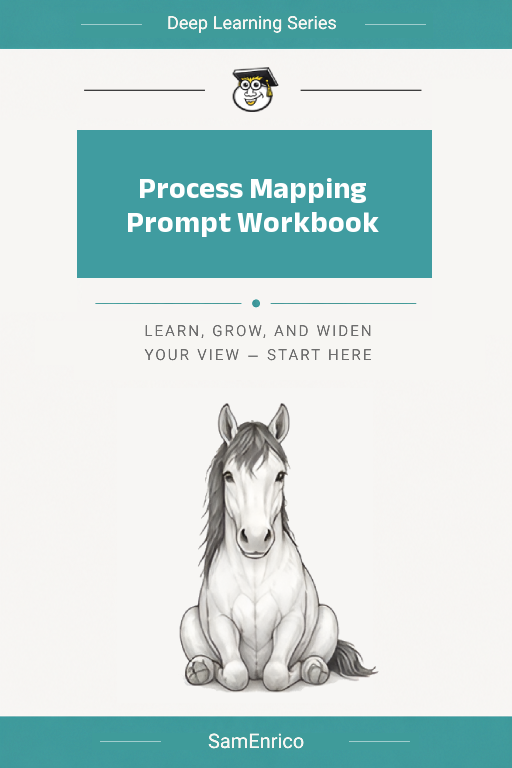
Non-FictionAI OperatorTechnical TrainingWorkbook
Process Mapping Prompt Workbook eBook
Generate BPMN diagrams, process flows, and swimlan
by Hamby Alise
Generate BPMN diagrams, process flows, and swimlanes from text descriptions using AI. Includes prompt chains for pain point identification and automation opportunity discovery.
Formats
Free sample
Chapter 1: The Eighteen-Hour Funeral--–- The first time I drew a perfect BPMN diagram, I wanted to quit my job.Not because the work was hard. Because the work was useless. I had spent eighteen hours across three days aligning boxes, adjusting swimlanes, fighting with connector routing that refused to stay where I placed it, and exporting to PDF only to discover that the rightmost lane had been cut off. I fixed the page size. I exported again. I printed on large-format paper. I walked the diagram to the operations director's office. She glanced at it for eight seconds, said "this isn't how we actually do it anymore," and dropped it in the recycling bin.That diagram was a funeral. I had documented a process that had already died, and I had done so with the care and precision of a medieval scribe illuminating a manuscript. Every shape was color-coded. Every gateway had the correct marker. Every annotation followed BPMN 2.0 standards. None of it mattered. By the time I finished drawing, the actual process had shifted three times. A new software system had been adopted. A manager had left. A regulation had changed. My beautiful diagram was a museum piece on the day I published it.This book exists because that gap between drawing and reality is now optional.We are living through a fundamental shift in how process work gets done. Artificial intelligence—specifically large language models like Chat GPT, Claude, and their specialized descendants—can now generate accurate BPMN diagrams, swimlane flows, and system maps from ordinary text descriptions. You do not need to learn XML. You do not need to memorize BPMN symbol libraries. You do not need to spend eighteen hours aligning boxes. You need to learn one skill: how to describe a process so that AI can see it.This chapter is for readers who already know what process they want to map. Perhaps you have a documented standard operating procedure. Perhaps you have a known workflow that your team follows. Perhaps you have a procedure that has been done the same way for years, and you finally want to document it. You are ready to generate diagrams immediately. If you are still discovering where problems hide—if you have customer complaints, support tickets, or frustrated employees but no clear process to point to—start with Chapter 5 instead. That chapter teaches you to find pain first. Then return here to map what actually matters.For the rest of you, let me show you why the old way kills your time, how the new way resurrects it, and why you will never open Visio before writing a prompt again.The Dirty Secret That Process Mappers Never Admit Every experienced process mapper knows a dirty secret, but almost no one admits it in public. Here it is: approximately seventy percent of your time is spent on formatting, not analysis.Let me be specific about what that means. You drag a shape from a palette onto a canvas. You resize it. You align it to the grid. You adjust the connector path because it insists on routing through the wrong swimlane. You change a font size because the default is too small to read when printed. You add a label. You realize the label overlaps a connector. You move the label. You export to PDF. You notice the PDF cut off the rightmost lane. You adjust the page size. You export again. You send it to a stakeholder. They ask you to change one step. You spend twenty minutes realigning everything the change broke.That is formatting. It is not analysis. Analysis is asking: why does this handoff exist? What happens if we remove this approval? Where is the wait time accumulating? Analysis is thinking. Formatting is data entry for a visual language that the tool cannot understand.The tragic truth is that most process maps are abandoned before they are used. Research across multiple industry surveys suggests that approximately sixty percent of business process diagrams are never referenced again after their initial distribution. They are created to satisfy a compliance checkbox. They are filed in shared drives. They are forgotten. The organizations that paid for the hours received no value from the output.This is not a failure of BPMN. BPMN remains a powerful, precise language for describing workflows. The failure is in the production method. We have been using nineteenth-century drafting techniques for twenty-first-century dynamic processes. Visio was released in 1992. Lucidchart launched in 2010. Both are built on the assumption that a human will manually place every element. AI changes that assumption entirely.Three Ways AI Transforms the Mapping Workflow When you shift from manual drawing to prompt-driven mapping, three fundamental things change about your work. Each change alone would be significant. Together, they represent a complete reinvention of the process mapper's role.First, the speed of iteration becomes effectively instantaneous.In the old world, testing an alternative process design meant redrawing the entire diagram. Want to see what happens if you move an approval step upstream? You duplicate the file, drag boxes, reconnect arrows, realign everything, and pray you did not miss a connection. A single alternative design could take an hour.In the new world, you type: "Redesign this process to move the Finance approval step before the manager review instead of after. Show the new Mermaid diagram." The AI returns a new diagram in seconds. You can iterate through ten designs in the time it used to take to align the first three boxes. This speed changes the nature of your work. You are no longer committing to a single design. You are exploring a landscape of possibilities.Second, the precision of documentation improves because the AI forces you to be explicit.When you drag a box onto a canvas and label it "approve request," you can leave enormous ambiguity. Does the approval require a signature? Is it sequential or parallel? What happens if approval is denied? The tool does not ask these questions. It accepts the ambiguity silently. Your diagram inherits your ambiguity.When you prompt an AI, you must specify these things. You do not have to specify them perfectly the first time. But the AI will generate something, and if your instructions were ambiguous, the output will be ambiguous. That ambiguity becomes visible. You look at the diagram and see that the approval step has no gateway after it. You realize you forgot to specify the rejection path. You add it. The AI forces you to be complete in a way that manual drawing never does.Third, the barrier to entry collapses.I have trained dozens of process mappers over the years. The ones who succeeded were not the ones who memorized BPMN notation. The ones who succeeded were the ones who could describe work clearly—who could explain, in ordinary language, who does what and in what order. The ones who struggled were often excellent analysts but poor visual designers. They knew where the bottlenecks were. They could describe the inefficiencies in detail. But they could not make the diagram look professional. They lacked what designers call "visual fluency."AI removes visual fluency as a gatekeeper. Anyone who can describe a process clearly can now generate a professional diagram. The analyst who cannot align a box to save her life can now…
This is the end of the free sample. Get the eBook to keep going. Buy now
About this book
Details
- Author
- Hamby Alise
- Publisher
- SamEnrico
- Language
- English
- Genre
- Non-Fiction, AI Operator, Technical Training, Workbook
- Released
- 2026-05-27
- Pages (approx.)
- 139
- Available as
- eBook, Audiobook

Read better in the ZLOADR app
Your eBooks on your phone or tablet. Sign in with your SamEnrico account and start reading.
More by Hamby Alise
 Cousteau's Ganges ExplorationHamby Alise$11.99Cousteau's Ganges ExplorationHamby Alise$11.99
 Weasel Words Influence GuideHamby Alise$11.99
 Manipulative AI Systems BanHamby Alise$11.99
 Mindfulness for Sleep ProblemsHamby Alise$11.99
 Restless Leg Syndrome Natural RemediesHamby Alise$11.99
 Six Days of Thunder: Israel's Lightning Strike in 1967Hamby Alise$11.99
 Talent Shortage Hotspots GuideHamby Alise$12.99
 How to Start a Bus Cleaning (non- Specialised) Business (Beginners Guide)Hamby Alise$11.99
 Understanding Keratoderma Palmoplantar Spastic ParalysisHamby Alise$17.99
 Strategy and Operations ManagerHamby Alise$11.99
You may also like
 Hong Kong Handover 1997Dunn Johnnie$11.99
 Zumba For Postnatal Recovery CourseNeal Christian$11.99
 Zumba for BeginnersLadner Nikia$11.99
 YouTube Comment Mining GuideHumes Pandora$12.99
 Worry Box MeditationCarlin Rudy$11.99
 Workplace Stress MeditationNguyen Lynn$11.99
 Workplace Stress and Sleep RepairHawley Ivory$11.99
 Workplace Perfectionism CureDelaney Jeffry$11.99
 Workplace Injustice Anger GuideWallen Isabelle$11.99
 Work Addiction and Burnout LinkGreenwood Ester$11.99
 Women in Yoga and WellnessBeattie Galina$11.99
 Women in Stand Up ComedyChun Evangeline$11.99