
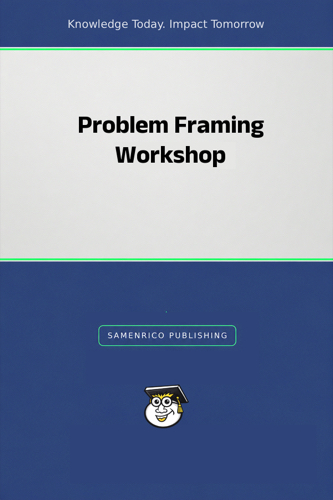
Problem Framing Workshop eBook
Reframe vague challenges into actionable design qu
Reframe vague challenges into actionable design questions before ideation.
Formats
Free sample
Chapter 1: The Solution-Jump Trap--–- In 1999, NASA lost the $125 million Mars Climate Orbiter because one engineering team used metric units while another used imperial units. The spacecraft disintegrated in the Martian atmosphere. In the post-mortem, no one said the problem was "bad unit conversion." Everyone agreed the problem was a failure of framing—the wrong question had been asked from the start.This is not an anomaly. It is the quiet catastrophe of modern organizations.Every day, in boardrooms and team rooms around the world, intelligent, well-intentioned people gather to solve problems. They generate sticky notes.
They vote on ideas. They build roadmaps. They launch initiatives. And six months later, they discover they have built the wrong thing, solved the wrong problem, or made the original situation worse. The post-mortems always sound the same: "If only we had known then what we know now." But the tragedy is that someone did know.
The signals were there. The data existed. The wisdom was in the room. But no one stopped to ask a deceptively simple question: Are we solving the right problem?This chapter reveals the single most expensive cognitive bias in business: the instinct to leap from a vague complaint to a concrete solution without first framing the problem. I call this the Solution-Jump Trap.
It is responsible for failed product launches, wasted engineering hours, toxic team dynamics, and the peculiar phenomenon of organizations running faster and faster in the wrong direction.By the end of this chapter, you will understand why 85% of companies struggle to define the problems they are trying to solve. You will take a diagnostic quiz that reveals whether your organization suffers from "Ready, Fire, Aim" syndrome. And you will receive a corrected mandate: do not run a solution brainstorming session until you have completed the framing workshop described in Chapters 5 through 9 of this book.Let us begin by examining the anatomy of a disaster.The Parable of the Conference Room Imagine a mid-sized software company called Cloud Logix. Their product is a project management tool used by 10,000 teams worldwide. For three quarters in a row, customer retention has dropped by 2% each quarter.
The CEO convenes a meeting. She opens with: "Our churn is killing us. We need solutions by Friday."The room erupts.The product manager says, "We need a notification system to bring users back." The engineering lead says, "Our onboarding is too slow—we need to cut three steps." The marketing director says, "We aren't communicating value clearly; we need a new email campaign." The sales head says, "Our pricing is wrong; we need to discount."By the end of the hour, the whiteboard is full. The team has generated seventeen distinct solution ideas. They vote on three.
They assign owners. They commit to deadlines. Six months later, they have built a notification system (which users ignore), simplified onboarding (which didn't change retention), launched an email campaign (which increased unsubscribes), and discounted pricing (which trained customers to wait for sales). Churn is now down 1%, but margins have collapsed. The CEO declares victory.
The company is actually worse off.What happened here is not a failure of effort or intelligence. It is a failure of problem framing. No one stopped to ask: "What do we actually know about why customers are leaving?" No one asked: "Which customers are leaving? When did they leave? What happened in the 48 hours before they left?
Have we interviewed anyone who left? Are the people who stayed different in some meaningful way?"The team jumped from "churn is bad" to "here is what we should build" without ever visiting the territory in between. They were rewarded for speed and punished for slow thinking. And they paid the price.This is the Solution-Jump Trap. And it is the number one business waste of the twenty-first century.Why Your Brain Wants You to Fail To understand why we leap to solutions, we must first understand how the human brain evolved.
Cognitive scientists have known for decades that the brain is not a rational computer; it is a prediction engine that prioritizes speed over accuracy. Daniel Kahneman, in his Nobel Prize-winning work, described two systems: System 1 (fast, automatic, pattern-matching) and System 2 (slow, deliberate, analytical). The Solution-Jump Trap is a pure System 1 phenomenon.When someone says "customer churn is up," your brain immediately searches its memory for similar patterns. It retrieves past solutions that worked (or seemed to work) in vaguely similar situations. It generates an answer in milliseconds.
This answer feels correct because it arrived quickly and with confidence. This feeling of correctness is an illusion.The technical term for this is availability bias: we judge the likelihood of an outcome by how easily examples come to mind. If you recently read a case study about a notification system reducing churn, that solution will feel more plausible, regardless of whether it applies to your situation. If the last three problems you solved required technical fixes, you will propose a technical fix for this problem, even if the root cause is cultural.But there is a deeper force at work: organizational reward systems. Most companies pay people for delivering solutions, not for understanding problems.
Your performance review asks: "What did you ship?" It does not ask: "Which problems did you reframe?" The product manager who says, "I spent three weeks interviewing customers and realized we were solving the wrong problem" is rarely promoted. The product manager who says, "I shipped three features in three weeks" is celebrated—even if those features made things worse.This creates a catastrophic incentive structure. Speed is rewarded. Reflection is punished. The Solution-Jump Trap is not just a cognitive bias; it is an economic one.
We have built organizations that pay people to fail intelligently.The 85% Problem In 2016, Thomas Wedell-Wedellsborg conducted a study of 106 corporate leaders across multiple industries. He asked them a simple question: "How often do you struggle to define the problem you are trying to solve?" The results were stunning. 85% of respondents said their organizations were "bad" or "very bad" at problem framing. Only 15% felt competent.Let me repeat that: nearly nine out of ten organizations admit they are bad at the single most important cognitive skill in business. You cannot solve a problem you have not defined.
You cannot innovate if you do not know what you are innovating about. Yet the vast majority of organizations have no formal training, no tools, no vocabulary, and no incentives for framing problems well.Wedell-Wedellsborg went further. He found that when teams were given identical problem statements and asked to generate solutions, the quality of the solutions was almost entirely predicted by whether the team had first spent time reframing the problem. Teams that jumped straight to solutions generated conventional, low-impact ideas. Teams that spent just 20 minutes reframing generated more novel, higher-impact solutions—even when those solutions were evaluated by independent judges.Twenty minutes.
That is all it took to double the quality of the output. Yet most organizations refuse to invest those twenty minutes because they are "too busy" to think.This is the central paradox of the Solution-Jump Trap: we are too busy solving problems to notice that we are solving the wrong ones.The Distinction That…
This is the end of the free sample. Get the eBook to keep going. Buy now
About this book
Details
- Author
- Dancy Rosario
- Publisher
- SamEnrico
- Language
- English
- Genre
- Non-Fiction, Self-Help, Problem Solving
- Released
- 2026-06-09
- Pages (approx.)
- 148
- Available as
- eBook, Audiobook

Read better in the ZLOADR app
Your eBooks on your phone or tablet. Sign in with your SamEnrico account and start reading.
More by Dancy Rosario
 Gambling Addiction For VeteransDancy Rosario$11.99
 Alcoholism and Indigenous Healing WaysDancy Rosario$11.99
 Blended Family StressDancy Rosario$11.99
 Skilled Nursing Facility GuideDancy Rosario$11.99
 HIIT Plateau Breaker GuideDancy Rosario$11.99
 Lawyer Food AddictionDancy Rosario$11.99
 Financial Statement Reading GuideDancy Rosario$11.99
 The Clown of Calcutta: A Victorian-Era Killer's Deadly PrankDancy Rosario$11.99
 The Lion of the Arena: The Forgotten Gladiators of 18th-Century PersiaDancy Rosario$11.99
 How to Produce Guitar StandsDancy Rosario$11.99
 EU Organic Certification ExportDancy Rosario$12.99
 Nigeria VAT FIRS Investigation GuideDancy Rosario$12.99
You may also like
 Define Problem Statement WorkshopNichols Curtis$11.99
 The Interruption MVP MethodLyon Camellia$11.99
 Pain Point Innovation GuideHagan Davina$11.99
 The Struggle Is Data GuideBattle Kirby$11.99
 Problem Solving DBT WorkbookCriswell Violette$11.99
 Problem Solving VisualizationWeeks Jamar$11.99
 Problem Solving for EmotionsCollado Zelda$11.99
 Group Creative Problem Solving HandbookOliveira Mardell$11.99
 Problem Solving DreamsSchmid Ray$11.99
 Collaborative Problem SolvingGilson Dara$11.99
 Collaborative Problem Solving HandbookCross Lisa$11.99
 TM Obstacle TroubleshootingRubio Carly$11.99