
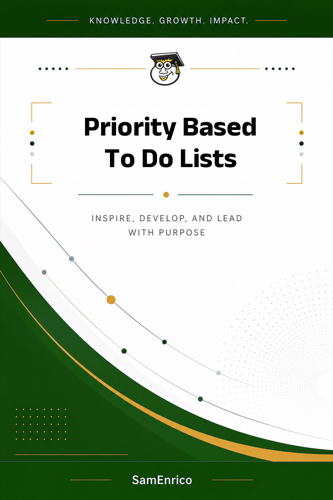
Non-FictionSelf-HelpTo Do Lists
Priority Based To Do Lists eBook
Build action lists sorted by ABCDE not by chronolo
Build action lists sorted by ABCDE not by chronological order.
Formats
Free sample
Chapter 1: The Tyranny of Now--–- The lie begins softly. You wake up, reach for your phone, and there they are: fourteen unread emails, three Slack messages, a calendar reminder for a meeting in forty-five minutes, and a nagging notification from your task manager telling you that seven items are overdue. Without thinking, you start sorting. The email from your boss gets answered first. Then the Slack message from a colleague who needs “just a quick favor.” Then the easiest task on your list—the one that takes two minutes—because checking it off feels like progress.
By 10 a.m., you have answered twelve emails, attended one meeting, and completed three small tasks. You feel busy. You feel productive. You feel, in the hollow way that busyness provides, like you have earned the right to exhale. But when you stop and look at what you actually accomplished toward your most important goals, the answer is often nothing.
You have been a victim of the tyranny of now.The chronological to-do list is the most dangerous productivity tool ever invented, not because it is malicious, but because it is seductive. It promises order. It delivers chaos disguised as motion. When you organize your tasks by the order they arrive—first come, first served—or by what is easiest to check off first, you are not prioritizing. You are reacting.
And reaction is the enemy of intention.Every day, millions of professionals sit down with a list that looks something like this: send invoice, reply to customer question, order office supplies, write quarterly report, schedule dentist appointment, brainstorm new marketing campaign, delete old files. Then they start at the top and work their way down, or they scan for the smallest task and do that first. The result is a life spent climbing a ladder that is leaning against the wrong wall. The quarterly report—which could determine your bonus, your team’s direction, or even your career trajectory—gets pushed to tomorrow because the invoice was due yesterday and the customer question felt urgent. But urgent is not important.
And the chronological list conflates the two until you cannot tell them apart.This chapter is not a gentle suggestion to reconsider your habits. It is an indictment of the way most people manage their work and a call to arms. You will learn why chronological lists create an illusion of progress, how urgency routinely overpowers importance, and the single most important distinction that separates high performers from the perpetually busy. By the end of this chapter, you will never look at your to-do list the same way again.The Addiction of Small Wins There is a neurological reason why chronological lists feel productive even when they are not. Every time you complete a task—no matter how trivial—your brain releases a small amount of dopamine.
This is the same neurotransmitter associated with pleasure, reward, and motivation. It feels good to check a box. It feels even better to check five boxes in rapid succession. Your brain does not care that those five boxes were low-value tasks like “organize desktop folders” or “delete old emails.” It only cares about the reward.This is the addiction of small wins. And chronological lists are perfectly designed to feed it.Consider a typical morning.
You have a high-value A-task: finalize the budget proposal that will determine whether your department gets funded for the next quarter. It is difficult. It requires concentration, analysis, and perhaps some uncomfortable decisions. It might take two hours of uninterrupted focus. But you also have three low-value C-tasks: reply to a non-urgent email from a vendor, move files from your desktop to the server, and update your timesheet.
The C-tasks are easy. Each takes less than five minutes. Each provides a small dopamine hit. And because they are at the top of your chronological list (the email arrived first thing this morning), or because they are the easiest to complete, you do them first.By 9:15 a.m., you have checked off three tasks. You feel a sense of accomplishment.
You feel like you are making progress. You are not. You have simply traded fifteen minutes of low-value work for the emotional reward of completion. And now, when you finally turn to the budget proposal, you have less energy, less willpower, and less time. The proposal gets pushed to the afternoon, where it competes with meetings, more emails, and the general fatigue of a day already half-spent.This is not a failure of discipline.
It is a failure of design. Chronological lists are designed to reward speed, not significance. They are designed to make you feel productive while keeping you from doing anything that matters.Urgency vs. Importance: The Great Confusion In their landmark book First Things First, Stephen Covey and his co-authors introduced a framework that has become known as the Eisenhower Matrix. It sorts tasks into four quadrants based on two criteria: urgency and importance.
Urgent tasks demand immediate attention. Important tasks contribute to long-term mission, values, and goals. The ideal quadrant is important but not urgent—the strategic work that moves the needle over months and years. The dangerous quadrant is urgent but not important—the interruptions, the small requests, the fires that someone else lit.Chronological lists are incapable of making this distinction. An email marked “urgent” (but not important) lands in your inbox at 8:02 a.m.
An important strategic project sits in a folder, unmarked, unurgent, and silent. The chronological list says: do the email first. It arrived earlier. Or perhaps the list says: do the two-minute task first. It is faster.
In either case, importance loses.The consequences are not trivial. Research on knowledge workers consistently shows that the average professional spends only about 40 percent of their time on tasks that directly align with their top three goals. The remaining 60 percent is consumed by urgent-but-not-important work, low-value administrative tasks, and the endless churn of communication. In other words, most people spend more than half of their working hours on things that do not meaningfully advance their careers, their businesses, or their lives.And the culprit is not laziness. It is the tool.
The chronological to-do list is a passive recording device. It captures whatever arrives, whatever is loudest, whatever is easiest. It has no built-in mechanism for asking the only question that matters: “Is this task actually important?”The Illusion of Progress One of the most insidious features of the chronological list is that it creates what psychologists call “progress illusions.” These are subjective feelings of advancement that do not correspond to objective movement toward a goal. Completing ten low-value tasks feels like progress. Your brain registers the checkmarks, the dopamine, the sense of closure.
But if those ten tasks were not moving you toward your most important outcomes, then the feeling is an illusion.This is not merely philosophical. It has measurable costs. When you believe you are making progress, you are less likely to change your behavior. You continue doing what you have always done because it feels effective. The chronological list traps you in a local optimum—a way of working that feels good but produces mediocre results.
You become a master of busyness and a novice at achievement.Consider two workers. Worker A uses a chronological list. Each…
This is the end of the free sample. Get the eBook to keep going. Buy now
About this book
Details
- Author
- Callaway Estell
- Publisher
- SamEnrico
- Language
- English
- Genre
- Non-Fiction, Self-Help, To Do Lists
- Released
- 2026-06-11
- Pages (approx.)
- 137
- Available as
- eBook, Audiobook

Read better in the ZLOADR app
Your eBooks on your phone or tablet. Sign in with your SamEnrico account and start reading.
More by Callaway Estell
 Addiction Recovery SleepCallaway Estell$11.99
 Francis and the Sultan Peace EncounterCallaway Estell$11.99
 Healing Through NVCCallaway Estell$11.99
 Validating Boredom GuideCallaway Estell$11.99
 Mindfulness of BreathCallaway Estell$11.99
 Remote Work for ScientistsCallaway Estell$11.99
 Cleopatra Economic PolicyCallaway Estell$11.99
 The Veles Conspiracy: A Witch’s Gambit in the ShadowlandsCallaway Estell$11.99
 The Siege of Nis: The Ottoman Bloodbath That Shaped the Balkans (1443)Callaway Estell$11.99
 10 Ways to Use Hyssopus Officinalis (Recipe Book)Callaway Estell$11.99
 Service Providers Guide to PeriodonticsCallaway Estell$11.99
 How to Produce Incense Making KitsCallaway Estell$11.99
You may also like
 Hong Kong Handover 1997Dunn Johnnie$11.99
 Zumba For Postnatal Recovery CourseNeal Christian$11.99
 Zumba for BeginnersLadner Nikia$11.99
 YouTube Comment Mining GuideHumes Pandora$12.99
 Worry Box MeditationCarlin Rudy$11.99
 Workplace Stress MeditationNguyen Lynn$11.99
 Workplace Stress and Sleep RepairHawley Ivory$11.99
 Workplace Perfectionism CureDelaney Jeffry$11.99
 Workplace Injustice Anger GuideWallen Isabelle$11.99
 Work Addiction and Burnout LinkGreenwood Ester$11.99
 Women in Yoga and WellnessBeattie Galina$11.99
 Women in Stand Up ComedyChun Evangeline$11.99