
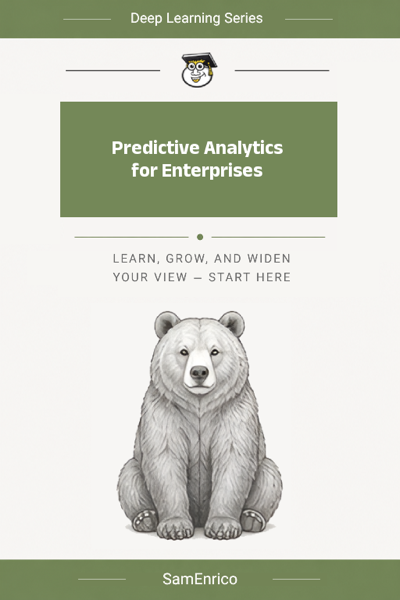
Non-FictionInformativeEducational
Predictive Analytics for Enterprises eBook
A Coursebook on Predictive Analytics for Enterpris
by Rubio Debera
A Coursebook on Predictive Analytics for Enterprises
Formats
Free sample
Chapter 1: The Omni Mart Warning---- Every morning at 8:47 AM, Sarah Chen, the Chief Marketing Officer of Omni Mart, opens three dashboards. The first shows yesterday’s revenue by region. The second shows customer counts by segment. The third shows a spreadsheet called “Churn Watchlist” that her team updates manually every Thursday.-- The first two dashboards are beautiful. They have green arrows pointing up, red arrows pointing down, and charts that would impress any boardroom.
The third is a disaster. It is a list of customers who have already stopped shopping at Omni Mart. By the time a name appears on that spreadsheet, that customer is gone. Their $847 average annual spend is gone. Their word-of-mouth recommendations to friends and family are gone.
And Omni Mart has no idea they were leaving until after they left.-- This is not a hypothetical problem. Omni Mart is a fictional retail chain created for this book, but its situation is real at thousands of companies right now. In 2023, the average enterprise lost 12-15% of its customer base annually to churn. Of those lost customers, 83% could have been identified as “at risk” at least 30 days before they left, based on patterns in their own transactional history. But almost no companies identified them, because almost no companies are doing predictive analytics.-- This book exists because that failure is optional.-- Over the next twelve chapters, you will learn how to move your organization from looking backward–asking “what happened?”–to predicting forward–asking “what will happen next?” You will learn the mathematics, the algorithms, the deployment patterns, and the ethics of prediction.
But before any of that, you need to understand why this transformation matters, why most companies fail at it, and how to spot the difference between a problem that can be solved with prediction and one that cannot.-- Welcome to the end of rear-view mirror management.The Analytics Maturity Model: Where Most Companies Are Stuck-- Every organization that uses data falls somewhere on a five-step maturity ladder. Most are stuck on the bottom two rungs. A few have climbed higher. Almost none have reached the top.-- Level 1: Descriptive Analytics – “What happened?”-- This is the dashboard level. Omni Mart’s first two dashboards are descriptive.
They tell Sarah that revenue was $47.2 million yesterday, which is up 3% from last Tuesday. They tell her that the Northeast region underperformed by 8%. They tell her that customers in the “Premium” segment spent 22% more than customers in the “Standard” segment.-- Descriptive analytics is valuable. You cannot manage what you cannot measure. But descriptive analytics only tells you about the past.
It is a rear-view mirror. It shows you the tree you already hit, not the tree coming up ahead.-- Level 2: Diagnostic Analytics – “Why did it happen?”-- Diagnostic analytics adds context. When Sarah sees that the Northeast region underperformed, she clicks into a diagnostic report that shows a snowstorm closed three distribution centers for two days. When she sees that Premium customers spent more, a diagnostic model reveals that those customers received a targeted email campaign that Standard customers did not.-- Diagnostic analytics is also valuable. It helps you understand causality.
It answers the question “why?” But it still only answers that question after the fact. By the time you diagnose why the Northeast region underperformed, the week is over. By the time you understand why Premium customers spent more, the campaign has already ended.-- Level 3: Predictive Analytics – “What will happen?”-- This is the core of this book. Predictive analytics uses historical patterns to forecast individual future outcomes. A predictive model at Omni Mart would scan 2 million customer records, identify the 5,000 customers most likely to churn in the next 30 days, and output their names–not after they leave, but before.
A predictive model would tell Sarah which regional distribution centers are likely to fail next week based on vibration patterns from Io T sensors. A predictive model would tell her which products are likely to sell out before Black Friday based on early browsing behavior.-- Predictive analytics does not require a crystal ball. It requires math. Specifically, it requires finding patterns in past data that generalize to future data. A customer who used to visit Omni Mart three times per week but has not visited in 18 days looks like other customers who eventually churned.
A distribution center whose vibration pattern deviated by 2.3 standard deviations last night looks like other centers that failed within 72 hours. A product that received 1,200 “save for later” clicks in 48 hours looks like other products that sold out.-- The rest of this book teaches you how to build these patterns, validate them, deploy them, and use them without causing harm.-- Level 4: Prescriptive Analytics – “How can I make it happen?”-- Prescriptive analytics is the bridge from prediction to action. A predictive model tells you that Customer #472,891 has an 87% probability of churn. A prescriptive system tells you what to do about it: send a 15% discount code, trigger a personalized email from the store manager, or add a “we miss you” loyalty bonus.-- Prescriptive analytics requires not just prediction but optimization. Given a set of possible actions (discount amounts, message types, delivery channels), which combination maximizes the probability of retaining the customer while minimizing cost?
This is a harder problem than prediction alone, and it is beyond the scope of this book–but you cannot do prescriptive analytics at all without first doing predictive analytics.-- Level 5: Autonomous Analytics – “The system decides and acts.”-- This is where prediction and prescription merge into automation. An autonomous system at Omni Mart would not just predict churn and suggest an action. It would send the discount code automatically, test two variants against each other, learn which variant works better, and adapt its strategy for the next at-risk customer–all without human intervention.-- Autonomous analytics is already here in narrow domains: algorithmic trading, programmatic advertising, dynamic pricing. It will expand. But it is built on the foundation of predictive analytics.
You cannot trust a system to act autonomously until you trust its predictions.-- Where is your company? Most organizations have descriptive analytics. Many have diagnostic. Relatively few have predictive. Almost none have prescriptive or autonomous.
If you are reading this book, you likely want to move from Level 2 to Level 3. That is the most valuable single step in the entire maturity ladder.The Click, Buy, Lie, or Die Paradigm-- Eric Siegel, the author of the bestselling Predictive Analytics, coined a phrase that deserves to be memorized: predictive analytics is about “click, buy, lie, or die.”-- Every prediction worth making in an enterprise is about some version of these four human behaviors. Will this customer click on the ad (click)? Will this customer purchase the product (buy)? Will this customer commit fraud on their insurance application (lie)?
Will this patient be readmitted to the hospital within 30 days (die, metaphorically or literally)?-- Why does this matter? Because aggregate trends do not predict individuals. Omni Mart can know with certainty that 5% of their customers will churn next quarter. That is a trend. But knowing that 5% will churn does not tell Sarah which 5%.
The customers who churn are not a random sample. They are specific people with specific behaviors: people who used to…
This is the end of the free sample. Get the eBook to keep going. Buy now
About this book
Details
- Author
- Rubio Debera
- Publisher
- SamEnrico
- Language
- English
- Genre
- Non-Fiction, Informative, Educational
- Released
- 2026-05-04
- Pages (approx.)
- 150
- Available as
- eBook, Audiobook

Read better in the ZLOADR app
Your eBooks on your phone or tablet. Sign in with your SamEnrico account and start reading.
More by Rubio Debera
 The Logical Creativity CourseRubio Debera$11.99
 Somali Famine JourneyRubio Debera$11.99
 Self Hypnosis For Confidence Trance GuideRubio Debera$11.99
 Recall Record Retention GuideRubio Debera$11.99
 Family Dream Journaling GuideRubio Debera$11.99
 Body Image After AssaultRubio Debera$11.99
 Serbian E Government ServicesRubio Debera$11.99
 Sleep Insulin Resistance LinkRubio Debera$11.99
 Jesse Jackson RainbowRubio Debera$11.99
 Boardroom Blitz: The Battle for Hasbro’s ThroneRubio Debera$11.99
 The Lion of the Seas: Johan de Witt and the Rise of the Dutch RepublicRubio Debera$11.99
 Frostbound Hearts: The Troll King and the Moonlit MaidRubio Debera$11.99
You may also like
 Hong Kong Handover 1997Dunn Johnnie$11.99
 Zumba For Postnatal Recovery CourseNeal Christian$11.99
 Zumba for BeginnersLadner Nikia$11.99
 YouTube Comment Mining GuideHumes Pandora$12.99
 Worry Box MeditationCarlin Rudy$11.99
 Workplace Stress MeditationNguyen Lynn$11.99
 Workplace Stress and Sleep RepairHawley Ivory$11.99
 Workplace Perfectionism CureDelaney Jeffry$11.99
 Workplace Injustice Anger GuideWallen Isabelle$11.99
 Work Addiction and Burnout LinkGreenwood Ester$11.99
 Women in Yoga and WellnessBeattie Galina$11.99
 Women in Stand Up ComedyChun Evangeline$11.99